Donald Trump stated on November 12 that he would consider a brief military campaign against the Cuban regime.
A day later, Miguel Díaz-Canel defended the decision to “activate wartime structures to work in peacetime.”
Among the threats and preparations is a population whose lives may be at risk and that lacks effective democratic mechanisms to change the course of its government.
The gravity of the moment lies in that sense of helplessness. According to the regime, citizens would be willing to face the consequences of a confrontation, but in reality, it is a subdued population that cannot freely replace those who make the decisions.
The totalitarian power that claims a supposed popular support and loyalty to the "revolution" as unassailable arguments to defend sovereignty keeps political competition closed that would allow it to be exercised.
The possibility of using force has a recent precedent. The U.S. operation on January 3 resulted in the capture of Nicolás Maduro and left 32 Cubans dead, acknowledged by Havana. Venezuela does not dictate what will happen in Cuba, but it compels us to take seriously the threats from an administration that has already acted militarily in the region.
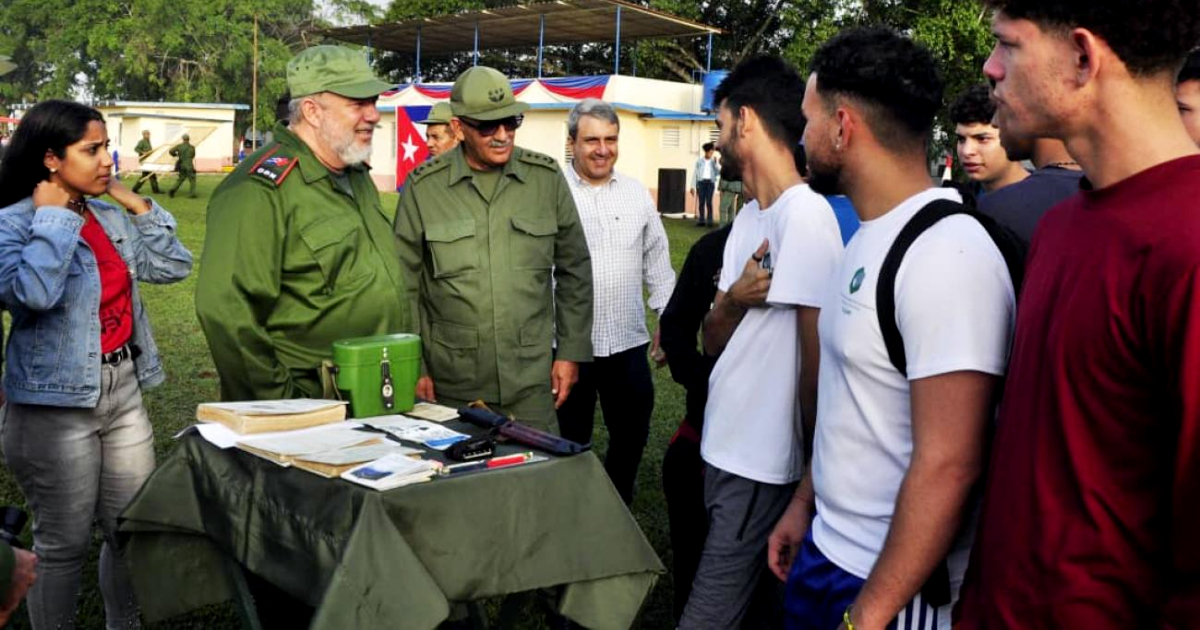
During the Moncada exercise, held on November 4 and 5, the Chief of the General Staff, Roberto Legrá Sotolongo, announced a defense “house by house, neighborhood by neighborhood, area by area.” The doctrine of the People's War includes militias, reservists, and civilian structures. The official propaganda accompanies it with calls to resist “to the last drop of blood.”
A population already suffering
The country called to this resistance arrives exhausted. In the 2026 survey by the Cuban Observatory of Human Rights (OCDH), eight out of ten respondents reported having skipped a meal due to lack of money or food.
The study gathered 1,318 interviews across 79 municipalities, conducted between June and July. This deprivation means deciding which food to eliminate from the day and how to divide what remains.
In October, an official report collected by EFE acknowledged that 300 of the 395 nationally produced medications included in the basic list were missing. It also reported a decline in the survival rate of children and young people with cancer from 85% to 65%. The deterioration of health care is already being measured in lost opportunities for survival.
The authorities attribute these shortcomings to the U.S. embargo. But the discussion about external restrictions cannot absolve those who govern the country of their responsibility.
Cuban citizens lack the free means to oversee the priorities of those in power —see the GAESA case— and to hold their leaders accountable based on their performance. The leaders' tenure remains secure while the living conditions of the governed deteriorate.
This protection has concrete instruments. Prisoners Defenders recorded 1,353 political prisoners at the end of October. The OCDH documented at least 387 repressive actions during that month, including arbitrary detentions, police cordons, threats, and harassment.
The punishment for protesting limits the entire society's ability to demand solutions and discuss the country's direction.
Russia's warning
Russia demonstrates the extreme to which this separation between those who decide and those who pay can reach.
The invasion of Ukraine, ordered by Vladimir Putin, has caused immense suffering to the attacked country and devastating loss of life among the Russians themselves.
The Ukrainian General Staff estimated that as of November 15, there were more than 1.62 million Russian casualties, a category that includes both dead and wounded. In October alone, it estimated 54,400. These are estimates from one belligerent party and not an independent count of fatalities.
Separately, an analysis from the Financial Times published on November 13, based on leaked records from Rosstat, estimated that at least 450,000 Russians have died as a result of the war by the summer, predominantly military personnel. The Institute for the Study of War (ISW) had gathered the initial estimates from that leak, noting that it could not verify them.
The Financial Times investigation indicates that the burden has disproportionately fallen on poor regions and ethnic minorities. The cost of the Kremlin's decisions is borne by households that lose their members and by communities forced to cope with deaths, injuries, and absences.
And in the midst of a tragedy of this magnitude, there is Putin, maintaining power after presidential elections that the European Parliament classified as illegitimate and undemocratic.
Russia is the aggressive power. In Cuba, the danger is that the defense of the regime will be imposed as a national obligation in the face of an external threat. The connection between both cases lies in the ability of an authoritarian leadership to compromise lives without subjecting its continuity to a free civic decision.
The people outside the decision
Havana declares its willingness to engage in dialogue with Washington. However, it has set a boundary: «The Cuban political system is not up for negotiation», affirmed Deputy Minister Carlos Fernández de Cossío on March 20, also excluding the presidency and other governmental positions.
However, that structure which is declared untouchable from the outside is also not subjected to free political competition within the country. The Cuban regime feels entitled to sacrifice its citizens in the name of its grip on power: the same power that denies them civil and political liberties, as well as mechanisms for participation that could threaten the macabre system they have built.
The questioning of that order has already appeared in a recent multilateral statement. The G7 called on November 11 for political and economic reforms, a multi-party democratic government, and freedoms of the press, expression, and association. It also called for the release of those arbitrarily detained and the promotion of inclusive dialogue to overcome the crisis.
The decisive issue is that Cubans can participate in that future. Speaking of sovereignty while denying them the opportunity to organize in order to change the government empties the word of its meaning. The nation becomes identified with the regime, and defending it comes to mean preserving those who lead it.
A confrontation would add destruction to a society already struggling to feed itself and receive medical care. For a family without resources, a hospital without medicine, or a community without stable services, even an operation described as brief can have lasting consequences. The duration envisioned by a strategist does not account for the time a population needs to recover.
The lives of Cubans are not a resource available to prolong the existence of the regime. Those who speak on behalf of the entire population must accept that the people could revoke their power. Before demanding a willingness to die, they must allow them to decide how they want to live.
Related videos:
Filed under: