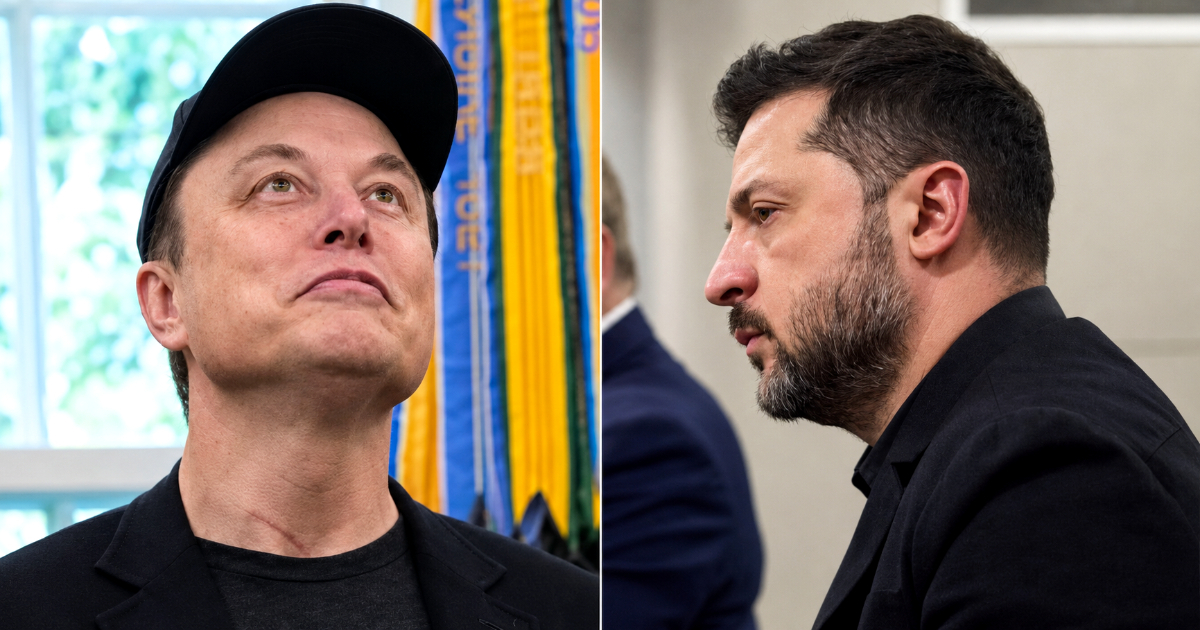
Ukrainian President Volodymyr Zelensky made an urgent public appeal on Monday to Elon Musk and the U.S. government to lift the speed restrictions imposed on the Starshield system—the military version of Starlink—that are undermining Ukraine's ability to intercept Russian drones before winter, according to a report by the BBC.
We are counting on these restrictions being lifted. The protection of lives and Ukraine's energy infrastructure for the winter directly depends on this, said Zelenski, who also appealed to the moral dimension of the conflict: It is important to be on the right side of history.
Starshield is a military-grade service developed by SpaceX and provided to Ukraine through the U.S. government. While commercial Starlink is used for general communications on the front lines, Starshield is specifically employed for drone interception in Ukrainian airspace.
The issue has a history spanning several weeks. Speed restrictions were first detected in October when Ukraine experienced prolonged outages.
Musk stated that Starshield was under the control of the U.S. government; President Donald Trump denied any responsibility and claimed that he had asked the entrepreneur to "restore it." The service appeared to normalize briefly, but Zelenski denounced that the limitations had systematically returned.
The imposed limit —approximately 161 km/h— proves decisive on the battlefield: Ukrainian interceptor drones lose connection with their operators at that speed and are unable to catch up with the Russian jet-propelled Shahed drones.
"Our interceptor drones lose connection with their operators at a speed of 161 km/h and simply cannot catch up to the Russian jet-propelled 'shaheds,'" wrote Zelensky on Telegram.
On Friday, Zelenski specified that the restrictions apply specifically along the front line and in Ukrainian territories under Russian occupation, not throughout the entire country. This geographical delineation has, according to him, a political significance: “If you impose restrictions there, you are already partially recognizing the temporarily occupied territories as if they are not ours,” he stated to the newspaper The New York Times.
The controversy reveals an underlying structural tension: a private company controls communication infrastructure upon which sovereign military operations depend, with implications reaching NATO countries and the U.S. forces themselves.
The Ukrainian access contract to Starshield is signed with the U.S. government and, according to Reuters, it expires in mid-2027, introducing uncertainty about the continuity of the service.
The chain of contradictions between Musk, Trump, Secretary of State Marco Rubio, and Secretary of Defense Pete Hegseth —none of whom have taken responsibility for the restrictions— has intensified the debate in Washington and in European capitals about the sustainability of having critical defense infrastructure in the hands of a private actor.
The diplomatic context exacerbates the situation. The Starshield restrictions coincide with intense pressure from the Trump administration on Zelenski to accept territorial concessions.
The Ukrainian president revealed on Friday that representatives of Trump proposed ceded the Donbas to Russia in exchange for a possible NATO membership, a proposal he rejected but stated could be put to a referendum.
Meanwhile, Russia intensified its attacks: from Saturday night to Sunday, it struck energy infrastructure in Zaporizhzhia, Sumy, Odesa, Zhytomyr, and Kirovohrad, as well as railway infrastructure in Dnipro, Kharkiv, and Zaporizhzhia. Two people died in an attack on a facility in Mena, Chernihiv region.
For its part, Ukraine responded with attacks on a petrochemical plant and a refinery in Nizhnekamsk, Tatarstan: "Two companies that supply raw materials and fuel for the Russian war were attacked," the Ukrainian army reported on Telegram.
Zelensky had asked his officials to work "as closely as possible" with the U.S. government and Musk's company. The BBC requested comments from the White House and Starlink, but received no response by the time of publication.
Related videos:
Filed under: