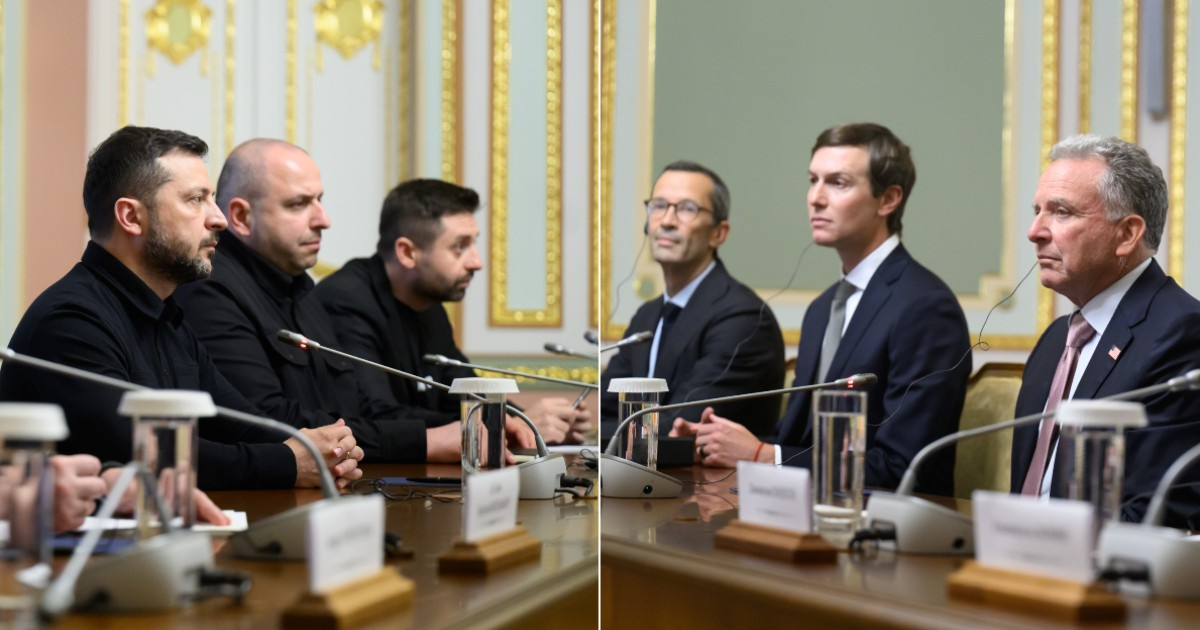
The Ukrainian president Volodimir Zelenski revealed this Saturday that negotiators from the Trump administration first proposed to him the possibility of Ukraine relinquishing the territory it still controls in Donbas in exchange for joining NATO, as reported by the BBC.
"Americans raised the following question: 'What would happen if Ukraine joined NATO? Would Ukraine withdraw from the Donbas?' It was the first time this issue was raised," Zelensky told reporters.
The revelation comes after a week of intense diplomatic activity: U.S. envoys Jared Kushner and Steve Witkoff first traveled to Moscow to meet with Russian President Vladimir Putin and then to Dublin, where a European Union summit was taking place, to meet with the Ukrainian leader.
Before that round, representatives from the three countries had met to negotiate in Abu Dhabi in the first direct contact between Russia and Ukraine in about nine months, without reaching a decisive breakthrough: Moscow rejected a proposal for a partial ceasefire concerning energy targets and reiterated demands that extend far beyond the battlefield.
The U.S. proposal marks a significant shift in the public discourse surrounding the negotiations, as Kiev has consistently maintained that it will not concede sovereign territory. Zelenski has reiterated on multiple occasions the goal of reclaiming the four provinces annexed by Russia in 2022 and the Crimean Peninsula, which has been occupied since 2014.
Russia currently controls approximately one-fifth of Ukrainian territory, including most of the Donetsk and Luhansk provinces that make up the Donbas. Relinquishing the small portions that Ukraine still holds there would, in symbolic terms, amount to a de facto recognition of Russian sovereignty over that region.
Zelenski expressed openness to submitting the proposal to a referendum, but set three conditions: firm security guarantees, freedom to maintain the capabilities of the Ukrainian army, and sufficient resources for the country's reconstruction.
At the same time, the leader warned that Washington does not act neutrally. "They have also picked up on Putin's signals, and this is an extremely difficult conversation," he said.
The pattern of pressures from the Trump administration on Kiev is already a constant: the U.S. president asked Ukraine to suspend attacks on Russian oil facilities to facilitate the supply of diesel and ease fuel prices, which have risen since the U.S. and Israel attacked Iran in February 2026.
Zelenski, for his part, accused U.S. officials of restricting the Starshield service—the military version of Starlink—that Ukraine uses to coordinate defensive operations, including the interception of Russian drones.
The tension between the two leaders reached its peak when Trump stated that it was "time for Ukraine to have a new president" and demanded new elections, which is impossible as long as the country remains under martial law. Zelenski responded that he would be willing to hold them a few months after reaching a peace agreement and that he would resign from the presidency in exchange for NATO membership.
While Washington puts pressure on Kiev, Moscow has not moderated its demands but rather expanded them.
Russia insists that it will not cease hostilities until a final agreement is reached that includes territorial delineation, Ukrainian neutrality, and also that NATO returns to its 1997 configuration by withdrawing troops and military infrastructure from the Central and Eastern European countries that joined the alliance after the dissolution of the Soviet Union.
It was precisely those same demands that the West rejected in 2021, months before Putin declared his determination to seize all of Donbas and launched the large-scale invasion of Ukraine in February 2022.
Zelenski acknowledged that the American proposal gave him some optimism: "NATO is back on the table," he stated. However, the gap between what Moscow demands and what Kiev is willing to accept remains, for now, unbridgeable.
Related videos:
Filed under: