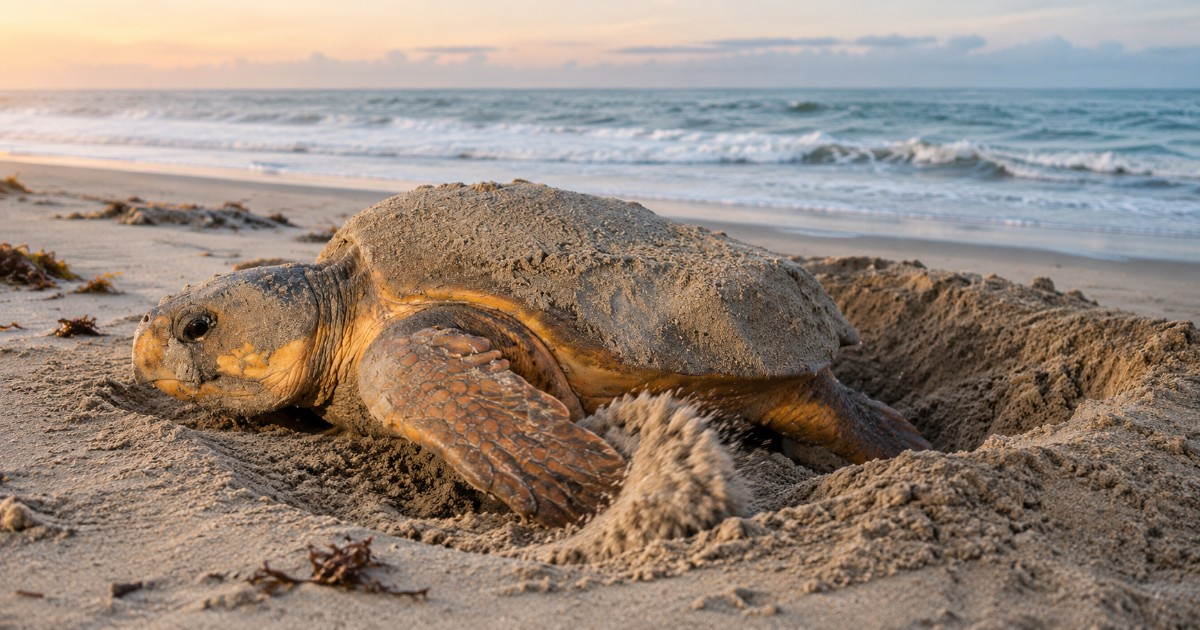
Florida has concluded the 2026 sea turtle nesting season with results that could make history: two species are close to setting new nesting records in the state, according to preliminary data released by wildlife conservation authorities.
The Florida Fish and Wildlife Conservation Commission (FWC) reported that the season officially concluded on October 31, and the figures collected up to that date suggest potential record highs for loggerhead and leatherback turtles.
The results still need to be reviewed before being declared final.
The loggerhead turtles (Caretta caretta) reached 136,743 nests statewide, preliminarily surpassing the previous record of 134,930, set in 2023.
The leatherback turtles (Dermochelys coriacea) also had a remarkable season, with 2,270 documented nests. If the data is confirmed after the annual review, the species will set a new state record.
The leatherback turtle is the largest of the sea turtles, and Florida is the only state in the continental United States where it regularly nests, according to specialists from the FWC.
Green turtles (Chelonia mydas) recorded 54,951 nests. Although this number is lower than the highs reached in 2023 and 2025, authorities consider it significant for a species whose reproductive activity shows great fluctuations from one year to the next.
The balance also includes 15 nests of the Kemp's ridley turtle (Lepidochelys kempii), a rare species on Florida's beaches, and one nest of the olive ridley turtle (Lepidochelys olivacea), whose discovery was regarded as one of the most interesting events of the season.
No hawksbill turtle nests were recorded.
The FWC coordinates the monitoring of nesting through monitoring programs that cover the state’s beaches, with the participation of researchers, volunteers, and organizations dedicated to conservation. These records allow for the study of reproductive trends and the assessment of the evolution of various species.
In Broward County, for example, authorities documented 3,762 nests in 2026, the second highest number in the history of their conservation program, which has been monitoring the beaches since 1981.
Of the total, 3,333 were loggerhead turtles, 350 were green turtles, and 79 were leatherback turtles.
The FWC reminds us that female turtles need calm beaches to lay their eggs and that hatchlings, upon emerging from their nests, rely on natural lighting conditions to find their way to the sea. Therefore, it recommends turning off unnecessary lights, avoiding the use of flashes, and keeping a distance from the animals.
The final results for 2026 will be announced once the annual review of the records is completed. Until then, Florida holds two potential nesting records that could confirm one of the most remarkable years for loggerhead and leatherback turtles on its beaches.
However, a season with numerous nests does not guarantee that all the hatchlings will make it to the ocean. Artificial lighting, human activity, and other dangers continue to threaten their survival.
In August, 55 loggerhead turtle hatchlings died on Anna Maria Island after becoming disoriented by the lights from nearby homes and businesses. Instead of heading towards the Gulf of Mexico, they moved inland and ended up on a coastal road.
The protection of nests is a constant concern in Florida. At the beginning of the 2025 season, the authorities of St. Pete Beach urged residents and tourists to keep the beaches dark, clean, and free of obstacles, as well as to respect the marked nesting areas and avoid any contact with the turtles.
Related videos:
Filed under: