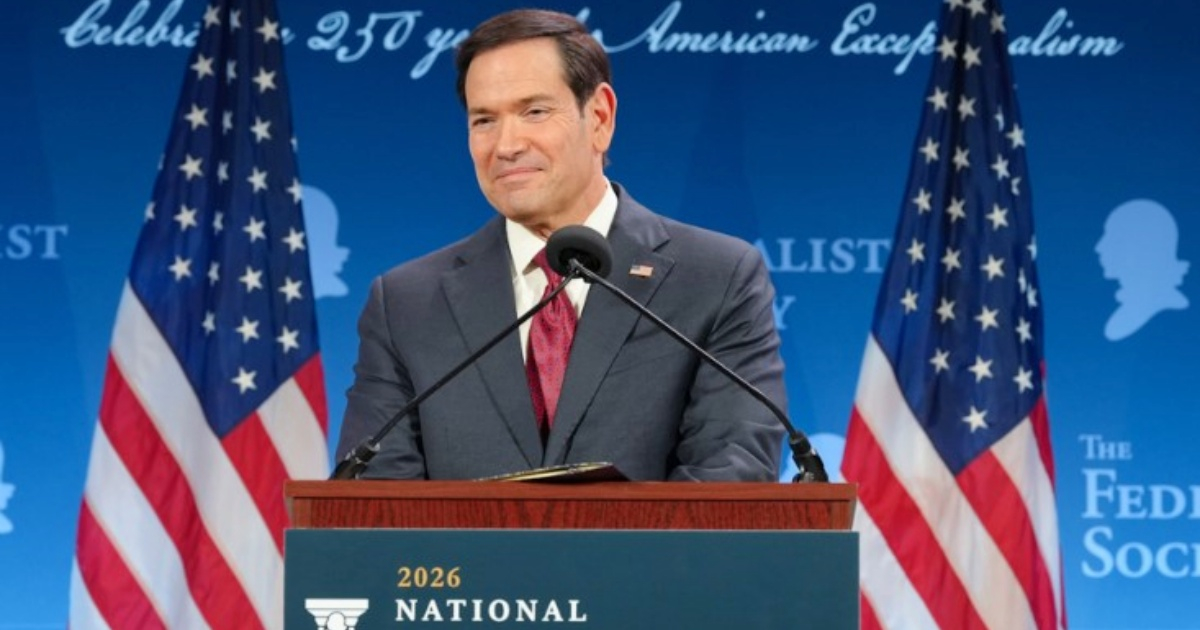
An opinion column published in National Review suggests that the priority of U.S. Secretary of State Marco Rubio to promote political change in Cuba might lead him to refrain from running in the 2028 presidential elections, given the possibility of leaving a position from which he wields direct influence over Washington's policy towards Havana.
The article, authored by journalist Skyler Safriet, argues that there is a strong tropical reason for Rubio to dismiss his presidential ambitions: the opportunity to continue working to end the Cuban communist regime during the remaining two years of Donald Trump's second term.
Safriet remembers that there are about 15 months left until the New Hampshire primaries, so Rubio would need to start a campaign soon if he decided to run for the Republican nomination.
This would imply giving up what the analyst describes as "a privileged position" to drive significant changes in Cuba.
The dilemma: Cuba or the White House
Safriet recalls that Rubio, the son of Cuban immigrants who arrived in the United States in 1956, has made his opposition to the Havana regime one of the main causes of his political career.
The Secretary of State also holds the position of National Security Advisor to the White House. He began serving in this second role on an interim basis on May 1, 2025, following the departure of Michael Waltz, and on September 22, 2026, Trump formalized his permanent appointment.
With that, Rubio became the second person in the history of the United States to hold both positions simultaneously as a principal, after Henry Kissinger, who held them between 1973 and 1975.
For Safriet, this concentration of responsibilities takes on special importance due to the current situation in Cuba and the pressure strategy being pursued by Washington.
The columnist believes that "Cuba is weaker" than at any other time in the last six decades of the U.S. embargo.
Among the factors mentioned are the economic sanctions imposed by the Trump administration, the disruption of Venezuelan oil supply following Nicolás Maduro's fall in January, and the challenges in securing fuel from Russia.
Safriet also claims that Russian oil tankers have not attempted to breach the U.S. blockade around the island since March.
The journalist also uses as an argument the result of the vote on October 28 in the UN General Assembly, where the resolution against the U.S. embargo received its lowest support in two decades.
Although the resolution was approved again, it received 130 votes in favor, 17 against, and 25 abstentions, compared to the 165 supports, seven votes against, and 12 abstentions in 2025.
The article interprets these events as a unique opportunity for the Trump administration to intensify its policy toward Cuba over the next two years.
Safriet also mentions Rubio's public call to Cubans to discreetly collaborate with the CIA, as well as his repeated criticisms of the Cuban regime, as signs of an increasingly active U.S. strategy.
Why could a candidacy in 2028 disrupt their plans?
The central argument of Safriet is that Rubio would have to leave the Secretary of State position to run for president, precisely when he believes that Washington has favorable conditions to increase pressure on Havana.
According to the journalist, an electoral victory in 2028 would not guarantee that Rubio could have greater influence over Cuba than he currently does.
Even if he were to reach the White House, he claims, he may have missed a critical political opportunity by interrupting his work in the Trump administration.
In that scenario, the author warns of the risk of “losing the momentum” of U.S. operations directed at Cuba if Rubio were to abandon his responsibilities now.
Trump himself has publicly reinforced the importance of the Secretary of State in his policy toward the island.
On November 12, the president stated that he wants to resolve the Cuban issue before the end of his term and emphasized Rubio's role in that objective. He also indicated that he would consider a limited military operation against Cuba, without announcing any decisions on the matter.
Rubio's statements about his future
For his part, Rubio has avoided committing to a presidential candidacy for 2028.
In May, he praised Vice President JD Vance as a potential Republican candidate and expressed his willingness to support him.
On November 5, in an interview with The New York Times, he denied reports suggesting that he was considering leaving the Government to prepare for a presidential campaign.
Rubio stated that working for Trump until the end of his second term "has always been my plan" and refused to continue answering questions about 2028.
Four days later, during his participation in the G7 foreign ministers' meeting in Paris, he reiterated that Cuba is a priority for Washington and that the United States will continue to work to promote changes on the island.
The electoral support for Rubio among Hispanics in Florida
The possibility of Rubio remaining in the Trump administration also contrasts with the support he receives as a potential Republican presidential candidate.
A poll among Florida's Hispanic Republican voters, conducted in October and recently released, shows a 57% support for him in a hypothetical 2028 primary, compared to 25% for Ron DeSantis and 10% for JD Vance.
The survey, commissioned by HispanicsVote.org, included 351 Hispanic Republican voters, with a margin of error of ±5.2 percentage points for that subgroup.
The results reflect support for a potential candidacy from Rubio among those surveyed, although they do not represent a measure of the preferences of the entire U.S. Republican electorate.
Safriet, however, believes that the current responsibilities of the Secretary of State and his interest in Cuba could weigh more in his decision than the expectations of a presidential campaign.
The journalist acknowledges the uncertain nature of her interpretation: "The future may harm me for speculating."
Nonetheless, he argues that Rubio's statements regarding his intention to remain in the government until the end of Trump's term may carry more credibility than similar promises made by other politicians before embarking on a presidential campaign.
Related videos:
Filed under: