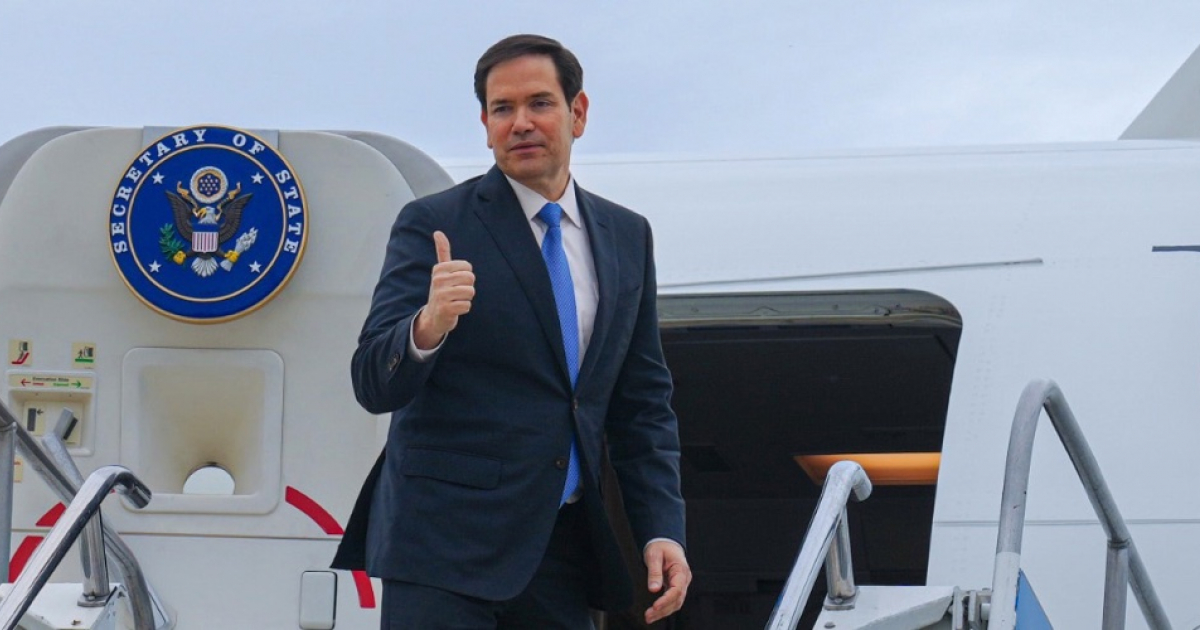
A new survey of registered Hispanic voters in Florida places Secretary of State Marco Rubio as the overwhelming favorite among Republican Hispanics for the 2028 presidential primaries, while those same voters largely oppose the deportation of immigrants without criminal records.
The poll, commissioned by HispanicsVote.org —a conservative organization founded by Barbara Casanova, president of the Republican National Hispanic Assembly (RNHA) in Florida— was conducted by pollster David Wolfson between October 14 and 18 with 855 registered Hispanic voters in the state, with a margin of error of ±4 points (±5.2 in the republican subgroup of 351 individuals).
Among Hispanic Republicans, Rubio receives 57% support in a hypothetical primary for 2028, far ahead of Ron DeSantis (25%) and Vice President JD Vance (10%). Cuban Americans make up about 46% of the surveyed Republicans, giving the exile community a decisive influence in these results.
El debate sobre las deportaciones y las políticas migratorias sigue siendo central para la comunidad hispana en EE.UU. Mantente informado con la cobertura completa en nuestra sección de
The Rubio effect goes beyond voting intention: 61% of Hispanic Republicans claim they would be "much more motivated" to vote in 2028 if the Cuban-American former senator were to lead the candidacy. In a hypothetical general matchup against California Governor Gavin Newsom, Rubio leads among all Hispanics in Florida with 39% compared to 32%.
Casanova attributed part of the support for Rubio's management at the State Department to his handling of issues related to Cuba, Iran, Venezuela, and Colombia, although he warned that "the field is still quite open" and acknowledged that "there is a lot of support for DeSantis in Florida."
Regarding Cuba, 53% of Hispanic Republicans support actively promoting political change and the opposition within the island; 11% prefer more pressure and sanctions on the regime; and 36% have no defined position.
The most significant political finding is immigration. 91% of all surveyed Hispanics— including 86% of Republicans—support limiting deportations to individuals convicted of serious crimes. Additionally, 97% advocate for a pathway to citizenship for long-term residents who pay taxes and do not have serious criminal records, and 79% oppose deporting long-term residents with no criminal history.
This rejection is particularly significant for the Cuban community in Florida, where detentions by ICE increased by 463% between October 2024 and January 2026. Furthermore, this Tuesday, the Eleventh Circuit Court of Appeals ruled that the I-220A form does not equate to humanitarian parole for the purposes of the Cuban Adjustment Act, directly impacting thousands of Cubans in Florida, Georgia, and Alabama.
Casanova criticized the execution of immigration policy: "I believe the administration has not done a good job communicating who is being deported, why, and how they are identified," she said to Newsweek. "It leaves a bad impression in our community and generates distrust and misunderstandings."
The survey also reflects severe economic pressure: 62% of Hispanics in Florida say their family is worse off than a year ago —only 1.8% report improvement— 54% believe the state is heading in the wrong direction, and 52% see the American dream as out of reach.
This survey is different from the Reuters/Ipsos one at the beginning of the month and the FIU Cuba Poll from September, although all three polls agree in pointing out Rubio as the favorite among Hispanic Republican voters in Florida for 2028.
Related videos:
Filed under: