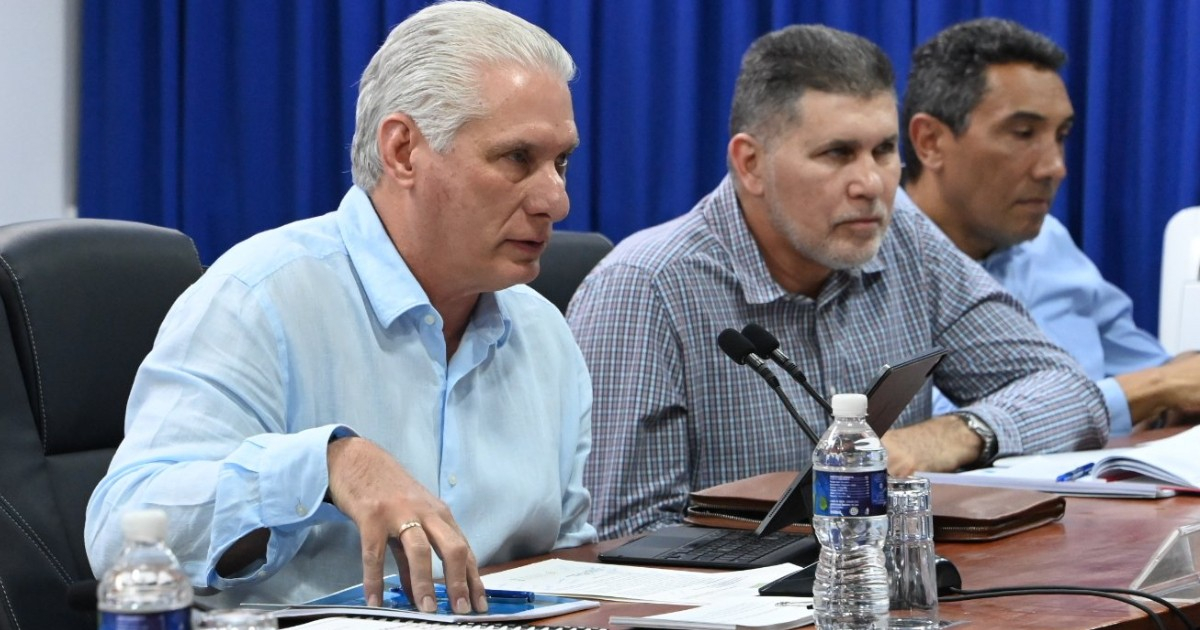
With Cuban transportation at its worst historical moment, Miguel Díaz-Canel once again turned to his most repeated formula this Friday: "creative resistance". He did so during the closing of a round of exchanges between the leadership of the Communist Party and workers in the sector, held at the headquarters of the Ministry of Transportation.
"We cannot manage scarcity as if it were normal. The response must be to combine creative resistance with the construction of structural alternatives," the leader stated during what was the seventh visit of the Central Committee to organizations deemed vital for the country so far in 2026.
The Minister of Transportation, Eduardo Rodríguez Dávila, acknowledged before Díaz-Canel that the year has been defined by a decline in passenger and cargo transportation, due to a lack of funding and spare parts to maintain the vehicle fleet. "President, transportation does not stop," the official said, although the numbers tell a different story.
Interprovincial bus departures from Havana collapsed from 419 daily in 2025 to just 11 in 2026, a reduction of 97.4%. National bus routes decreased from over 100 to only 21, and cargo volume could plummet from 70 million tons to around 20 million by the end of the year.
Interprovincial buses, which in 2025 were transporting over 5,000 passengers daily, now carry less than 1,000. The train service in Las Tunas was suspended again on November 16 due to lack of fuel, just days after its resumption.
Díaz-Canel attributed the disaster to the U.S. embargo, which he described as a "deliberate suffocation policy that affects the mobility of the population and the logistical operations of the country." He mentioned the lack of diesel, the low availability of the fleet, and electrical disruptions as factors that result in shortages, price increases, and an impact on quality of life.
What was not mentioned is that "creative resistance" has been their response to each new crisis for years, without any improvement in the country's indicators. In October 2022, they made it a public slogan in front of delegations from 64 countries; in December 2023, they repeated it at the closing of the National Assembly; in February 2026, they applied it to power outages; in March of that year, they even presented cooking with charcoal and firewood as an example of the concept.
In June 2026, before the Extraordinary Plenary of the Communist Party, Díaz-Canel acknowledged that "resistance alone is not enough." The shift was short-lived: by October, he was already speaking about “citizen creativity” as a variation of the same slogan, and this Friday he returned to the original formula applied to transportation.
The backdrop is a free-falling economy. The CEPAL projects a contraction of the Cuban GDP of 10.3% in 2026, the worst in Latin America and the Caribbean, with a cumulative loss exceeding 23% since 2019. The official inflation rate surpassed 25% year-on-year in August, with food prices rising more than 36%.
The pattern repeats itself with each crisis: a new discourse, the same slogan, and Cubans facing alone the consequences of 67 years of dictatorial management that no "creative resistance" has managed to reverse.
Related videos:
Filed under: