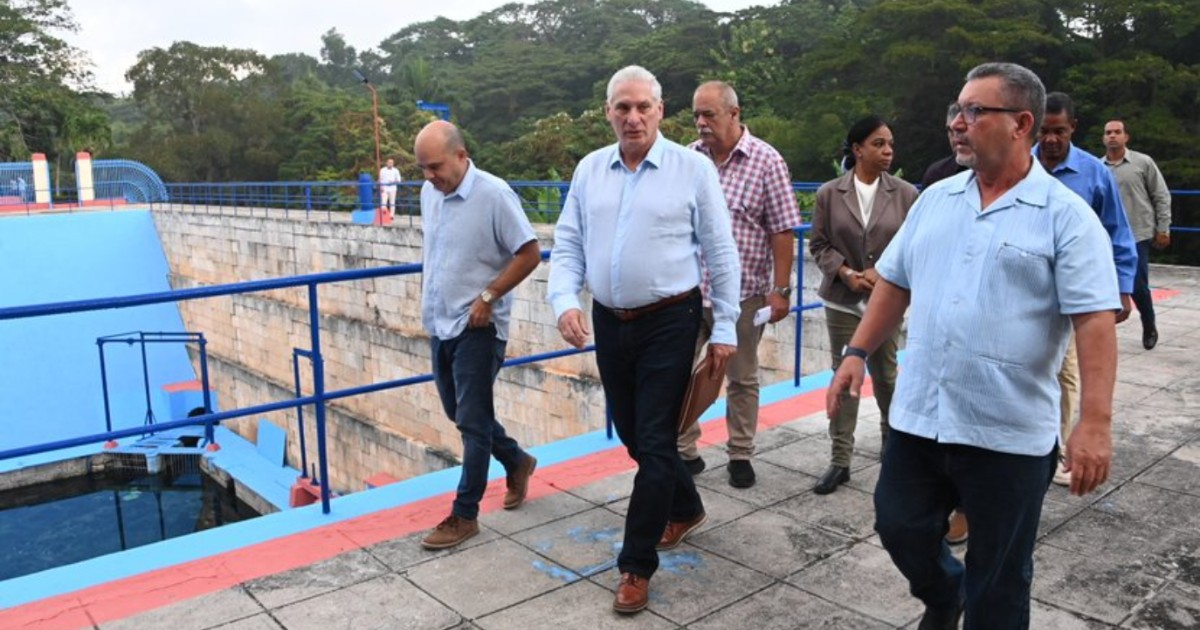
Miguel Díaz-Canel visited La Taza de Vento this Thursday, in the Boyeros municipality of Havana, to monitor the progress of the Comprehensive Water Supply Assurance Program in Havana and stated that "in the last ten days I believe we have made comprehensive progress, but we must continue."
The president's statement contrasts with the reality experienced by 255,000 Havana residents, as acknowledged by the government itself. Water problems extend far beyond that official assessment, with interruptions, low pressure, and irregular supply affecting daily life in all neighborhoods.
The first vice president of the National Hydraulic Resources Institute, Javier Toledo Tápanes, reported that at the beginning of the program, the number of affected individuals in the capital reached 577,000, a figure that has decreased by half in recent weeks. Nonetheless, he projected that the number will continue to decline over the next 15 days.
Toledo Tápanes detailed the ongoing works at La Taza de Vento, part of the historic Albear Aqueduct, built in 1893: "Here, the Vento well has been restored; there is a well that pumps directly; the pumping stations have been restored; La Taza has been returned to its original state; and the tunnel is currently being restored."
The official also noted that an additional unit is being installed at the El Gato spring, another one in Cuenca Sur, and two new ones at "Aguada del Cura," and that a future dredging of the Almendares River is planned.
In the event, Vice Prime Minister Inés María Chapman Waugh, Minister of Energy and Mines Vicente de la O Levy, President of the INRH Antonio Rodríguez Rodríguez, and the First Secretary of the Party in Havana, Liván Izquierdo Alonso, participated.
Díaz-Canel also inquired about the situation in the Granma municipality of Manzanillo, in Santiago de Cuba — which, according to the official report, has been improving — and in the capital municipalities of Cotorro and Arroyo Naranjo, described as "particularly difficult" cases.
The water crisis has structural roots that Díaz-Canel himself recognized as "real, serious, and complex" in early November, admitting that "it cannot be resolved with just a speech or a single measure."
At the national level, the INRH reported nearly 2.7 million Cubans affected by supply interruptions, accounting for 34.5% of the population. Sixty-six percent of the outages are due to a lack of electricity to operate the pumps, and 25% are due to breakdowns in the equipment itself.
Pipes that are between 60 and 70 years old lose between 40% and 70% of the water before it reaches households, and 87% of the country’s aqueducts depend on the national electrical grid, making each blackout an automatic water outage.
In September, Díaz-Canel admitted that the regime cannot guarantee the 10 to 12 hours of electrical stability that the pumping systems need to operate.
While the construction work progresses at an uncertain pace, families in neighborhoods like Zamora in Marianao have been collecting rainwater for drinking for more than six months, and in Las Margaritas in Santa María del Rosario, the water cut has lasted over two years. Private water trucks in Havana range from 18,000 to 50,000 pesos, equivalent to several months' worth of minimum wages.
The announced structural solution —ten solar photovoltaic parks of 200 MW for the three main sources of the capital— will not be ready until August 2027, according to the government itself.
Related videos:
Filed under: