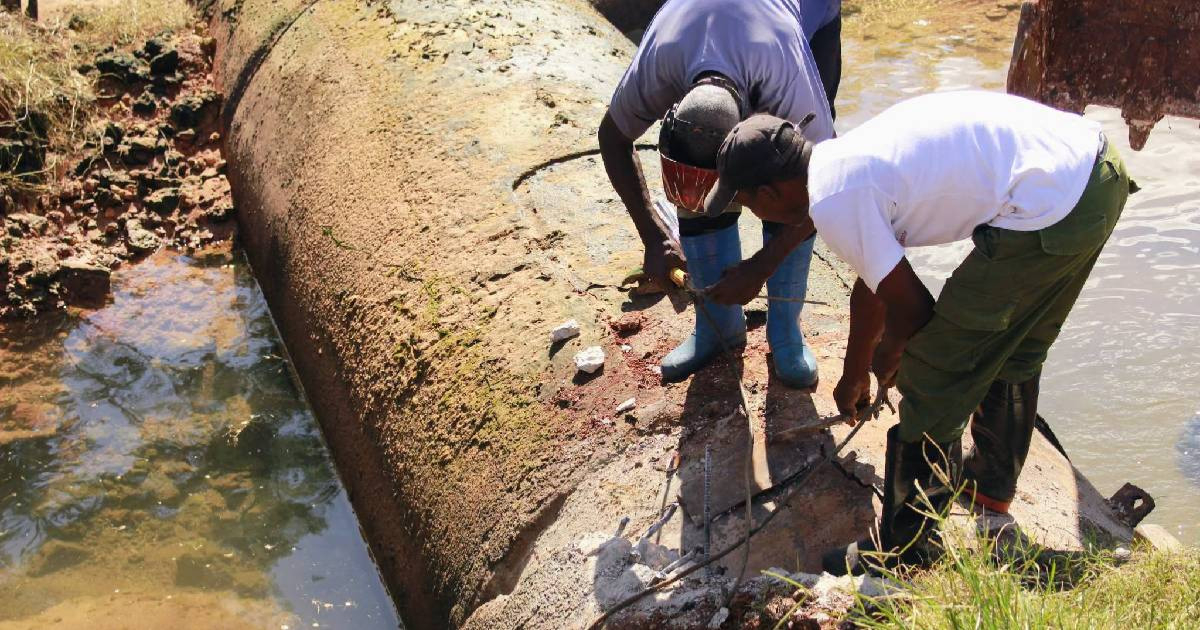
At least seven major leaks in the Cuenca Sur pipes threaten the water supply to municipalities in central Havana, where emergency repairs are being carried out following a shutdown by the distributor.
According to a report on the Facebook profile of Canal Habana, the interruption occurred early Friday morning, and the work is progressing "well," although some areas present greater challenges and require meticulous interventions, especially in the area known as Espina de Pescado.
Cuenca Sur is the largest water supply source in Cuba. Its networks stretch over 60 kilometers between the provinces of Artemisa and Mayabeque to transport water to the capital, but the authorities themselves acknowledge that they are worn out due to multiple factors.
The investment process in that infrastructure, which is regularly monitored by the government, includes the replacement of the most damaged section of piping. Other actions are also being carried out at various points in the complex system of conduits, including Aguada del Cura, the source indicated.
Authorities assert that the interventions will ensure greater volume and pressure in the supply, as well as reduce the impacts caused by leaks, which account for 14% of the total.
The restoration of service will not be immediate once the repairs are completed. Water from Cuenca Sur takes between six and seven hours to reach the capital, so authorities anticipated that residents would begin to notice an improvement on Friday night.
The intervention occurs in the midst of an escalating water crisis. On November 12, a total electrical failure in Cuenca Sur worsened the leaks in the main pipeline and required intervention at three points. Failures in that infrastructure were also recorded in October and August.
In addition to the issues with the networks, there is the energy dependency of the capital's hydraulic system. Eighty-seven percent of its infrastructure relies on electricity, which means that power outages directly impact the water supply.
As of November 18, the National Institute of Hydraulic Resources reported 2,206,000 Cubans experiencing total or partial disruptions in service throughout the country. In Havana, the number had decreased from a peak of over 577,000 people to approximately 255,000, although hundreds of thousands of residents still lack a stable supply.
On Wednesday, the ruler Miguel Díaz-Canel visited La Taza de Vento in Havana to supervise the Comprehensive Water Supply Assurance Program and stated that "we have made progress," a statement that contrasts with the recurrent interruptions and the difficulties faced by residents who have been without running water for weeks.
At the beginning of November, the leader acknowledged that the crisis was "real, serious, and complex" and that it could not be resolved "with just a speech or a single measure."
Among the solutions announced by the Government is the construction of 10 solar photovoltaic parks with a total capacity of 200 MW for the main supply sources of the capital. The completion of these installations is scheduled for August 2027.
Related videos:
Filed under: