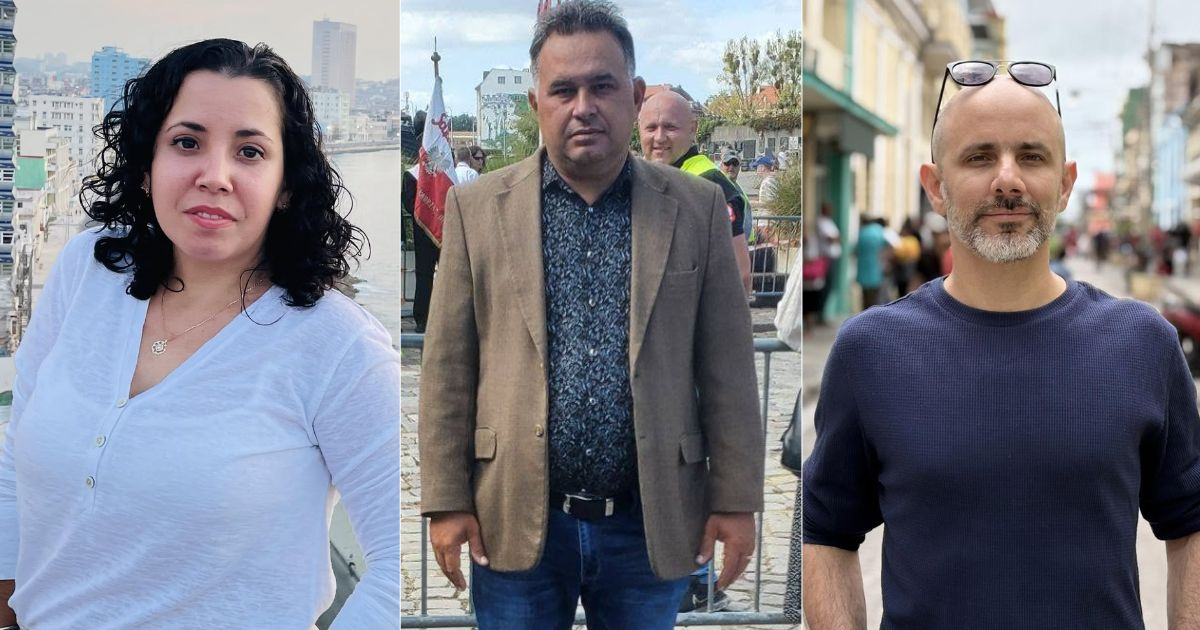
The Mexican communicator and journalist Renán Martínez Casas published this Friday in the AMEXI agency an analysis column on the repression of the Cuban regime against independent journalism, focusing on the kidnapping of reporter Vladimir Turró Páez and concluding that, in Cuba, practicing journalism amounts to committing a serious crime.
On November 13, Turró described what he experienced the night before: three State Security agents forcefully removed him from his mother's home in Havana, transported him with his head forced down between his feet in a private vehicle, and took him to a remote location. There, one of them aimed a gun at him while another recorded him with a phone, demanding that he publicly declare his resignation from CubaNet.
"We ended up on a hill. It was a time of immense terror. Why? Because upon arriving there, one had a phone in hand and the other had a gun, and they tried to force me to resign from CubaNet," reported the journalist himself.
The intimidation included a simulation of Russian roulette. "The one with the gun was pointing it at me, removing the magazine where the bullets go, putting the magazine back in, pulling the trigger, and then taking it out again. I don't know if the magazine had bullets or not, but the reality is that I experienced an immense, immense terror," Turró described, who did not utter a single word nor agreed to record the video.
After approximately ten hours in custody, he was transferred to the Sixth Police Unit, where an instructor from Villa Marista presented him with a warning notice threatening him with imprisonment for "usurpation of legal capacity." He refused to sign it and was released around nine o'clock at night. His response was unequivocal: "I'm really not going to stop doing my job; I will continue practicing journalism..."
Martínez Casas frames this episode within a broader repressive pattern, supported by documented figures. The Cuban Human Rights Observatory (OCDH) recorded at least 387 repressive actions during October 2026, including 30 arbitrary arrests and 145 house arrests against activists.
The Cuban Observatory for Freedom of Expression (OCLE) recorded in September 134 violations of freedom of expression resulting from 106 incidents, marking a 129.4% increase in specific violations of press freedom compared to August.
The analysis also documents other emblematic cases. Henry Constantín, director of La Hora de Cuba, spent two months in provisional prison on November 16 at the maximum-security Kilo 7 prison in Camagüey, accused of "disobedience," after being sent to a punishment cell and spending 15 days without communication with his family.
The Inter-American Press Association demanded his immediate release at its 82nd General Assembly held in Bogotá on October 25. The creator Eduardo Ceballos Pérez (Eddy Ceballos, from Despingovery Channel) has been in provisional detention since June 2026 on charges related to espionage for publishing a video about an abandoned Soviet military installation.
This repressive cycle in November also targeted other voices. Yoani Sánchez was detained for nine hours on November 5, accused of "attacking the constitutional order," while Camila Acosta appeared on November 19 with her husband before the police on the same charge.
"What is certain is that this is another setup by State Security to pressure us, whether to abandon our activism or our work as independent journalists," Acosta stated.
The columnist notes that this repression of free expression and journalistic practice is supported by a legal framework designed to criminalize them: Article 124 of the Penal Code defines the crime of "propaganda against the constitutional order" with penalties of three to ten years in prison; Law 162 on Social Communication prohibits content that "subverts the constitutional order"; and the Constitution formally recognizes freedom of the press but restricts media ownership to the state.
Cuba ranks 160th out of 180 countries in the World Press Freedom Index 2026 by Reporters Without Borders, and Prisoners Defenders reports over 1,350 political prisoners on the island.
"In Cuba, telling the truth can cost one their freedom, peace of mind, and even the safety of a family. That is the seriousness of a system that punishes the exercise of fundamental rights and turns critical thinking into a political threat," concludes Martínez Casas.
Related videos:
Filed under: