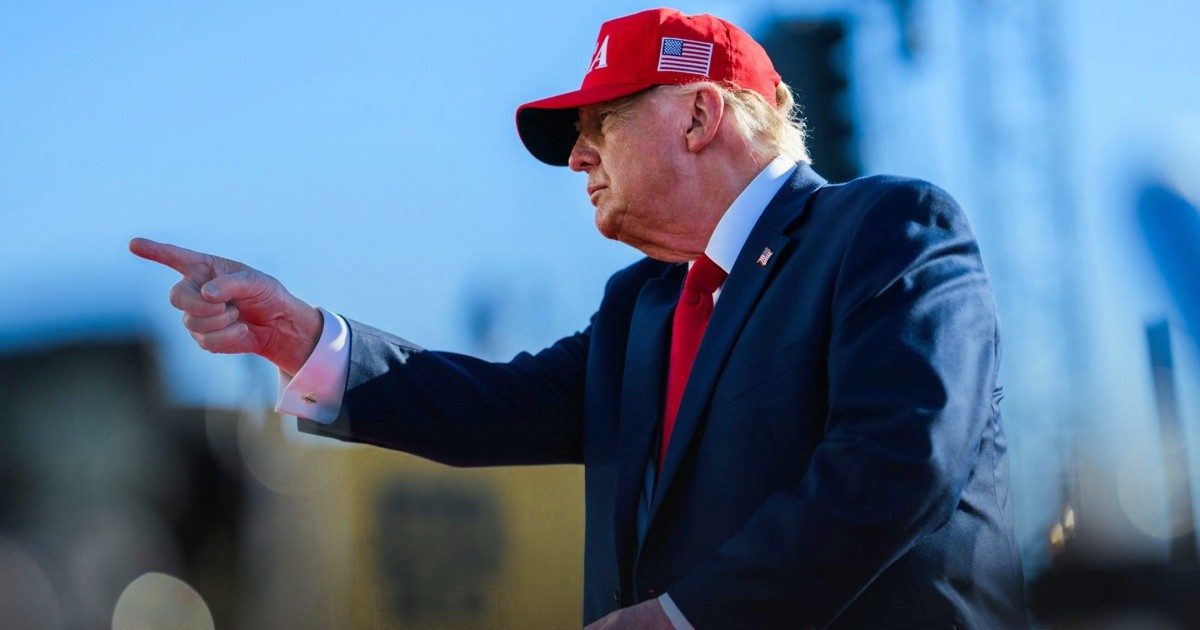
President Donald Trump suggested on Saturday the possibility of achieving what he described as a "historic" collaboration with the Democratic Party, which will take control of both chambers of Congress in January 2027. These statements arose during a telephone interview with the program "Saturday in America" from Fox News Channel and marked a significant shift in the president's tone towards the opposition.
The backdrop is the Republican defeat in the legislative elections of November 3, in which the Democrats regained control of the House of Representatives and the Senate. The new Congress will officially take office on January 3, 2027.
Credit cards: the most concrete point
The most substantial issue that Trump brought to the table was the regulation of credit card interest rates, with a proposed cap of 10% annually, at least for one year.
“I would do it. These credit card companies have made a lot of money,” the president declared.
Trump had promised this measure during the 2024 campaign and formally introduced it in January 2026, but it failed due to opposition from the financial industry and the lack of support from his fellow Republicans.
The average interest rate on credit cards in the United States is around 22.2%, according to the Federal Reserve Bank of New York, and the total accumulated debt exceeds $1.23 trillion.
Researchers estimate that a cap of 10% would save consumers around 100 billion dollars annually.
The response from the Democratic camp was immediate. Senator Elizabeth Warren, who is expected to chair the Senate Banking Committee, stated: "Let's limit credit card interest rates and save money for Americans."
The Republican senator Josh Hawley also supported the initiative: “The president is right. Let’s pass my bill to limit credit card interest rates.”
Healthcare, migration, and praise for democratic leaders
Beyond personal finance, Trump highlighted healthcare and immigration as other areas for potential bipartisan cooperation, without specifying concrete measures.
“The Democrats have some good points on healthcare… and they have some bad points as well. There are options for us to do well in healthcare and in many other areas,” he explained.
The president praised Hakeem Jeffries, nominated to head the House of Representatives, and Chuck Schumer, the Senate leader: “Hakeem Jeffries is a smart and reasonable guy. The same goes for Chuck Schumer.”
He also introduced his chief of staff, Stephen Miller, as a possible bridge to the opposition: "Stephen Miller is a very good person and I think Hakeem Jeffries will be able to see that. I hope to collaborate with Hakeem Jeffries."
The mention is striking since Miller is the chief architect of the administration's restrictive immigration policy.
Trump also argued that the new scenario could yield better results than governing with a narrow Republican majority: "There are options that we could do better than with a very small majority of Republicans."
This conciliatory tone contrasts with Jeffries' own announcement that the Democrats plan to investigate potential conflicts of interest and abuses of power by the administration when they take control of Congress.
Trump had already opened the door to negotiate on immigration weeks ago, after admitting that his deportation policy may have hurt the Republican Party at the polls.
Iran, the FBI, and the 2028 Race
Regarding Iran, Trump was direct: "I never cared much about the regime. Some say regime change, but that needs to be explained what that means. I've already taken down two regimes," he stated, before announcing his expectation to reach "a permanent agreement with Iran" that would prevent the country from developing nuclear weapons.
Regarding the cyber attack against the FBI, he described it as "not good," although he suggested that the incident could shed light on what he referred to as the "Russia, Russia, Russia hoax."
Regarding 2028, he mentioned Vice President JD Vance and Secretary of State Marco Rubio as prominent figures but left the door open for other candidates: "JD Vance and Marco Rubio are very popular. They are doing fantastically, but there could be surprises. We have very capable people." Both were present in the White House press room and reacted with laughter.
The true test of bipartisan will will come in January 2027, when the Democrats take over Congress and must decide whether to prioritize legislative collaboration or the investigations against the Trump administration that they have already announced.
Related videos:
Filed under: