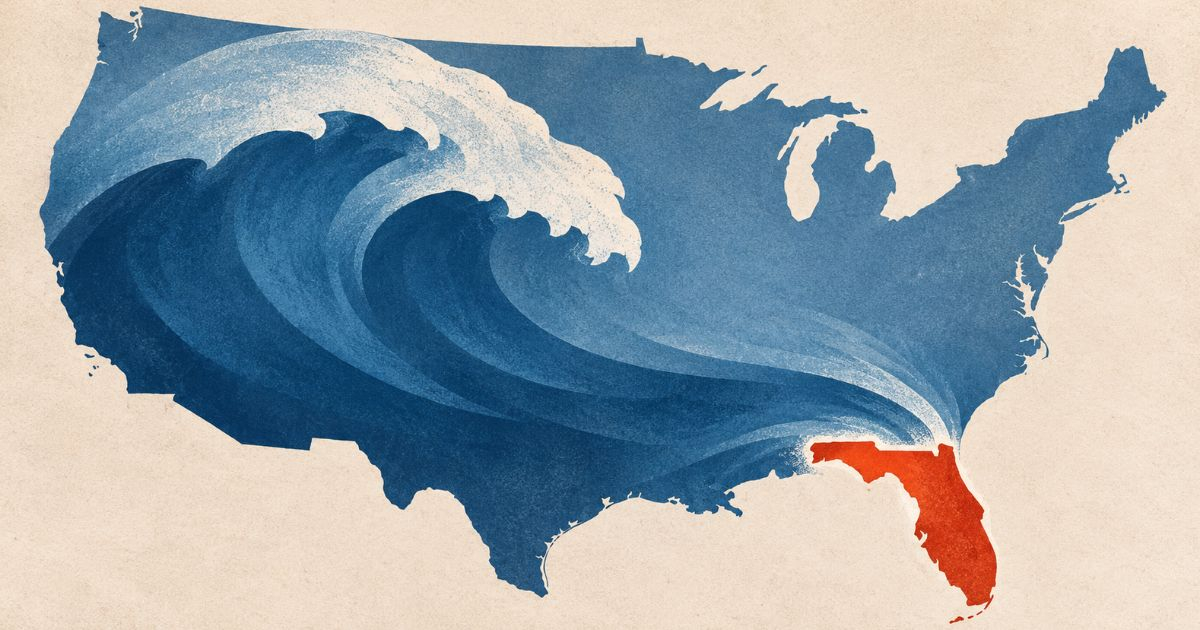
Florida became one of the main exceptions to the Democratic advance in the midterm elections on November 3.
While the Republican Party suffered significant defeats in other states and lost control of Congress, it managed to retain the governorship and major state offices in Florida.
What explains the state's resistance to a trend that negatively impacted the Republicans in much of the country?
The president of the Florida Republican Party, Evan Power, defended this Sunday in an opinion column published by the Orlando Sentinel that the combination of political principles and organizational work allowed his party to maintain an advantage in numerous electoral contests.
But the results and analyses from specialists show that the Republican resistance also responded to concrete factors: a significant advantage in voter registration, greater financial resources for campaigns, demographic shifts, and mobilization around proposals such as reducing taxes on homes.
A lead of over 1.5 million voters
The first factor was present long before the polls opened. According to the official data from the Florida Department of State, by the end of October, there were 5,720,737 registered Republicans compared to 4,203,512 Democrats.
The difference was 1,517,225 voters in favor of the Republican Party, a considerable advantage even in an election year marked by a strong Democratic momentum nationwide.
The change reflects a political transformation that has been ongoing for several years. In 2020, Democrats still outnumbered Republicans in Florida's voter registration.
Since then, the growth of the Republican base and the arrival of new residents have contributed to altering the balance between the two parties.
The political scientist Aubrey Jewett from the University of Central Florida explained to The Washington Post that this advantage provided the Republicans with a buffer against electoral dissatisfaction that affected the party in other areas.
More money and a consolidated electoral structure
Financing also played a significant role. According to campaign spending data collected by The Washington Post, Republican Byron Donalds and his political committee had spent over 165 million dollars by October 29, compared to about 25 million used by the campaign and committee of Democrat David Jolly.
The difference allowed the Republicans to maintain a campaign with greater advertising presence and mobilization capacity.
Specialists consulted by WUSF, Florida's public radio, highlighted that Democrats in the state did not benefit from the same level of party investment that candidates in other competitive areas received.
The composition of the population also had an influence. Florida has attracted many older residents, a group that tends to lean more toward the Republican Party.
WUSF highlighted that this trend contrasts with states like Texas and Georgia, where the growth of younger and more diverse electorates aided the Democrats.
Another factor was Amendment 3, backed by Governor Ron DeSantis and approved in the elections, which expands property tax exemptions for certain primary residences.
The possibility of paying lower taxes may have encouraged the participation of Republican voters.
The weight of the Cuban-American vote
In South Florida, the support of a significant portion of the Cuban-American community remains another component of Republican strength.
The FIU Cuba Poll 2026, released by Florida International University before the elections, found that 68% of the Cuban Americans surveyed planned to vote for Republican candidates in Congress.
That support coexisted with disagreements regarding Donald Trump's immigration policy: 76% of respondents opposed the increase in the deportation of Cubans with no criminal records.
The contradiction also emerged in the debate following the elections. Republican leaders in Florida dismissed the idea that deportations were the primary explanation for the electoral decline among Cubans and Hispanics and pointed to economic and national political factors.
The support from Cuban Americans, however, does not mean that the entire Hispanic electorate in Florida voted the same way. The results show significant differences among communities, regions, and age groups.
Florida held firm, but the Republicans lost ground
The Republican victory was not as sweeping as in previous elections. According to the official results from Florida, Donalds received 4,135,955 votes, which is 50%, while Jolly garnered 4,030,579, or 48.73%.
The difference was just 105,376 votes, or 1.27 percentage points. The contrast is striking compared to the 2022 elections, when DeSantis secured reelection with a lead of over 19 points, and the 2024 presidential elections, when Trump won Florida by approximately 13 points.
In addition, the Democrats seized 15 seats from the Republicans in the state House of Representatives, ending their supermajority, although the Republican Party retained legislative control.
There were also significant changes in the southern part of the state. Miami-Dade cast the majority of its votes for the Democratic candidates for governor and the federal Senate, after having supported Trump in 2024 and DeSantis in 2022.
Donalds himself acknowledged after the elections that some Republican voters abstained or supported Democratic candidates, and he linked some of that dissatisfaction to families' economic concerns.
Related videos:
Filed under: