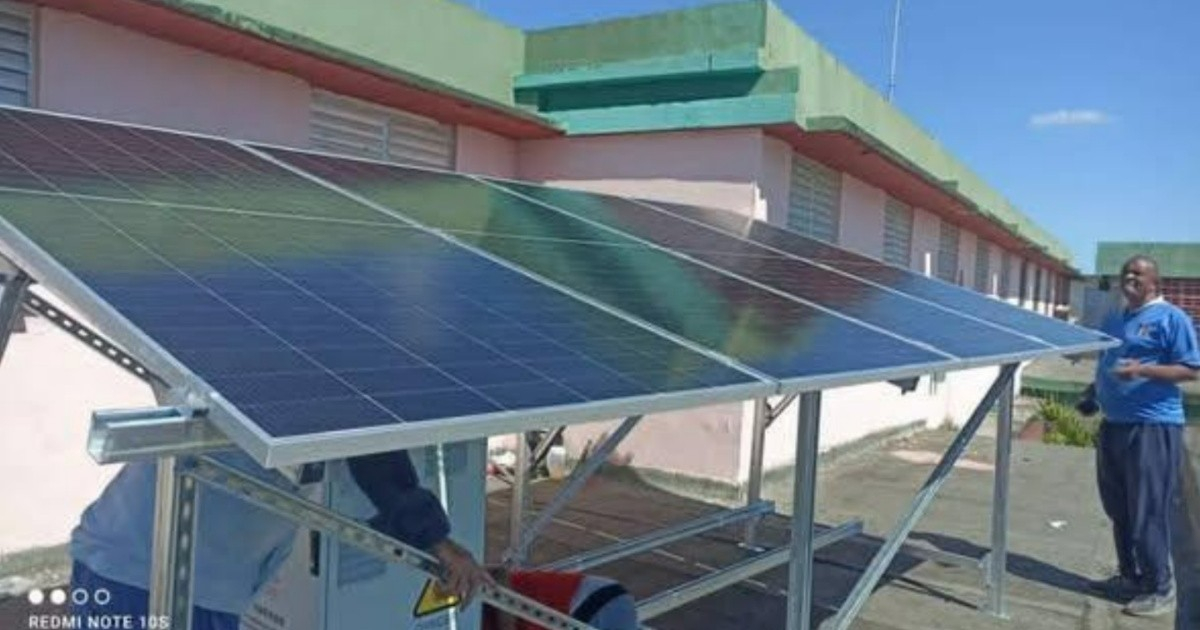
The Seville Council will allocate 100,000 euros for the installation of photovoltaic systems in 13 health and education centers in Pinar del Río, in a project carried out by the Andalucía-Cuba Association which, according to the state media Cubadebate, will benefit over 1,200 students and preschool children.
The initiative comes at a critical moment for the western province, which has experienced some of the longest power outages in the country: in October 2026, some circuits in Pinar del Río remained without electricity for over 90 hours, while the national generation deficit exceeded 2,020 megawatts.
The equipment will have capacities ranging from three to 12 kilowatts, depending on the technical needs of each installation.
The beneficiaries include polyclinics, medical offices in remote areas, four children's circles, the Tania La Guerrillera Pedagogical School, and the Provincial Center for Medical Genetics.
In the education sector, the priority will be cooking food in childcare centers, where the energy crisis has forced the use of firewood and charcoal to prepare meals for the children.
The photovoltaic backup will also reach the kitchen area and the dormitories of the Pedagogical School, where several hundred students from across the province are currently housed on scholarships.
In health, three polyclinics will receive 12-kilowatt systems that will keep laboratories operational and connect ultrasound equipment to improve patient care.
The Provincial Center for Medical Genetics— which caters to all high-risk pregnancies in the 11 municipalities of Pinar del Río — will also have a system of equal capability.
Sandra Ramírez Guzmán, director of Health in the region, emphasized the impact of that last facility: "This will be a great help for the Maternal and Child program."
Pinar del Río does not start from scratch in terms of solar energy: prior to this project, photovoltaic systems had already been installed in 19 educational institutions in the province, in all of its polyclinics, and in maternity and elderly homes.
In April 2026, China installed photovoltaic systems in the 20 polyclinics of Pinar del Río, including emergency services, maternity homes, and the psychiatric hospital, in yet another demonstration of the province’s reliance on external cooperation to sustain its basic services.
Spain had also sent, through the Spanish Agency for International Development Cooperation, 18 photovoltaic systems to health centers and social services in Cuba in that same season.
The project approved in August 2026 is part of the decentralized cooperation line that the Diputación de Sevilla maintains with Cuba through the Andalucía-Cuba Association, a nonprofit organization based in Córdoba.
Antonio Zurita Contreras, president of the association, noted that the initiative "represents a demonstration of the solidarity and support that has been offered to the Cuban people for several decades."
While international cooperation provides targeted solutions, the daily reality in Pinar del Río remains harsh: in November 2026, residents of La Palma reported seven months without water from the aqueduct and nights spent in complete darkness, reflecting a structural crisis that no solar panel can resolve on its own.
Related videos:
Filed under: