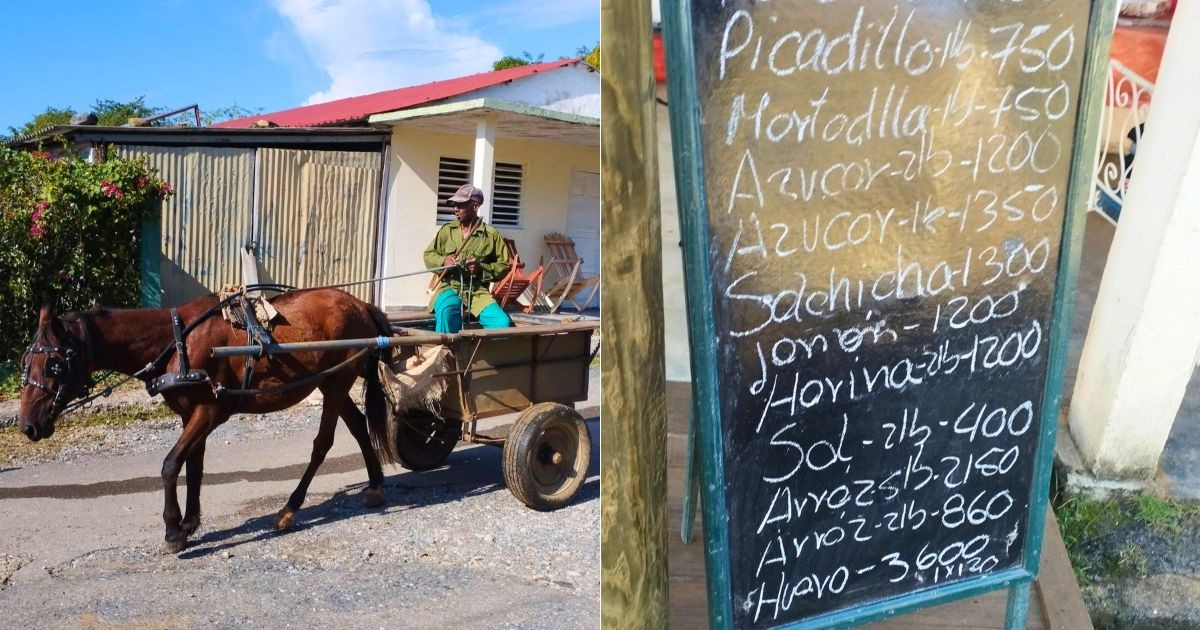
A resident of La Palma, Pinar del Río, posted this Saturday on Facebook a testimony about daily life in that municipality: seven months without water from the municipal aqueduct, nights completely dark due to power outages, no television or radio, internet access limited to a few hours a day, and no state intermunicipal transport.
Luis Enrique Rodríguez Ortega wrote from La Palma while tobacco and tomato were being planted in the farmland after a night of rain, and his text begins with a reflection on the resilience of the people of La Palma in the face of a series of hardships that, as he acknowledges, no one could have imagined a few years ago.
"Nobody could have told us a few years ago that the Municipal Aqueduct would go without supplying homes with precious water for over seven months," wrote Rodríguez Ortega, who also describes the total darkness of the nights: "No one could have imagined nights so dark, a sky with zero 'light pollution' for months and months; obviously without television or radio, zero 'noise pollution.' The connection was only for a few daytime hours."
The result, he recounts, is a forced return to more basic rhythms: "We went back to the schedule of farm animals, 'going to bed with the chickens' and waking up with the crowing of the rooster."
In one of the images accompanying the post, a price list for food items is displayed, indicating the nearly impossible survival situation faced by the municipality and the country. Among other products, the following prices are listed: minced meat at 750 pesos per pound, sausages at 1,300 pesos, rice at 430 pesos per pound (2,150 for five pounds), ham at 1,200 pesos... This is in the context where the average salary on the island is barely 7,400 pesos.
The author points to the energy root of the collapse, and adds to this picture the scarcity of medications, the disappearance of state intermunicipal transport, and what he calls the “life and death of the rationing booklet.”
However, the text is not just a lament. Rodríguez Ortega emphasizes that the palm workers have had to find their own solutions: "Each person has been addressing the problem with their own initiatives, primarily through the construction of wells and transporting water in 'pipas,' and don't think it's easy; it’s stressful." At the same time, he notes that "home lighting is increasing, with rechargeable lamps, ekoflow, solar panel systems, etc."
It's not the first time that the resident of Pinar del Río has brought attention to his municipality in the midst of this crisis. In early November, he publiclyquestioned ETECSA for limiting internet access to less than eight hours a day — from 10 a.m. to 6 p.m. — without a response from the company. An internet user who commented on that post summed it up bluntly: "The cause is the same one that leaves an entire town without water for months […] this internet connection issue is just another stripe for the tiger."
At the provincial level, over 169,700 people in Pinar del Río faced irregular access to potable water by the end of October 2026, with 46 pumping units and six booster stations out of service. The price for private water trucks exceeded 15,000 Cuban pesos in the province, according to the state newspaper Guerrillero.
Cuban authorities themselves have acknowledged that nearly 2.7 million Cubans —about 35% of the population— were experiencing water supply interruptions at the beginning of October. The structural cause is that more than 80% of the aqueducts rely on the National Electric System, and the INRH attributes over 60% of the interruptions to electrical failures.
Rodríguez Ortega concludes his publication with a conviction that blends resignation and determinism, making it clear that nothing can be expected from the regime: "Everything depends on us."
Related videos:
Filed under: