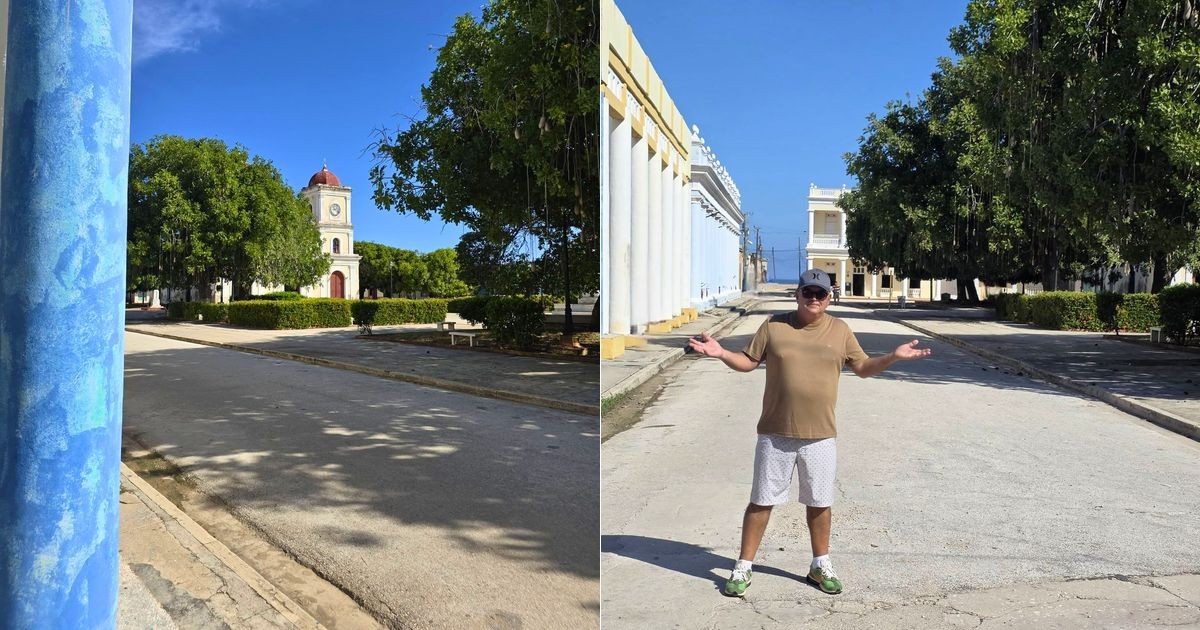
A family that decided to take a stroll through Gibara, the so-called "White Villa" of the Holguín province, came across something unexpected: completely empty streets, closed shops, and a silence that quickly became a topic of conversation on social media.
Jorge Zayas Hernández posted on Facebook several photographs from the outing along with a caption that expressed the bewilderment of the moment: “We decided to take a stroll through the White Town with the kids, and the surprise was like this... Ehhh, where are the people of Gibara? Everything, absolutely everything is closed, not even Yakelin opened her salon.”
The images that accompanied the post showed deserted colonial streets, dilapidated facades, utility poles with tangled electric wiring, and just a stray dog crossing the pavement, with the blue sea in the background as the backdrop of a city frozen in time.
The scene did not surprise those who are familiar with Gibara. Dozens of internet users responded with comments that ranged from humor to deep sadness. Some joked that the residents of Gibara would be “fishing in the water” or “sleeping, taking advantage of the electricity,” while others described the situation in words that left no room for irony.
"The last time I visited Gibara, it felt like a ghost town from a horror movie [...] not a soul on the streets or at the beach," wrote one user. Another recalled a recent visit with her husband: "Nothing reminded me of the COVID period." A third comment was even more direct about the causes of the decline: "My friends from Gibara have died, and others have emigrated to the U.S."
The phenomenon is neither new nor exclusive to this municipality. A documented review in July 2026 already displayed empty beaches and closed businesses in Gibara even during the height of the summer season. That same month, a resident reported in an open letter power outages exceeding 20 hours daily and episodes of up to 56 consecutive hours without electricity, in addition to more than twenty days without running water.
In September 2025, dozens of residents came out to protest after more than 24 hours without electricity, with at least seven documented arrests.
The depopulation of Gibara is part of a national demographic crisis of historic proportions. Cuba went from more than 11 million inhabitants in 2022 to 9.4 million by the end of 2025, a decrease of over 1.6 million people in just three years. The external migration balance in 2025 was −245,264 people, and most of those leaving are under 40 years old, resulting in aging communities with no generational replacement.
Similar scenes have repeated in other locations: Limonar, in Matanzas; Bejucal, in Mayabeque; and Isabela de Sagua, in Villa Clara, among others. The sight of empty streets in broad daylight has become a recurring image of Cuba in 2026.
Gibara, whose Historical Urban Center was declared a National Monument in January 2004 and hosts the International Festival of Poor Cinema, witnesses an increasing contrast between its colonial heritage and the daily desolation.
"A sad reality, Cuba is completely empty," summarized an internet user. Another closed their comment with an unanswered question: "What will be left?"
Related videos:
Filed under: