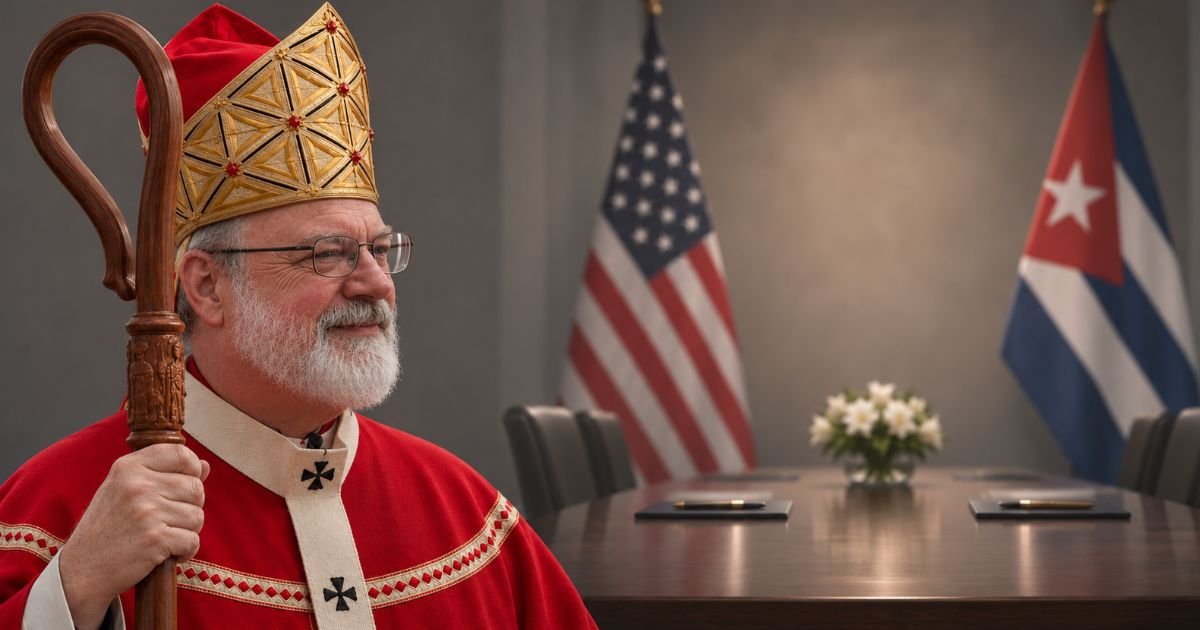
The American cardinal Seán Patrick O’Malley revealed that during his recent visit to Cuba, he warned the regime that it will be difficult to initiate a dialogue with Washington if it does not release political prisoners and take significant steps to favor rapprochement between the two countries.
In an interview granted on November 17 to EWTN News, published this Wednesday, the emeritus archbishop of Boston explained the obstacles to the normalization of relations and expressed his concern about the consequences of the crisis on the Cuban population.
O'Malley assured that the authorities of the island conveyed their willingness to engage in dialogue, but he warned them that if they do not release the political prisoners and make "very strong gestures," it will be very difficult to initiate those conversations.
The religious leader lamented that, as long as no progress is made, it is the Cuban people who continue to suffer the consequences.
His statements reveal an aspect that the Cuban authorities omitted in the official information about the meeting that Miguel Díaz-Canel held with the delegation of U.S. bishops on November 14, at the Palace of Conventions in Havana.
On that occasion, the Cuban leader expressed gratitude for the role of the Catholic Church in the distribution of humanitarian aid, without mentioning the situation of political prisoners.
The cardinal warns about the deterioration of Cuba
The religious figure, who has been traveling to the island for more than four decades, acknowledged that he had never found the country in such an unfavorable situation.
"I have been traveling for 42 years [...] and I have never seen it worse than it is today," he stated.
O'Malley described hospitals unable to operate, fuel shortages, garbage piling up in the streets, mosquito-borne diseases, and communities still suffering the consequences of Hurricane Melissa.
Among the causes of the crisis, he pointed out the deficiencies of the Cuban state economic system and the impact of U.S. sanctions.
He also questioned the effectiveness of these recent actions to bring about political change on the island.
Considers the humanitarian aid from the United States insufficient
The cardinal explained that the main objective of his trip was to address the distribution of humanitarian assistance and considered the $100 million package announced by Washington in May insufficient, given the magnitude of the population's needs.
During his stay in Havana, O'Malley also met with the head of the U.S. diplomatic mission in Cuba, Mike Hammer, to discuss the coordination of aid shipments from the Donald Trump administration.
From the package announced by Washington, 60 million dollars are allocated to a program managed by Catholic Relief Services and Cáritas Cuba, aimed at assisting nearly 200,000 households without the involvement of the Cuban regime or the military conglomerate GAESA.
O'Malley advocated for increasing assistance and supporting essential institutions for the population, especially hospitals.
Political prisoners, an obstacle to dialogue
According to the cardinal, Cuban authorities are concerned about the possibility of a U.S. military intervention, while Secretary of State Marco Rubio and other officials in Washington are adopting a very cautious stance regarding a potential dialogue.
O'Malley's request coincides with that made by Democratic Congress members Gregory Meeks and Joaquín Castro, who on November 18 sent a letter to Díaz-Canel demanding the release of more than 200 political prisoners.
Both lawmakers, advocates of diplomatic rapprochement with Havana, acknowledged that the releases would strengthen the position of those in the U.S. Congress who support a more constructive relationship with Cuba.
Related videos:
Filed under: