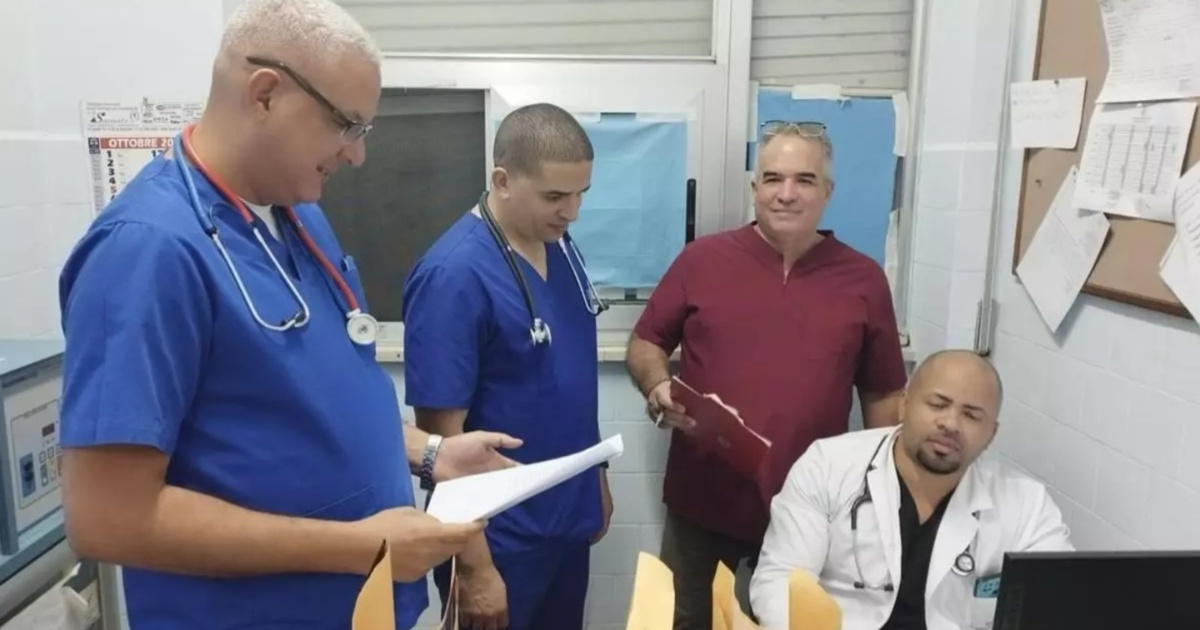
A local Italian media outlet unintentionally captured this week the grueling pace at which Cuban doctors are working in Calabria: on Thursday, after completing a session of the official Italian PLIDA exam that lasted over 12 hours without interruption, many of them went straight to the hospitals to cover the night shift.
The episode took place at the "P. Galluppi" Lyceum in Tropea, home to the local committee of the Società Dante Alighieri, where the language certification session was held with a significant presence of members from the Cuban medical brigade operating in the region.
The newspaper Informa Calabria narrated it as a story of dedication and vocation. Titti Rando, president of the Tropea committee of Dante Alighieri, stated: "Seeing these Cuban doctors face the challenges with such seriousness deeply moves us. They are individuals who have left their homeland to care for ours. And knowing that many of them, after such a demanding exam, went straight back to the hospital to work all night evokes an immense feeling of gratitude."
What the Italian press celebrates as an admirable gesture actually describes a workday that far exceeds any reasonable limit: more than twelve hours of academic testing followed by a night shift, without a break in between.
This episode is part of a program that the Cuban regime manages through the Cuban Medical Services Marketing Agency (CSMC), a state-owned company that negotiates and collects fees for missions abroad.
According to research by the Cuban Observatory of Human Rights (OCDH), the agreement sets a gross monthly salary of 4,700 euros per professional, of which approximately 3,500 euros—nearly three-quarters—are transferred to the CSMC, and about 1,200 euros go to the doctor.
In February of this year, Mike Hammer, the Chargé d'Affaires of the United States in Havana, traveled to Calabria to pressure Governor Roberto Occhiuto to end the program, citing forced labor and human trafficking. Occhiuto refused, arguing that Cuban doctors are essential to keeping hospitals and emergency services open in one of the poorest regions of Italy.
The European Parliament approved a resolution in June that explicitly mentions Cuban medical brigades as a potential form of human trafficking, and the OCDH requested the European Union to investigate the program in September.
The PLIDA exam taken by these doctors also has a dimension that the Italian article does not mention: the certification in Italian is a necessary step to validate qualifications and practice independently in Italy, outside the oversight of the mission.
In 2026, 63 Cuban doctors who had participated in the program requested to join the Calabrian healthcare system individually, which would allow them to receive payment directly without the intermediaries of the CSMC.
The contrast with the situation in Cuba is striking. On Saturday, the Saturnino Lora Hospital in Santiago de Cuba issued a call to fill 401 vacant positions across 27 job categories —with salaries ranging from 3,885 to 6,435 Cuban pesos per month— because, according to the institution itself, "everyone has left."
That same day, a resident physician from the Arnaldo Milián Castro Hospital in Santa Clara reported consecutive shifts of over 30 hours, months without pay, and the prohibition of diagnosing hepatitis, leptospirosis, and dengue.
While Calabria praises the dedication of Cuban doctors, the island's hospitals are emptying of specialists that the regime exports to earn foreign currency.
Related videos:
Filed under: