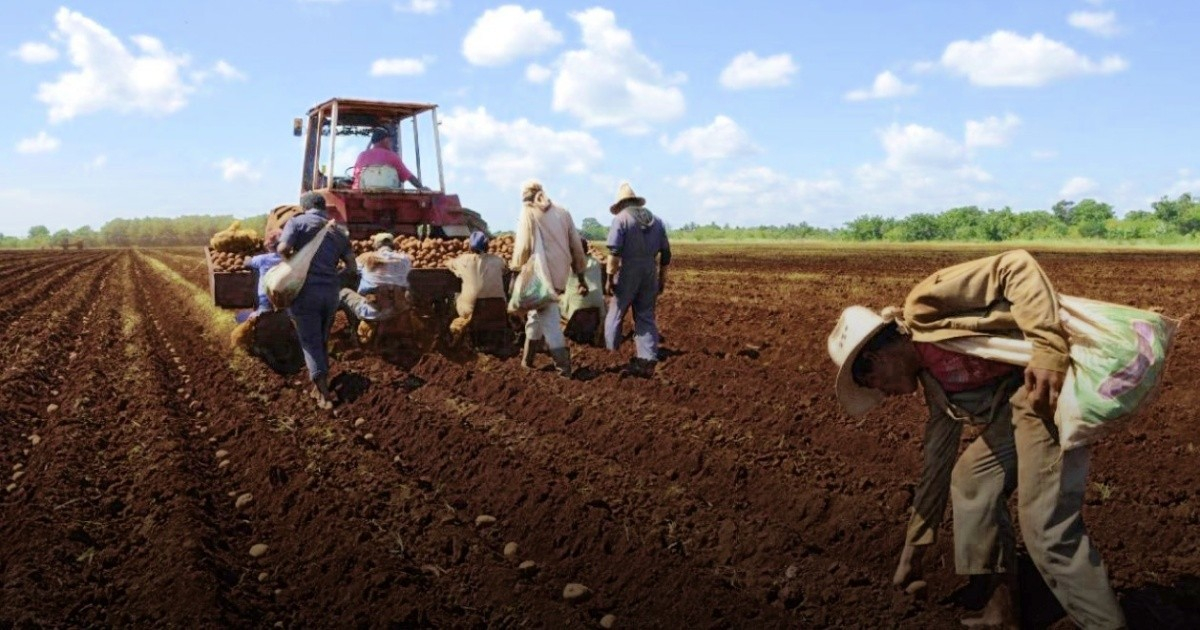
Amid the serious food production crisis in Cuba, specialists from the Center for Environmental Engineering and Biodiversity of Ciego de Ávila (CIBA-CA) have developed a biofertilizer made from natural microorganisms that, according to its creators, improves soil quality, accelerates plant growth, and increases crop yields, as reported by the state agency Prensa Latina.
The product, named ME Biohumedal-01, is a culture of naturally occurring efficient microorganisms. The specialist from the Environmental Testing Laboratory of CIBA-CA, Lázaro Rodríguez, explained that it is “composed of a compatible blend of photosynthetic and lactic bacteria, yeasts, and fermentation fungi.”
The biofertilizer is available in two forms: liquid, ready to dilute, or solid, inoculated in dry materials such as husks or worm humus.
Among the benefits attributed to it by its developers are the improvement of soil structure, reduction of compaction, solubilization of nutrients, and the suppression of pathogenic microorganisms through natural competition.
Furthermore, according to Rodríguez, it accelerates germination, increases the vigor of stems and roots, and promotes optimal flowering and fruiting.
The specialist also highlighted an environmental effect: "The use of efficient microorganisms has a significant impact on the environment, as it eliminates unpleasant odors associated with gases such as methane and hydrogen sulfide."
The product has already been tested in plots of private producers in Ciego de Ávila, although neither Prensa Latina nor the Cuban News Agency provided quantitative figures on yield increases, evaluated crops, or detailed experimental results.
The director of CIBA-CA, Yamilé Jiménez, framed the development as "part of the collective's commitment to sustainable development in the agricultural sector and the desire to maintain the traditional research lines that support food production."
The announcement comes at the worst moment for Cuban agriculture in decades. Agricultural production fell by 53% in 2024 compared to 2020, according to data from the National Office of Statistics and Information. Rice production dropped from 304,000 tons in 2018 to just 79,000 in 2025; citrus production fell by 82.7% and beans by 60.2% between 2020 and 2024.
One of the structural factors behind this collapse is precisely the shortage of fertilizers: Cuba does not produce them, and imports were "practically nonexistent" during the six years leading up to August 2025 due to a lack of foreign currency. The country imports between 70% and 80% of the food it consumes, at an estimated cost of 2 billion dollars annually.
The ME Biohumedal-01 is not the first bioproduct that the regime presents as an alternative to chemical inputs. Cuba already had more than 30 national fertilizers and biological pesticides by August 2025, and in July of that same year, the government promoted Russian nanosilicon as a solution for agriculture without any verifiable results being known.
The announcement of ME Biohumedal-01 also lacks information on industrial production capacity, costs, pricing for farmers, or real possibilities for national application, which reproduces the usual pattern of official Cuban communication regarding the agricultural crisis: scientific solutions without quantitative data or a roadmap for their mass implementation.
33.9% of Cuban households had at least one member who went to bed hungry in the 30 days prior to October 2026, and 25% of Cubans went to bed without dinner, according to data cited that month. In light of this situation, Díaz-Canel warned that "if there are no foods, there is no social stability," and days later summarized the regime's agricultural policy with a slogan: "we will eat what we are capable of producing."
Related videos:
Filed under: