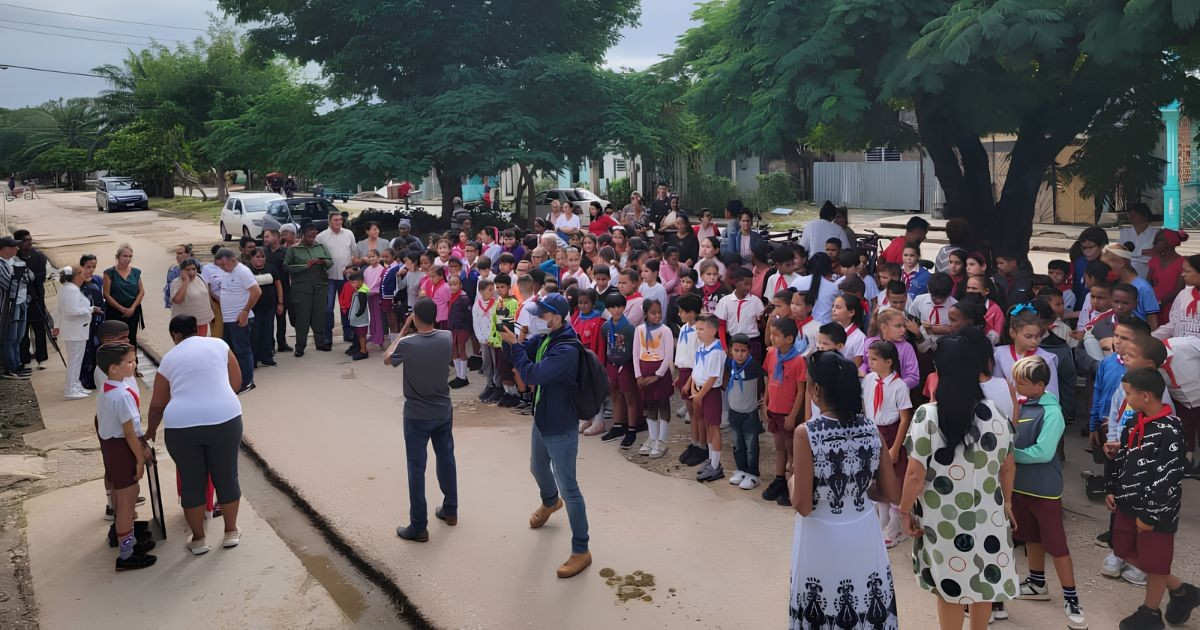
The Municipal Education Directorate of Ciego de Ávila announced this Saturday the opening of the first Urgent or Temporary Care Institution in that province, aimed at providing immediate attention and provisional protection to girls, boys, and adolescents in situations of emergency, severe risk, or abandonment.
The event was attended by political and governmental authorities from the Avilan territory, as well as representatives from the Attorney General's Office of the Republic of Cuba, as reported by the educational leadership on their social media.
The new center is based on the progressive implementation of the —Law 178, approved on July 18, 2025, and published in the Official Gazette on January 28, 2026— which replaces the legislation from 1978 and establishes a new framework for the protection of individuals under 18 years of age.
The regulates the operation of these institutions: each can accommodate up to a maximum of 12 minors, with a stay not exceeding 30 calendar days, while each case is evaluated and a final family or institutional placement is determined.
The regulations also require that centers have permanent specialists in social work, psychology, health, and education, which poses a significant challenge in a country with a social services system in clear crisis.
Ciego de Ávila is thus joining a gradual opening process that has already reached other provinces. The first center in Havana opened its doors on July 26, 2026, in the Diez de Octubre municipality. According to official figures, the institution had served 17 children by mid-September, a number that has risen to 26 in November.
The one in Pinar del Río, inaugurated on July 25, 2026, and presented at that time as the third in Cuba, was adapted from an old school with a capacity for 18 children; in August, it was attending to nine kids aged between four and 13 years old. Sancti Spíritus was preparing to open its first center since September 2026.
Regarding the experience in Pinar del Río, the center's director, Yuderkis Pérez Díaz, described the institution's mission as follows in statements collected by the Cuban News Agency: "In this, the first center of its kind in Vueltabajo and the third in Cuba, we provide immediate care and temporary protection to children or adolescents in emergency or at-risk situations [...] while legal proceedings determine the final measure for their care."
The opening of these centers takes place in a context of acute child vulnerability. According to the World Food Programme (WFP) of the United Nations, 48.5% of Cuban schoolchildren aged six to eleven do not receive any meals or snacks at their educational institutions, due to budgetary constraints and the concentration of school feeding programs in boarding and semi-boarding schools.
More than 95% of the population has inadequate access to food, according to the Food Monitor Program. In Ciego de Ávila, the case of the five-year-old boy with cerebral palsy and severe malnutrition seeking assistance came to light. This and other stories illustrate the extent of the helplessness faced by families in the province and in other regions.
Nationally, two mothers with minor children were sleeping in doorways in Havana at the end of this month without any housing assistance from the authorities. Additionally, in recent days, a Cuban girl moved people by talking about hunger in her classroom: "In my classroom, children are absent because there is no food to give them. We are in a difficult situation here in Cuba."
Related videos:
Filed under: