While Cubans endure blackouts lasting up to 18 or 19 hours a day, or more, the regime now suggests that the electrical outages should not disappear, but rather become more “manageable.”
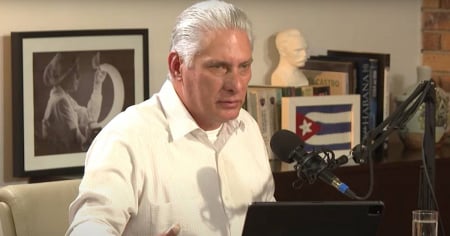
This was expressed by the general director of the Electric Union (UNE), Alfredo López Valdés, during an edition of the podcast “From The Presidency”, where the leader Miguel Díaz-Canel discussed the energy crisis alongside the Minister of Energy and Mines, Vicente de la O Levy.
López admitted that eliminating blackouts is not possible: "What we would like is for there to be no blackout. That is not going to be possible. But we can make the blackout manageable," he said bluntly, putting aside the old promises to eliminate outages in the summer, with which they fooled the people during the summer months.
His proposal is to enhance the rotations so that citizen discomfort is "better organized," although he acknowledged that when the deficit reaches 90% of the circuits, the system collapses and becomes uncontrollable.
To justify this "organization," the official explained that the UNE has a supposed technical monitoring system that analyzes the daily performance of electricity distribution "day by day, province by province," a kind of juggling act with misery and scarcity.
It displayed a monitoring table operated by an internal technical management team, led by a former head of the office, which evaluates and issues recommendations every day; however, this apparent control does not translate into real improvements for the population; on the contrary, the greater the "rigorous control," the worse the crisis becomes.
One of the examples presented was that of Holguín. There, as explained, several important hospitals are connected to two electrical circuits that alternate to distribute electricity between the facilities and the nearby residences.
This creates the perception among citizens that some have electricity for longer periods than others, fueling discontent, even though López was quick to assert that similar situations occur in many cities, while avoiding mentioning others by name.
Díaz-Canel, for his part, tried to justify the general discontent by claiming that "the people who understand what is happening" only want to know when they will have electricity; in other words, according to the ruler, people are not protesting due to the lack of power, but rather for the absence of information.
"What I need to know is when I am going to be paid, how long it will take to get paid, and when I will have energy," he stated as a recurring complaint he has heard during his visits to provinces and municipalities.
He also acknowledged that there are provinces with "more complex situations," specifically mentioning Pinar del Río, Cienfuegos, and Matanzas, where blackouts exceed 20 hours daily.
In these areas, he stated, the management of electrical circuits is even more disorganized, and many communities endure long periods without power, lacking clear planning. According to Díaz-Canel, the issue of the energy crisis does not lie in the collapse of the system, but rather in poor planning.
The most revealing moment came when López Valdés admitted that, in the face of blackouts lasting 18 or 19 hours, the possibility of management disappears completely: “When there is a blackout of 18 or 19 hours, it is very difficult to manage. Not to say that it is unmanageable.”
The confession makes it clear that the UNE lacks the real capacity to even ensure a rational distribution of the impacts.
The official message, in summary, is not that the crisis will end. It is that it will be managed in a way that causes "less inconvenience," although reality shows that even that is not guaranteed.
In May 2024, the Minister of Energy and Mines, Vicente de la O Levy, had already acknowledged publicly that blackouts in Cuba were "bearable", downplaying the seriousness of the energy crisis and preparing the country for a situation that had no short-term solution.
At that stage, the Cuban authorities stated that power outages would be unavoidable during the summer due to the deterioration of infrastructure and fuel shortages, although they promised that efforts would be made to minimize their duration.
Recently, and a year later, the regime confirmed that blackouts would continue during the months of July and August. According to the general director of Electricity, Lázaro Guerra, the energy deficit would exceed 1,500 MW, a figure well above the available generation capacity, making it impossible to ensure a stable supply.
The fundamental causes mentioned were the shutdown of thermoelectric plants, the increase in demand, and the dependence on imported diesel. Despite promises of improvements with renewable energy and technical maintenance, officials admitted that they could only hope for a partial reduction of the impacts.
Frequently Asked Questions About Power Outages in Cuba and the Management of the Energy Crisis
Why can't the Electric Union of Cuba eliminate power outages?
The Electric Union of Cuba has acknowledged that it is not possible to eliminate blackouts due to a deficit in electricity generation, caused by breakdowns in key generating plants and a lack of fuel. According to Alfredo López Valdés, director of the UNE, efforts are being made to make the blackouts "manageable," but the reality is that the situation remains critical.
How does the energy crisis affect the Cuban population?
The energy crisis in Cuba severely impacts the daily lives of the population, with prolonged blackouts that can last up to 19 hours or more. Cubans face difficulties in carrying out everyday tasks such as cooking and preserving food, and they suffer a direct impact on their quality of life. Furthermore, social discontent has increased, reflected in criticisms and protests on social media.
What are the causes of the electricity generation deficit in Cuba?
The electricity generation deficit in Cuba is due to a combination of factors, including breakdowns in generating units, a lack of fuel, and outdated infrastructure. The situation is exacerbated by the constant outages at major thermoelectric plants, such as Felton and Guiteras.
What measures has the Cuban government proposed to address power outages?
The Cuban government, through the Electric Union, has proposed to refine the scheduling of power outages to make them "manageable." A technical monitoring system is mentioned that supposedly analyzes the daily behavior of the electrical dispatch, although this has not improved the situation in practice. The lack of clear planning and unfulfilled promises have generated even more discontent among the population.
Filed under: