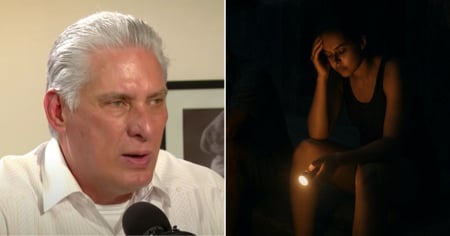
The leader Miguel Díaz-Canel once again avoided self-criticism regarding the energy crisis affecting Cuba, justifying the blackouts with an increase in electricity consumption and stating that the government's strategies have been "correct," even though their effects are not visible due to external causes.
During a new episode of his podcast Desde La Presidencia, the president defended the state investment in photovoltaic panels and the recovery of distributed generation, two strategies that, he stated, have yielded concrete results, although without visible impact for the citizens due to the lack of fuel.
Díaz-Canel emphasized that the investment plan in solar panels has been successful, noting that photovoltaic generation has increased from 107 to 1,437 megawatt hours since March, and that it is expected to exceed 2,500 megawatt hours daily by July.
However, he admitted that this progress has not translated into a tangible improvement for the population because this energy has been allocated to cover deficits caused by a lack of fuels.
“The strategy is indeed the right one, and we will continue with it,” he stated, adding that the output from the solar parks has been “compensating” for what could not be produced through other means.
He also defended the recovery of distributed generation, stating that more than 1,000 megawatts have been rehabilitated, although only 300 have been utilized due, once again, to the scarcity of fuels.
“If we had 700 megawatts incorporated, the deficit would decrease significantly,” he stated, suggesting that the infrastructure is ready, but the supply is not.
The Cuban leader also denied the failure in the maintenance of the thermoelectric plants. He stated that there are currently “two fewer plants out of service” than a few months ago, and anticipated that by the summer several units could be brought back online, such as plants 2 and 3 in Santa Cruz, unit 4 in Cienfuegos, and unit 5 in Renté. Only Felton and Felton 2 would remain offline, he said, without providing a precise timeline or explaining why this situation could not have been anticipated.
However, the reality faced by citizens contrasts sharply with the optimism of the official discourse. Power outages lasting over 10 hours continue to affect multiple provinces, worsening living conditions amidst a sweltering summer, food shortages, and issues with basic services such as drinking water.
Blame on consumption and a call for citizen responsibility
Instead of addressing management failures, Díaz-Canel focused part of his message on blaming the high levels of electricity consumption. According to him, the country reached a peak demand of 3,000 megawatts at noon, a figure he described as “skyrocketing” and “unusual” in Cuba.
"We need to work on reducing the high levels of demand that exist both during the day and at night,” he said, referring to the excessive electricity consumption by the population. He acknowledged the effects of heat and drought but emphasized the need for “awareness” regarding consumption.
Such statements generate discontent among citizens, as the weakest link is held responsible for a crisis that largely stems from structural problems within the Cuban energy system and from inefficient and centralized state management.
The president's words come amid a climate where the people continue to show their frustration with the situation, as was the case in the Santa Rita Popular Council in Jiguaní, Granma province, which was the scene of a vigorous citizen protest this Wednesday.
Videos shared by activist Idelisa Diasniurka Salcedo Verdecia showed residents protesting in the streets against power outages, water shortages, and the hardships of daily life. “They took away the internet, but they're on the streets!” Salcedo wrote, referring to the regime's attempts to silence the demonstrations.
The official response to the protests has been criminalization. Instead of listening to the population, Díaz-Canel himself has labeled the protesters as “antisocials” and “criminals”, comparing the current discontent to the Maleconazo of 1994 and denounced “external manipulation” behind the mobilizations. His speech, far from calming the atmosphere, has highlighted a growing disconnection between political power and society.
However, the protests in Santa Rita are not an isolated incident. This week, demonstrations have been reported in universities in Guantánamo and Cienfuegos, as well as in Santiago de Cuba and Bayamo. Students, workers, and entire communities have taken to the streets to protest the lack of electricity, food, and basic resources, in a demonstration of collective frustration at the collapse of the national electric power system.
In Santa Rita, local officials attempted to appease the population by claiming that there are water trucks available, but they cannot be used due to a lack of fuel. This explanation only served to confirm the level of paralysis and disorganization affecting all levels of the state.
Filed under: