
Related videos:
When discussing Cuban athletics, prominent figures hold high positions, but journalists, photographers, commentators, and cameramen have also been part of that great family. Among this family, there are indispensable individuals whose hard work in recording statistics can be vital for making any analysis.
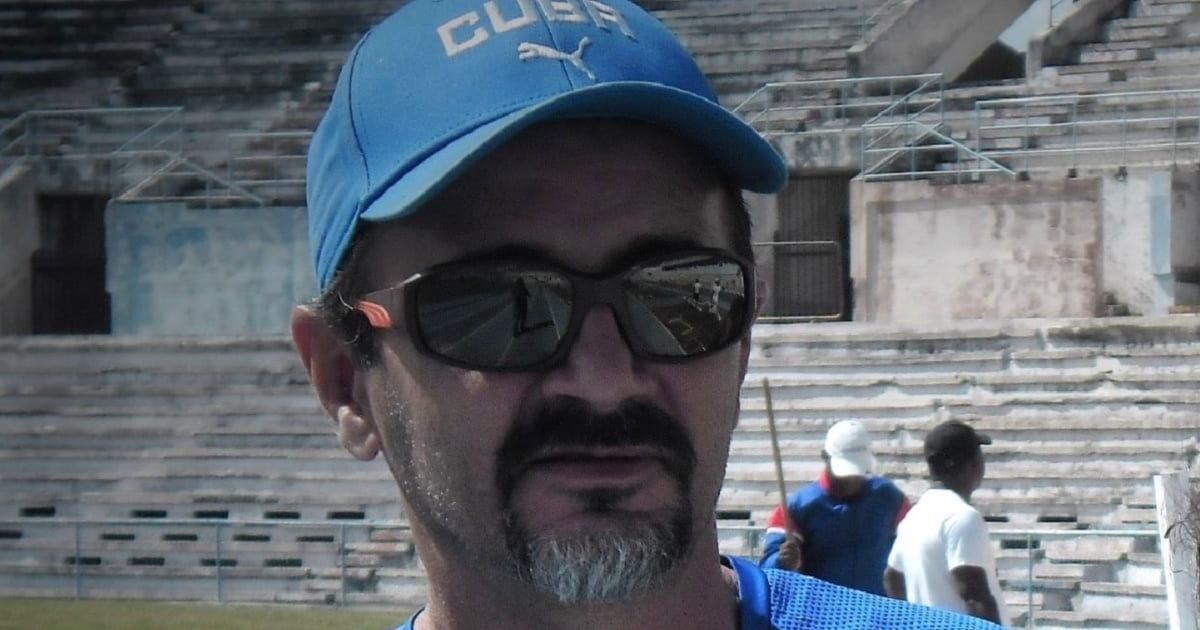
Figures like the great Basilio, currently Alfredito Sánchez, and also our interviewee today, Eddy Luis Nápoles, who knows a great deal about statistics and is always willing to help those in need in such an important area of track and field.
Where is Eddy Luis now, what is he doing, and why did he leave the Estadio Panamericano, where everyone needed him so much?
I currently reside in Ciego de Ávila, working as a researcher and statistician, primarily focusing on time and mark sports; of course, athletics is an essential part of this work.
I live with my wife Iliana Villavicencio, with whom I have been for 10 years. She is very special; she is my partner in everything.
In early 2016, while working at the National Athletics Commission, I went to Peru, and upon my return the following year, there was a new board in athletics that no longer required my services. As a principle, I do not go where I am not invited.
At that moment, I received an invitation from Dr. René Romero, who was then the director of the Cuban Sports Research Center, to work there, but accommodation limitations and other factors led me to decline that offer, for which I am very grateful to Romero.
Before we delve into your beginnings in sports, what are your thoughts on the current situation of athletics in Cuba? Suspension of events in the provinces and internationally, broken trains that don't transport athletes, no proper conditions in provincial stadiums, adverse conditions in the national stadium despite efforts, poor nutrition, deterioration of the dormitories..
What do you want me to say, Julita? Cuban athletics today, as everyone knows, is not in good shape. It is part of Cuban sports that has experienced its best moments and is a true reflection of the reality faced by contemporary Cuban society, with significant limitations in terms of both material resources and knowledge and vision from the governing bodies. Coupled with the lack of resources, this makes the situation even more chaotic.
In Cuba, there are currently two athletic facilities that could, albeit with limitations, host athletic competitions: the Pan American Stadium in Havana and the "Rafael Fortún" track in Camagüey.
But it's not enough just to have the facilities. It requires moving many people, whether to the capital or to Camagüey, and that's where the challenge lies. Remember that athletics consists of 47 events, and on top of that, you need to consider the judges, coaches, and officials… We need to be realistic: under the current conditions in the country, it is impossible to hold an athletics competition with all the necessary components, and that objective perspective is something that those responsible for creating the national competition calendar lack.
This year, the "Fortún" (speed), "Janet" (throwing), and "Brunet" (distance) events were canceled. The 13-14 category of the School Games also had to be eliminated.
Therefore, we need to be proactive when making the announcements and scheduling. For example, the 13-14 age category should conclude at the zonal level, and the School Games, which should be the main competition, must also have a zonal elimination round with only the top eight competitors in each event. We would like everyone to participate, but it's impossible, so we need to simplify.
I want to express that Cuban athletics needs to get on board with modernity. For several years now, athletics around the world has turned into a business, and Cuba has fallen behind, and will continue to do so if the officials do not change their mindset.
It is necessary to engage in marketing, promoting the image of the top athletes. Do you think the Spanish Ana Peleteiro is better than Leyanis Pérez? No! The Cuban is better by a long shot, but Peleteiro is much better at selling her image and has millions of followers on social media, which counts when it comes to contracts, competitions, and sponsorships.
On the other hand, the Technical Commission of Cuban athletics needs to master the work tools provided by World Athletics; to understand the classification systems for major events, to be proficient in the competition formats, the levels of these events, and the scoring they provide.
It's not the same to jump 6.85 in a level F competition as it is in the National Championship (C). They need to know how to utilize the Road to... to better manage the limited budget available and to be as objective and fair as possible in decision-making regarding who will participate in this or that competition. That information is available on the World Athletics website (formerly IAAF); you just need to know how to make the most of it.
Regarding this situation you've described that leads to the exodus of Cuban talents, what does it mean for you to see young people who have grown up alongside you go on to achieve success under other flags?
It's like the saying goes: "Working for the English," but I take pride in the fact that, for me, they remain Cuban and as such, I celebrate their achievements and victories. I want to share that I communicate with most of the Cuban athletes who are now outside of Cuba, whether under different flags or, as they are called, independents.
There are Reynier Mena, Roger Iribarne, Jenns Fernández, Arnaldo Romero, Yulenmi Aguilar, Jordan Díaz, Andy Díaz, Lester Lescay. Seeing them leave is a defeat for the country and for our sport, but they cannot be bound to convictions without arguments, and if in Cuba they do not have the minimum conditions for their complete fulfillment, they have no choice but to head towards new horizons.
Thus, the achievements keep coming: Pichardo is the Olympic champion (Tokyo) and world titleholder, Jordan Díaz is the Olympic champion (Paris), Andy Díaz is the world champion, Mena ran 19.63 and has won the Diamond League; these are just a few among others. I am proud of all of them and I applaud them as such!
What did it mean to see three triple jumpers from the Cuban school winning medals for three other countries in Paris 2024?
I felt immense pride. It is the greatest achievement, even if under different flags, of athletes born in Cuba. Never before, in any global event, had three athletes born in Cuba occupied the Olympic podium. It is a victory for the Cuban Triple Jump School. By the way, I have a good relationship with Jordan Díaz and Andy Díaz.
You created the incredible group ATLETISMO SIN FRONTERAS, a forum for specialists and lovers of the sport of kings. Has it met your expectations?
The group has exceeded my expectations. It started as a small national group, but one day I thought about expanding it to the rest of the world and it currently has 150 Cuban members, Mexicans, Peruvians, Spaniards, Guatemalans, Americans, Brazilians, Colombians, Venezuelans, Argentinians, Uruguayans, Italians, French, etc.
They are part of the group of coaches, athletes, officials, statisticians, referees, journalists, social media content creators, and those who are knowledgeable about and passionate about both Cuban and international athletics.
It is a group for sharing and disseminating information related to athletics at any level, free of charge. It also debates topics concerning Cuban and international athletics, proposes improvements for the sport on the island, and provides a space for criticism of poor practices.
The group "Atletismo sin Fronteras" has been labeled by some officials as a "terrorist" group, but it is far from that designation. It is most akin to an Advisory Council, though not recognized by those who neither listen nor know how to listen.
It's very difficult to select one star among Cuban athletes, but could you tell me who the five greatest of all time are?
You made it tough for me! Here I go, but with six: Alberto Juantorena, Javier Sotomayor, Iván Pedroso, Dayron Robles, Leonel Suárez, and Anier García among the boys; Osleidys Menéndez, Maria Caridad Colón, Ana Fidelia Quirot, Yipsi Moreno, Maritza Martén, and Yumileidi Cumbá for the girls.
And on an international level, who would you choose?
Usain Bolt, Carl Lewis, Sergey Bubka, Edwin Moses, Daley Thompson, and Armand Duplantis; as well as Shelly-Ann Fraser-Pryce, Marita Koch, Sydney McLaughlin, Yelena Isinbayeva, and Jackie Joyner-Kersee.
You were in the stadium during two periods. Do you have any anecdotes from those times? Did you have any particular star friends?
That's right, I had the opportunity to work with great professionals of Cuban athletics between 2001 and 2007, such as Jesús Molina, Abelardo Cuco Pacheco, Ariel Muñiz, Santiago Antúnez, Vicente Zúñiga, and the charismatic Eduardo Pérez Caballero, known as Guayacol.
Then, I did it between the end of 2012 and 2016, also with people who had athletics in their blood, some acquaintances from my previous experience: Molina, José Bordón, Sergio Martínez, Edilberto Acuña, Rafael McBeath, and Jorge Luis Sánchez.
At both times, I was a member of the technical committee; my main role was to statistically record the competitive results of Cuban athletes, both in Cuba and abroad.
At that time, Basilio Fuentes, Roberto Ávila, and later my friend Alfredo Sánchez were also there. I also carried part of the internal documentation of the National Commission, which included national and international calls, projects, and work strategies; I was in charge of the archive and control of the methodological folders for each department of the CNA.
And besides your colleagues, which athletes did you interact with?
I had the opportunity to forge friendships with the leading Cuban athletes of that time: Javier Sotomayor, Iván Pedroso, Yoelbi Quesada, Osleidys Menéndez, Yumileidi Cumbá, Emeterio González and many more... From that first opportunity, I still have great friends, such as Dionisio Quintana, Ricardo Ponce, Gabino Arzola, Roberto Apeaceiro, Mario Antonio Guerra...
I cannot help but mention a friend who, unfortunately, is no longer with us, Humberto Calvario, whom I knew from working together in Camagüey. Alongside Calvario and Raúl Abreu, I started taking my first steps in the east of Havana.
Do you remember any moment that feels significant to you?
Well, yes, you know, I had the opportunity to witness the beginning of Gabino Arzola's career as a high-level coach. Given the lineage of that guajiro from Pinar del Río and in a teasing manner, I used to tell some of his early students: “You are part of the experiments that Gabino is conducting at multiple events, and the results started to show with Gretchen Quintana, Leonel Suárez, Yunior Díaz, Yorgelis Rodríguez, Adriana Rodríguez, all elite multipliers on a world level.”
Years later, he said to him: "Guacho, the experiments yielded results." Gabino Arzola has established himself as a world-class coach.
How did you become who you are today, with such extensive knowledge of athletics and its statistics? Did you ever participate in track and field?
I didn’t have the opportunity to participate in athletics during my school years, although in high school and pre-university I excelled in the 600-meter events. My passion for sports—I remember there was always a lot of sports on in my house—might have begun in 1974, when I was 10 years old, with the celebration of the World Boxing Championship in Cuba. Yes, not athletics… boxing! I didn't miss a single fight.
Then came the 1976 Montreal Olympic Games, and the races of Alberto Juantorena were the icing on the cake. During my university years, I participated in competitions, some at the national level, and that is where my passion for athletics was forged, eventually becoming my favorite sport.
Achieving a record, depending on the level, can be the pinnacle of human performance, and I enjoy that to the fullest. I have had the opportunity to watch several world records set by Cuban athletes on television, including Juantorena's two records, the first in Montreal and the second the following year in Sofia; also the 13.21 by Alejandro Casañas; all of Sotomayor's; the 71.70 by Osleidys in Helsinki...
You left boxing for field and track, any others?
Hahaha. I saved for last how my professional career in athletics began, and if I tell you it was because of the 1990 World Cup in Italy, you won’t believe me. Let me explain.
I graduated in 1990 and was part of the so-called Order 18, meaning I had completed my Military Service, and upon graduating, I had the option to decline the job placement offered by the University, which I did.
But alongside my study partner José Ángel Zayas, we had participated in the contest organized by the newspaper Juventud Rebelde dedicated to the 1990 World Cup, and one day at the end of August, Zayas passed by my house in Florida and said to me, "Let's go to Camagüey to the Provincial Sports Directorate to collect the prizes," and off we went.
Upon arrival, we saw other classmates and asked what they were doing, and the response was: “We are here because we are going to be placed at INDER.” Then, we expressed our interest in joining. In the end, my friend Zayas requested to work as a football coach in Esmeralda and I as an athletics coach in Florida, and we both came away with our work permits, so... Long live Italy '90!
Many years after that World Cup, today Eddy Luis Nápoles is a reference point for the culture of athletics in Cuba, a computer scientist who never turns down a request for help regarding a record, a performance, or a feat that elevates the king of sports in Cuba and around the world.
Filed under: