
Related videos:
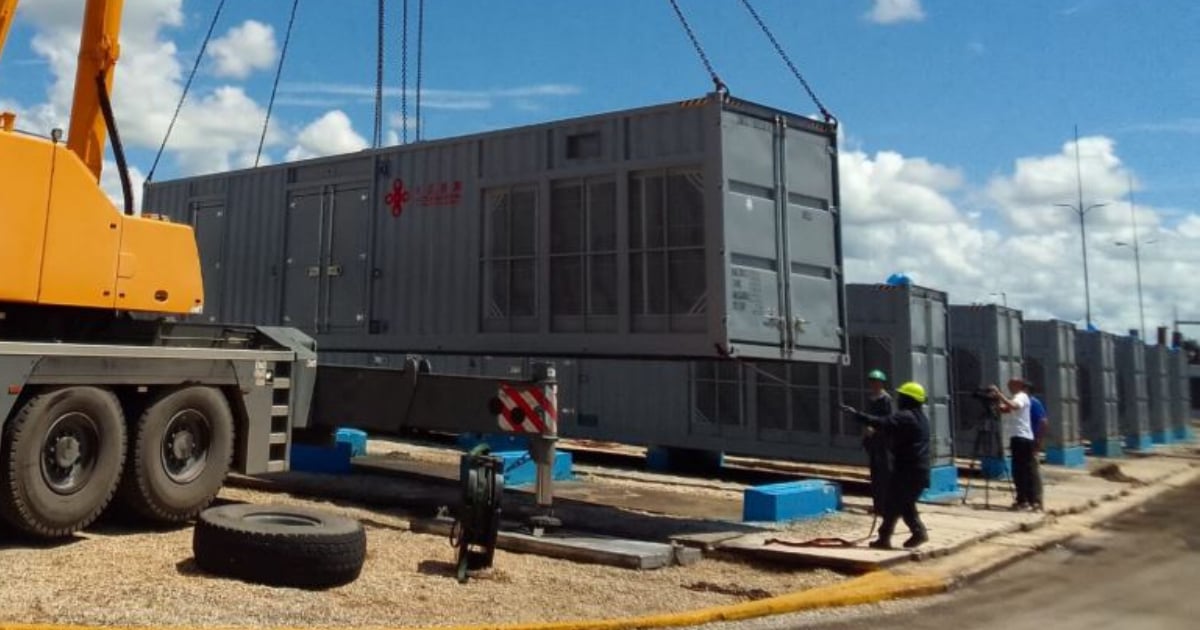
The Cuban government announced with much pomp the arrival in Matanzas of eight generators donated by China, installed at the Guanábana power plant, with a combined capacity of between 25 and 30 megawatts (MW).
The official media presented the delivery as part of a plan for "restoring generation capacity" and emphasized the speed with which the diesel engines, each with a capacity of 1.8 MW, were installed.
However, beyond the official propaganda, the underlying problem persists: Cuba lacks sufficient fuel to sustain the operation of this equipment, and the energy crisis continues to hit citizens hard.
The state-run press itself revealed that the motors will complement photovoltaic solar parks and distributed generation, which allows for the creation of "microsystems" to supply limited areas when the National Electrical System (SEN) collapses.
This has happened at least five times since August 2024, with nationwide blackouts that left the country in the dark for days.
According to Mario Pedroso Caballero, general director of Geysel, the distributed generation during the last drop of the SEN was what enabled the thermoelectric plants to supply power to the system, highlighting the importance of the actions being undertaken.
"The role of distributed generation is to be able to isolate itself at certain times and create microsystems with other types of generation sources, providing service to a significant number of consumers, and during normal times, it synchronizes with the SEN," said the newspaper Girón.
The Chinese donation is part of an increasingly close political relationship between Havana and Beijing.
In recent months, the regime has received components, photovoltaic parks, and other equipment from the Asian giant, with the aim of alleviating an energy crisis that has resulted in power outages of up to 20 hours a day in various provinces.
In Matanzas, one of the most affected areas, electricity outages have exceeded 24 hours, exacerbating water supply issues and increasing the incidence of viral diseases.
Furthermore, the relief that the generators can provide will be limited. They run on diesel, a resource that the country is unable to import in sufficient quantities due to a lack of foreign currency and debts to suppliers.
Previous years' experience shows that even when new equipment is installed, it ultimately ends up turned off due to a lack of fuel or malfunctioning due to the absence of spare parts.
The outlook worsens considering that the Antonio Guiteras thermoelectric plant, the most important in the country and located precisely in Matanzas, will cease operations at the end of this year for a capital maintenance that will last at least six months.
The general director of the UNE, Alfredo López Valdés, acknowledged during the Round Table that the Guiteras is facing a "maintenance deficit" and regulatory issues, which have led to repeated unexpected outages and extreme fragility of the National Electric System (SEN).
Without this plant in operation, national generation will rely on smaller units, many of which are unstable and in poor condition, which suggests even more prolonged and frequent blackouts.
Experts warn that the government's strategy, based on donations, leasing floating power plants, and announcements of future solar parks, does not address the root cause of the collapse: decades of lack of investment, technological obsolescence, and poor management.
Meanwhile, Cubans are preparing for even tougher months ahead.
The shutdown of the Guiteras and the lack of fuel for the new engines forecast a critical scenario where blackouts will continue to impact daily life, with direct consequences for public health, the economy, and social stability.
Frequently Asked Questions about the Energy Crisis in Cuba and the Donation of Generators by China
What impact will the generators donated by China have on the energy crisis in Cuba?
The generators donated by China will have a limited impact on Cuba's energy crisis. While they assist in establishing "micro-systems" in specific areas, the country is grappling with a fuel shortage that complicates their continuous operation. The donation is part of a governmental recovery strategy, but it does not address the structural deficit in electricity generation in the country.
Why is the Antonio Guiteras thermoelectric power plant crucial for Cuba's electrical system?
The Antonio Guiteras thermal power plant is the most important in Cuba, and its operation is vital for the National Electric System (SEN). However, it faces maintenance and regulatory issues that have repeatedly taken it out of service, contributing to the collapse of the SEN and prolonged blackouts across the country. Its upcoming shutdown for major maintenance will further exacerbate the energy situation.
What is the current situation of the National Electric System (SEN) in Cuba?
The National Electric System (SEN) of Cuba is facing a severe crisis with widespread and frequent blackouts. The lack of investment, technological obsolescence, and fuel shortages have led to a structural collapse of the system. Despite recovery efforts, such as the incorporation of renewable energy and equipment donations, the situation remains critical, severely impacting the population and the country's economy.
What role does renewable energy play in Cuba's energy crisis?
Renewable energy, such as solar parks, makes a significant but insufficient contribution to addressing the energy deficit in Cuba. Although new solar parks have been synchronized to the SEN, their capacity does not meet the deficit accumulated due to the collapse of thermoelectric plants and the lack of fossil fuels. Diversifying the energy matrix remains a crucial challenge amid the crisis.
Filed under: