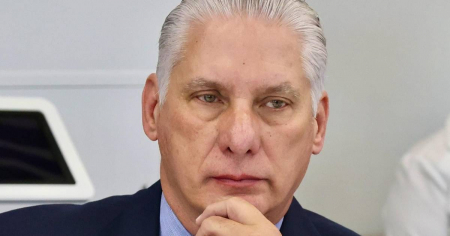
The Cuban leader Miguel Díaz-Canel has once again launched an attack against Cuban farmers during one of his usual visits to "economic targets."
“Whenever we visit positive experiences, we reflect on how to do things better: Why do some break the inertia while others do not, if adversity challenges everyone equally? The reasoning arose again upon witnessing the success of impactful ventures in Mayabeque,” Díaz-Canel said on X, presenting a video summarizing his tour of successful agricultural experiments.
The leader, who frequently visits farms and showcase ventures, once again places the blame for the crisis on the farmers, without addressing the structural causes that hinder their prosperity, due to his government's poor management.
During his visit last Friday to Mayabeque, Díaz-Canel toured the La Asunción farm, which has 500,000 papaya plants; the pig breeding center in San José de las Lajas; and the Los Olivos farm in Jaruco.
"There is a lot of land to cultivate."
It is not the first time that Díaz-Canel admonishes farmers. Last May, in a speech characterized by a didactic tone and the evasion of responsibility, the Cuban leader had already scolded the country's farmers for the low agricultural production, asserting that “there is a lot of land to cultivate”, without acknowledging the role of the State in the inefficiency of the Cuban agricultural system.
During the closing of the National Congress of the National Association of Small Farmers (ANAP), the president reiterated old promises of productive transformation, blaming the farming sector for not making better use of the land under usufruct, despite the multiple restrictions imposed by the government itself, according to a report from Canal Caribe.
"This congress will truly be historic if we manage to change the situation of food production in the country... there is a lot of land to cultivate, there is a lot of land to bring into production," said Díaz-Canel in a speech that overlooked the serious issues of access to supplies, technology, and autonomy facing Cuban producers.
While acknowledging that in earlier stages the country had abundant resources that were wasted "without achieving efficiency," the leader did not take institutional responsibility nor did he propose fundamental reforms to the centralized model that binds the Cuban agricultural sector.
"If we have food on the house..."
Last week, the ruler had already made headlines during one of his tours for resorting to simplism to address the inflation that burdens Cubans.
Far from providing real solutions, he insisted on stock phrases that ignore the impact of his own policies on the current situation.
"If we have food freely available, prices will inevitably drop," he stated during a visit to the Consuelo farm in Alquízar, Artemisa, reducing the structural crisis of the economy to an almost childish formula, as if shortages, lack of supplies, and government controls were not his administration's responsibility.
The president toured just 0.20 hectares of sweet potatoes and 0.60 hectares of bananas grown by producer Wilfredo Vallés Rodríguez, presented as a model to be replicated throughout the country.
The ruler insisted that experiences like Vallés' must be multiplied, as if a couple of plots could reverse the structural food shortages affecting the population.
Frequently Asked Questions about the Agricultural Crisis and Díaz-Canel's Speech in Cuba
Why does Díaz-Canel blame farmers for the low agricultural production in Cuba?
Díaz-Canel blames farmers for not breaking the inertia and not making better use of the land in usufruct, without acknowledging the restrictions imposed by the government and the structural shortcomings of the Cuban agricultural system. The leader avoids taking responsibility for the poor state management and the policies that limit access to supplies, technology, and markets.
What are the limitations faced by Cuban farmers according to the context?
Cuban farmers face serious problems accessing supplies, technology, and autonomy. Additionally, they are subject to bureaucratic obstacles, arbitrary inspections, and a lack of incentives. These limitations are largely caused by government policies that monopolize access to markets and regulate the distribution chain, preventing producers from selling freely and at fair prices.
What reforms does Díaz-Canel propose to address the agricultural crisis in Cuba?
Díaz-Canel has not proposed fundamental reforms to the centralized model that keeps the Cuban countryside bound. Instead, he insists on speeches about the need to "work hard" and appeals to the creativity of farmers, without addressing the true causes of the crisis or offering concrete solutions that would allow for a genuine opening of agricultural trade and effective decentralization.
How does the current agricultural crisis affect the Cuban population?
The agricultural crisis profoundly affects the Cuban population, which faces a chronic shortage of food and high prices that erode salaries. National food production is insufficient, forcing the importation of over 70% of the food consumed. The situation is especially critical for staple products like rice and pork, whose production has dropped dramatically.
Filed under: