
Related videos:
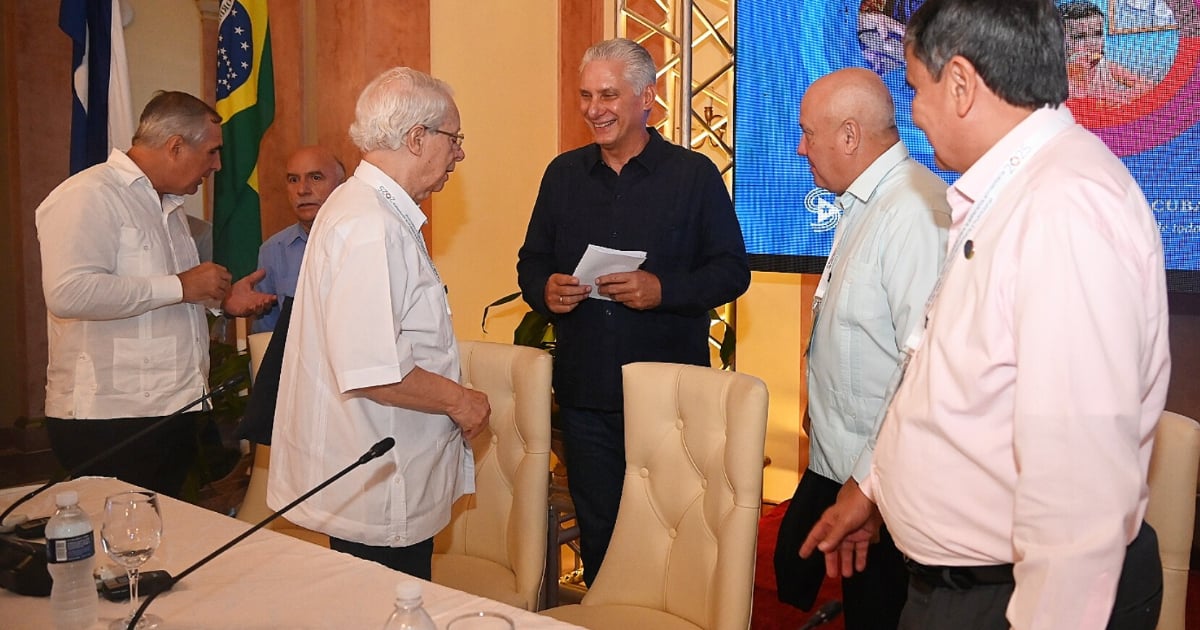
While millions of Cubans are facing one of the most severe food crises in recent decades, with shortages dictating the pace of family kitchens, the ruling Miguel Díaz-Canel took advantage of the setting at the Hotel Nacional to speak once again about the major "global" challenges regarding food and nutritional sovereignty and security.
The event, titled "First High-Level Meeting on Public Policies for Food Sovereignty," featured international guests, an ambitious roadmap, and a rhetoric that bordered on self-satisfaction. However, outside the walls of the conference room, the national reality contradicts every statement made.
"Life has shown how it can be produced in a more friendly manner," stated Díaz-Canel on Wednesday, while in agricultural areas of provinces like Villa Clara or Holguín, farmers are forced to abandon their harvests due to a lack of fuel, fertilizers, or basic machinery.
According to data collected by independent media, more than 70% of the food consumed by the Cuban population must be imported —a paradox for a country that speaks of “food sovereignty” as a revolutionary slogan.
In his speech, the leader of "continuity" also praised the relations between Cuba and Brazil, highlighting the figure of Lula da Silva as “an eternal friend and brother of Cuba.” However, in the neighborhoods of Havana, Santiago, or Camagüey, political brotherhood does not fill the plates.
Instead, queues are growing, testimonies from families who only eat once a day are multiplying, and reports of malnutrition are intensifying, especially among children and the elderly.
The Cuban regime has insisted that it is winning "the battle of agroecology," but it does not explain why essential products such as rice, beans, root vegetables, or meat are conspicuously absent in state markets.
It does not explain why the ration book — that model of "food security" that the regime presents as an example — has ceased to guarantee the minimum essentials for survival.
In the name of cooperation and multilateralism, Díaz-Canel assured that the event was “a lesson for the world”. However, in the real country, the ordinary Cuban has to resort to bartering, remittances, or sacrificing their health in order to feed themselves.
Every day, images of empty plates, sales in freely convertible currency (MLC) that are inaccessible to most, and people rummaging through garbage bins in search of leftovers go viral.
The contrast is stark: while roadmaps are being designed and agreements are being signed, the Cuban agricultural system continues to plummet. Private producers face bureaucratic hurdles, municipal self-sufficiency programs struggle to sustain themselves, and rural exodus leaves fields idle and dairy farms dismantled.
The food sovereignty that is so often invoked seems more like a utopia stagnating in speeches. Cuba is increasingly dependent on humanitarian donations, on imports that it can afford with its dwindling foreign currency reserves, and on family survival strategies. Speaking of "effective public policies" in that context is, at the very least, a mockery.
The disconnection between the government narrative and the island's food reality is not new, but it reaches unusual heights when stated from an air-conditioned room, amidst diplomatic toasts and praises for multilateralism. In deep Cuba, food insecurity is not debated: it is suffered.
"Thank you very much for being with us," Díaz-Canel concluded. However, beyond the protocol, many Cubans would appreciate fewer speeches and more food.
Filed under: