
Related videos:
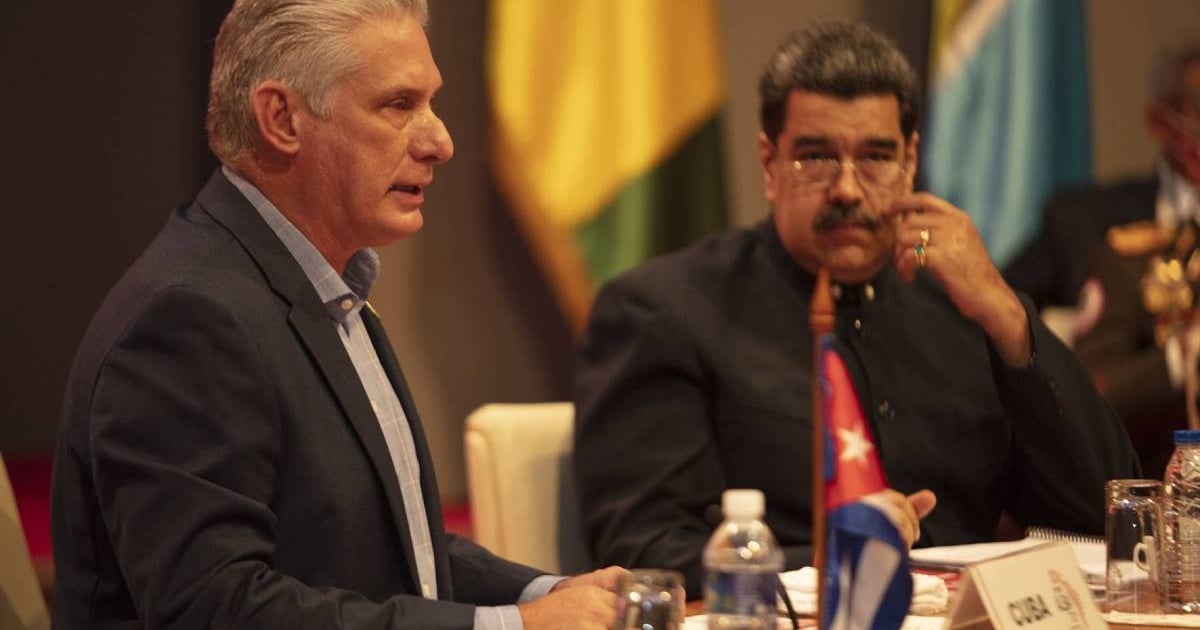
The Cuban leader Miguel Díaz-Canel Bermúdez expressed his support for the regime of Nicolás Maduro this Thursday, following the confirmation that the United States authorized the CIA to conduct covert operations within Venezuelan territory.
In a post on his official Facebook account, the Cuban leader evoked phrases from José Martí and Fidel Castro to justify his support for chavismo and his political ally in Caracas.
“In moments when the empire and its misguided leader approve covert CIA operations against Venezuela, we express our solidarity with that brotherly people and, especially, with their President Nicolás Maduro,” wrote Díaz-Canel.
“Today, Cuba remembers more than ever the words of Martí: ‘Let Venezuela know how I can serve her, she has in me a son,’ and of Fidel: ‘For Venezuela, we must give everything’,” Díaz-Canel added in his message.
The reference to "giving it all" is interpreted as a suggestion of military or logistical support from Cuba to Venezuela, a country that has received assistance from Havana in terms of intelligence, advisory services, and military training.
Díaz-Canel concluded his message by stating that "Venezuela and its popular, military, and police fusion will once again overcome the threats and actions of the empire," in a clear reference to the United States.
Rising tensions between Caracas and Washington
The words of the Cuban leader come after the statements by Donald Trump, who confirmed that he authorized the CIA to carry out secret operations against structures linked to drug trafficking within Venezuela.
The order grants the agency the authority to act independently or in coordination with Southern Command in the Caribbean. Trump emphasized that the measure aims to curb the flow of drugs and irregular migrants into the United States.
Maduro responds in "Bolivarian English"
Maduro reacted with a message in his peculiar "Bolivarian English," urging to avoid a war: "Not war, peace".
He accused Washington of promoting a new "regime change attempt," evoking the coups orchestrated by the CIA in Latin America during the 20th century.
"The people of Latin America do not want, do not need, and reject the coups d'état orchestrated by the CIA," declared Maduro, before calling on Americans to mobilize "to prevent a war in the Caribbean."
The growing friction between Caracas and Washington rekindles fears of a new phase of confrontation in Latin America, with Cuba and Venezuela as the centers of resistance against the United States.
In his message on Thursday, Díaz-Canel not only reaffirms the political and military alliance between Havana and Caracas but also directly aligns himself with Maduro's discourse, as both regimes face significant international sanctions and accusations of human rights violations.
Frequently asked questions about Cuba's support for Venezuela and tensions with the U.S.
What does Díaz-Canel's support for Maduro imply?
Díaz-Canel's support for Maduro implies political and potentially military solidarity from Cuba towards Venezuela in response to the covert operations authorized by the U.S. against Venezuela. Díaz-Canel has used phrases from historical Cuban figures to justify this support, suggesting that Cuba is willing to "give it all" for Venezuela, which could be interpreted as military or logistical backing.
What is Cuba's stance on military intervention in Venezuela?
Cuba has expressed total support for Venezuela but has refrained from confirming whether that support would include military intervention. Cuban Foreign Minister Bruno Rodríguez avoided directly answering this question, while Deputy Foreign Minister Carlos Fernández de Cossío has dismissed the possibility of direct military involvement, stating that "Cuba will not go to war with the United States."
What actions has the U.S. taken against Venezuela and Cuba recently?
The U.S. has authorized CIA covert operations in Venezuela and has strengthened its military presence in the Caribbean, justifying these actions as part of the fight against drug trafficking. Additionally, the U.S. has raised the bounty for the capture of Nicolás Maduro, who is accused of drug trafficking and terrorism, and has tightened sanctions against Cuba.
How has Nicolás Maduro responded to the actions of the U.S.?
Maduro has responded with a call for peace and denounced an attempt at regime change by the U.S. Using his characteristic "Bolivarian English," Maduro urged, "No to war, peace," and accused Washington of trying to intervene in Venezuela, recalling past coups promoted by the CIA.
Filed under: