
Related videos:
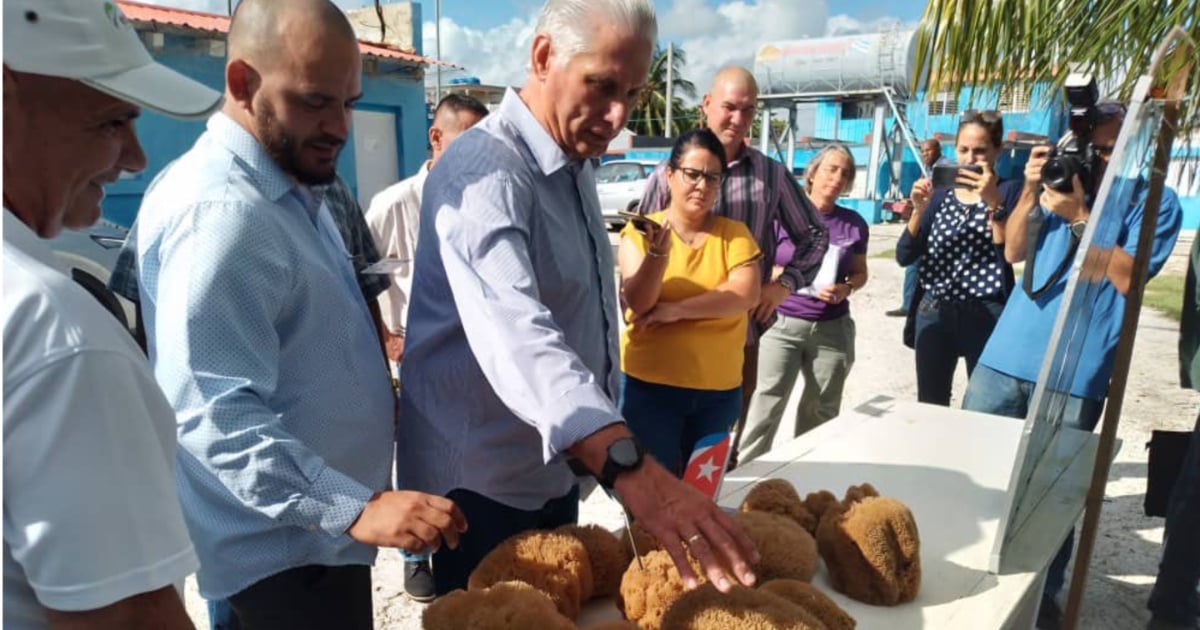
The ruler Miguel Díaz-Canel posed with sea sponges intended for export during a tour of the CAIMAR Base Business Unit in Caibarién, amidst a government visit to Villa Clara.
While Cuba sinks deeper into crisis, the government representative "expressed interest" in the salaries, the entity's profits, and alternatives to improve energy efficiency in the fishing sector's capture levels.
In the journey, the official delegation included a stop at the mipyme REMpeZ, dedicated to food production, with a persistent message that its products should "reach the people."
In CAIMAR, Díaz-Canel —accompanied by Roberto Morales Ojeda and provincial and municipal authorities— requested information about salaries and the company's results, and heard from the managers about "possible alternatives" to enhance energy efficiency in capturing.
During the tour, "excellent quality sponges for export" from the vessel Plástico 317 of UEB CAIMAR were showcased in a scene featuring the president.
In dialogue with Michel Leiva Pérez, captain of the Plástico 19, initiatives from the crew were highlighted, positioning it as "the most productive collective in the country for the capture of scale fish" so far this year.
On that same day, the leader visited the REMpeZ Cooperative Center for SMEs in Commerce and Gastronomy in Caibarién, where he discussed production lines, diversification goals, salaries, working conditions, and raw material procurement with the workers.
The micro, small, and medium enterprise REMpeZ, founded in 2021 in Remedios, produces breads, pizzas, and cookies in various formats, fine pastries, hamburgers, and cold cuts, and processes and packages meat, agricultural, and seafood products.
On August 13, he "chained himself" to the production center of the Caibarién Commerce and Gastronomy Company to "supply the population" with basic and safe food at affordable prices through stores and butcheries, reported its head, Lázaro Morilla Quintana.
Local communication regarding the visit highlights "quality in the preparations" and describes the initiative as "an excellent idea in support of local development,” during a tour presented as part of the government visit to Villa Clara.
The media coverage included the scene of the leader with export-grade sponges, while the institutional speech reiterated the goal of increasing catches and extending productive models that ensure food at affordable prices.
The official discourse is far from the reality that Cubans live, where food insecurity is increasing exposure to deficiency diseases, affecting physical and cognitive development and weakening the body's defenses.
The organization Food Monitor Program (FMP) has warned that the diet of most households is highly repetitive, lacking in micronutrients and fiber, and reliant on ultraprocessed foods like ground meat and sausages, instead of fresh proteins such as fish or beef.
This poor diet, warns the FMP, sustains a “hidden hunger” that directly impacts health and quality of life.
To illustrate the magnitude of the problem, the observatory revealed that two adults in Havana would need at least 41,735 pesos per month to afford a barely sufficient diet, an amount equivalent to nearly 20 minimum wages or two years of minimum pensions in Cuba.
The monitoring, conducted over a period of six months, evaluated 29 products from eight food groups in both state and private networks, aiming to meet the basic requirements for two young and healthy adults.
Even prioritizing cheaper and less nutritious foods, the basic food basket remains unaffordable for most households.
Filed under: