
Related videos:
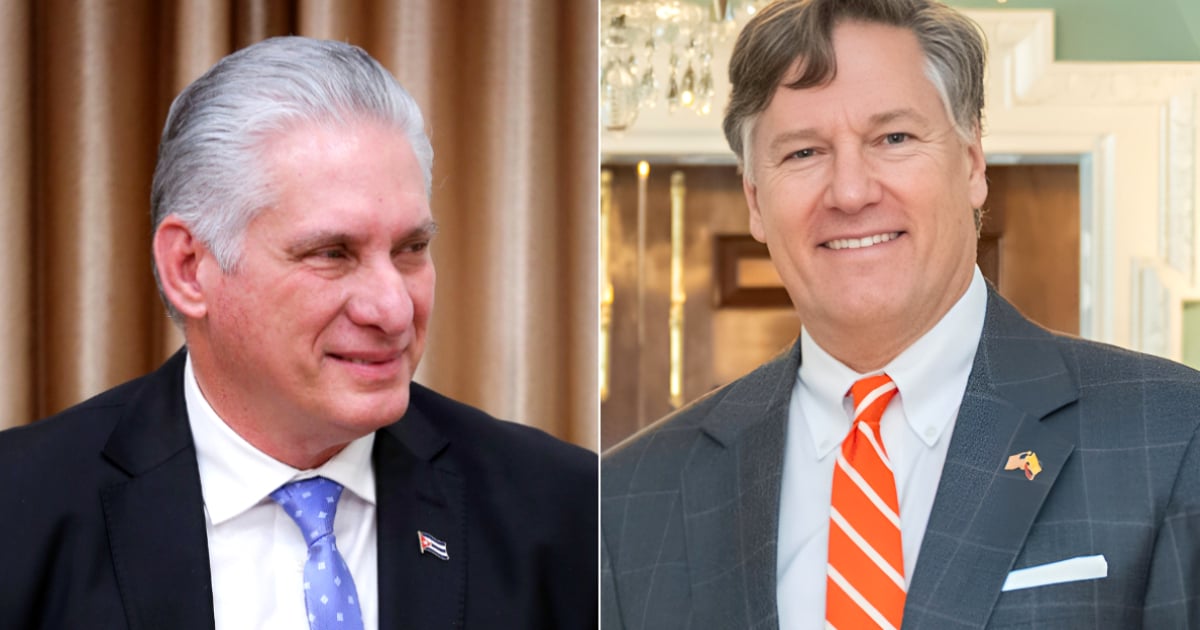
The diplomatic confrontation between Havana and Washington escalated this Thursday on social media, as the Cuban leader Miguel Díaz-Canel and the U.S. Under Secretary of State, Christopher Landau, engaged in a public exchange on X (formerly Twitter) regarding the impending vote in the UN General Assembly that will once again address the resolution against the U.S. embargo.
The U.S. government pressures and deceives several countries to change their traditional position against the blockade, wrote Díaz-Canel, reiterating the speech of Chancellor Bruno Rodríguez Parrilla during his recent press conference in Havana.
They fear what will happen: the overwhelming rejection from the international community of their genocidal policy and economic stranglehold against Cuba, added the first secretary of the Communist Party.
The response from the high-ranking U.S. official came just hours later and was unusually direct in tone.
“You shouldn’t even believe your increasingly brazen lies. There is no ‘blockade’ against your country; if there were, how would all that Mexican oil and those German and Canadian tourists be arriving?”, Landau retorted to the leader of the so-called “continuity.”
The only genocide happening over there is the one you are committing against your own people, subjecting them to hunger and misery through your communist policies. And speaking of votes, if you are so proud of your management over the last 66 years, why don’t you allow your own people to vote?, asked the senior official.
The message from Landau —Undersecretary of State and right-hand man to Marco Rubio at the State Department— made a significant media impact and highlighted the tightening of Washington's rhetoric towards the Cuban regime.
A clash during a diplomatic offensive
The exchange occurs less than a week before the annual vote on the resolution titled "Need to end the economic, commercial, and financial blockade imposed by the United States of America against Cuba," which will take place on October 28 and 29 at the UN General Assembly.
In this edition, however, the context is very different. Washington has activated an international strategy to break the nearly unanimous consensus that has supported Cuba for three decades, now linked to the scandal involving Cuban mercenaries serving Russia in the war in Ukraine.
A leaked diplomatic cable from Reuters revealed that the State Department has instructed its embassies to persuade allied governments to vote against or abstain, arguing that the Cuban regime is an "active accomplice of Russian aggression" and "uses its citizens as pawns in war."
The narrative of the "blockade" is cracking
Landau's response also reflected Washington's shift in communication, which aims to dismantle the narrative of the "genocidal blockade" with concrete data: the United States remains one of the main suppliers of food, medicine, and essential goods to Cuba, despite the sanctions.
According to figures from the Department of Agriculture (USDA), in 2024 alone, Cuba imported over 370 million dollars in U.S. agricultural products, including chicken, wheat, and corn, while trade in medical and pharmaceutical supplies remained stable.
Furthermore, Cuban Mipymes import cars, trucks, and motorcycles, as well as containers filled with home appliances, machinery, spare parts, and technology from NATO countries without any real obstacles, which dismantles the myth of total isolation.
In contrast, the island maintains internal prohibitions, censorship, strict currency control, and bureaucratic barriers that suffocate its own private sector. For Washington—and a significant part of the international community—the real blockade is internal: a political system that hinders the economic and political freedom of its citizens.
Adverse regional context
The diplomatic dispute also reflects a geopolitical realignment in the hemisphere. Since his return to power, President Donald Trump has promoted a doctrine of spheres of influence aimed at containing the regimes allied with Moscow, Beijing, and Tehran in Latin America.
In recent weeks, the Southern Command has conducted naval maneuvers in the Caribbean alongside the Dominican Republic and Barbados, and has strengthened its presence off the coast of Venezuela.
The regime of Nicolás Maduro —a source of subsidized oil that sustains Cuba— is under increasing international pressure due to its connections with drug trafficking, while Nicaragua faces sanctions for human rights violations and cooperation with Russia and Iran.
This hostile regional environment leaves Havana with no room for maneuver and an evident fear: that the UN will cease to be the stage where its victim narrative receives applause and will once again become the place where its isolation is measured.
A message between the lines
Landau's response not only dismantled the narrative of the embargo but also revealed the shift in U.S. foreign policy: from passive containment to directly holding the regime accountable for national misery and political repression.
While Díaz-Canel insists on blaming Washington for the crisis, the evidence points inward.
And, on the eve of the UN vote, the exchange of tweets between both officials encapsulates what is at stake in the diplomatic arena:
Cuba tries to keep alive the tale of the "genocidal blockade"; the United States, on the other hand, seeks to demonstrate that the only blockade that exists is the one imposed by the totalitarian regime on its own people.
Filed under: