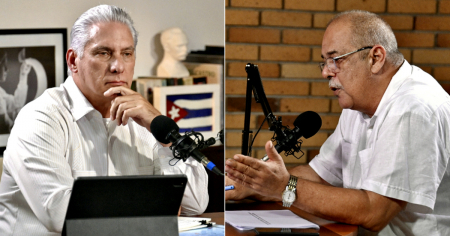
Cuban leader Miguel Díaz-Canel once again pointed to China as an economic model for Cuba, stating that the reform process of the Asian giant "serves as a reference" for the island's strategy amid the severe crisis it is facing.
During a meeting at the Palace of the Revolution with Li Zongyuan, general director of the Museum of the Communist Party of China (CPC), the leader stated that the transformations driven by Beijing provide “very important content” that will serve as a guide for “overcoming the very difficult circumstances we are facing as part of the intensified blockade.”
Díaz-Canel emphasized Xi Jinping's "leadership" and expressed gratitude for the hospitality received during his visit to the Asian country, where he toured the Museum of Reform in Shenzhen. "The Chinese experience clarifies a lot for us about the foundation and thought of the Reform, and about the role of the Communist Party of China in its guidance," he stated.
The meeting included the participation of Roberto Morales Ojeda, Secretary of Organization of the Central Committee, as well as the heads of the Ideological and International Relations departments of the PCC, in addition to the Chinese ambassador in Havana, Huan Xin.
The meeting is part of the commemorations for the 65th anniversary of the establishment of diplomatic relations between both countries and is taking place during a period of intense political and economic cooperation. In recent months, the Cuban regime has been negotiating with Beijing the restructuring of its financial and business debts, and has signed eleven cooperation agreements that range from agriculture and biotechnology to artificial intelligence and internal security.
The approach to China has become one of the main strategies of the regime to try to navigate the economic crisis, characterized by prolonged blackouts, inflation, and shortages. However, analysts warn that the Chinese model, which is based on market openness without relinquishing the political control of the Party, would be difficult to replicate in Cuba as long as internal restrictions persist and Cuban residents on the island are excluded from entrepreneurial activities.
Recently, Díaz-Canel publicly compared Cuba to China and Vietnam, defending the one-party system as "a guarantee of stability and national sovereignty." In an event alongside Raúl Castro, he stated that "the prosperity of modern China is not magic, but the triumph of the socialist ideal adapted to its characteristics," and asserted that this model "refutes its adversaries."
For his part, President Xi Jinping has described the bilateral relationship as “a model of solidarity among socialist countries” and has reiterated his willingness to strengthen political and economic cooperation with Havana.
Despite the official rhetoric, the strengthening of ties with Beijing reflects Cuba's growing dependence on the Asian giant, amid a backdrop of international financial isolation and internal deterioration. While the government seeks inspiration from Chinese reform, millions of Cubans face daily blackouts, understaffed hospitals, and a devalued national peso, with no signs that the promised reforms will reach the pockets of the population.
Filed under: