
Related videos:
The propaganda machinery of the Cuban regime is reviving its cult of the late dictator Fidel Castro amid one of the worst economic, health, and social crises in recent decades. This time, the call comes from the official portal Cubadebate, which published the article "It Was Worth Living in the Age of Fidel", where it urges to turn to “the horse, the genius” of Fidel Castro to confront the current crisis in Cuba.
The text, signed by Marxlenin Pérez Valdés, partner of Fidelito Castro Smirnov, grandson of Fidel Castro and son of the dictator's firstborn, Fidel Ángel Castro Díaz-Balart, was published on November 17, coinciding with the 20th anniversary of the former ruler's speech at the University of Havana in 2005.
In the article, Pérez Valdés asserts that “it is imperative for all revolutionaries to turn to him today” and suggests that “when times become complicated —and this certainly is— it is our duty to turn to ‘the horse’, ‘the genius’.” The author urges the new generations to follow his “legacy as a compass for a revolutionary path” and concludes that “it is worth having been born and lived in the era of Fidel.”
Wave of criticism and sarcasm on social media
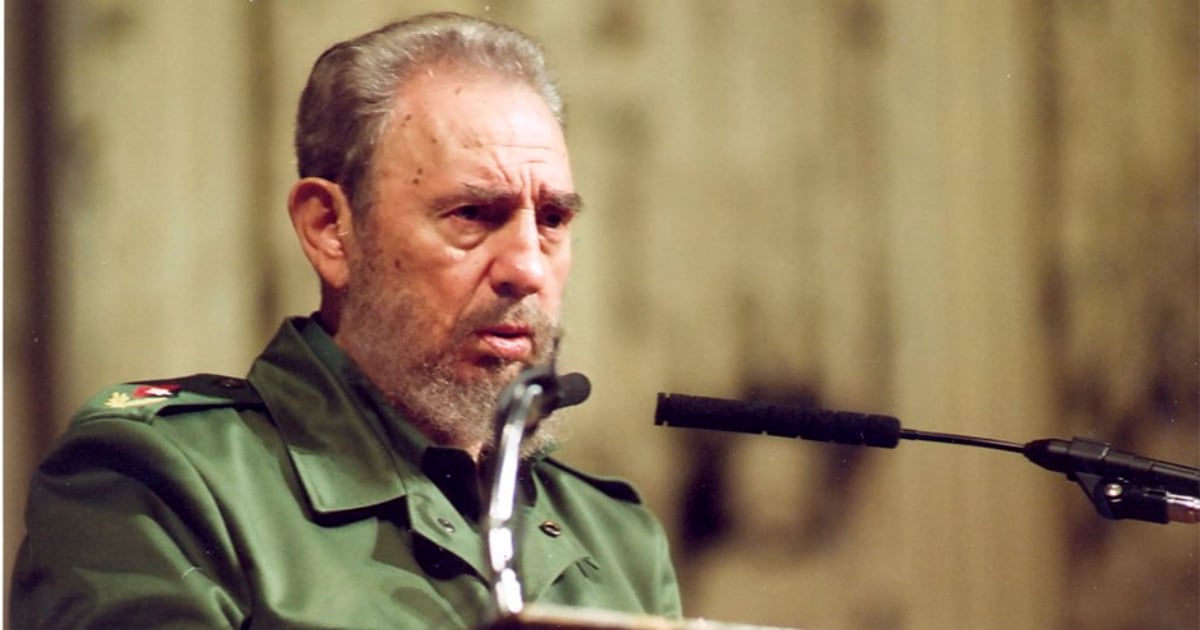
The post by Cubadebate on Facebook, which shared that excerpt alongside an image of Fidel in the Aula Magna, sparked an immediate backlash from the public. Within a few hours, it amassed hundreds of interactions, most of which were critical or openly mocking, as seen in the post by Cubadebate.
Among the comments, many Cubans ridiculed the message and reminded everyone of the country's reality. "The genius left a debt that not even a mountain goat can leap over," wrote a user. Another added that "in just three years, 10% of the country has emigrated, but everyone is grateful to have lived in Fidel's century." Some simply laughed at the messianic tone of the message, while others were more cutting, pointing out that "Just look at how much of a genius he was; he managed to do what no leader ever could: destroy a country down to its foundations and leave his descendants millionaires."
Frustration was also expressed through political sarcasm and emotional exhaustion. “Noooooo, next question,” quipped one reader, while another commented, “Oh damn, why are you reminding me? I just want to fall into a coma and wake up when all of this is over.” Only a few comments defended the post with tags like #FidelPorSiempre or #100AñosConFidel, in stark contrast to a flood of criticisms that summed up the general sentiment: “It was a tragedy that Fidel was born in Cuba” or “The genius died and left his spell: Cuba turned into ruins.”
A propaganda strategy in progress
The text from Cubadebate adds to a series of recent actions that confirm the regime's attempt to revive the cult of Fidel Castro's figure in anticipation of his centenary in 2026. In recent weeks, the Secretary of Organization of the Communist Party, Roberto Morales Ojeda has repeatedly invoked the late dictator to justify the regime's management, asserting that “the only one who can solve this country’s problems is the Revolution,” as he declared amidst the crisis caused by Hurricane Melissa and the criticisms over government mismanagement.
The same leader praised the “revolutionary medicine” promoted by Fidel days later, amid an unprecedented health crisis. This was accompanied by the contest of décimas in honor of the dictator launched by Cubadebate, which was met with a wave of mockery and public outrage.
In the symbolic realm, the cult has extended to other spaces. During the Fiesta de la Cubanía, military personnel paraded with a cap of the dictator inside a glass urn, in blatant violation of the law prohibiting the use of his image. In the same city, residents performed a spiritualist ritual in which they invoked "Father Fidel," an episode that many interpreted as a grotesque caricature of political worship.
Also from the cultural perspective, the troubadour Amaury Pérez Vidal publicly remembered his "friend Fidel" while receiving a state award, a gesture that sparked controversy even within the artistic community.
Fidel as a "solution" in a country on the brink of collapse
The call to "turn to the horse" comes in a context marked by widespread blackouts, soaring inflation, shortages of food and medicine, and an unprecedented exodus. For many Cubans, the insistence on looking to Fidel is far from inspiring. “Times have become difficult precisely because of him,” commented a user on social media, while another ironically summarized that “if they talk about Fidel, they've lost, because no one wants him anymore thanks to the Internet.”
The myth against hunger
Official propaganda tries to once again portray Fidel Castro as a savior, when for most Cubans he symbolizes the root of the troubles that besiege them today. While Cubadebate invites people to "turn to genius," the public turns to something more pressing: the line, the blackout, or the airport. In an increasingly impoverished and disillusioned Cuba, revolutionary nostalgia no longer serves as either comfort or faith.
Filed under: