
Related videos:
The mayor of the Cuauhtémoc borough, Alessandra Rojo de la Vega, ignited the controversy surrounding the removal of the statues of Fidel Castro and Ernesto “Che” Guevara from the Tabacalera Garden by suggesting that a “great idea” would be to melt them down and use that material to create a tribute to Carlos Manzo, the municipal president who was shot and killed in Mexico in November.
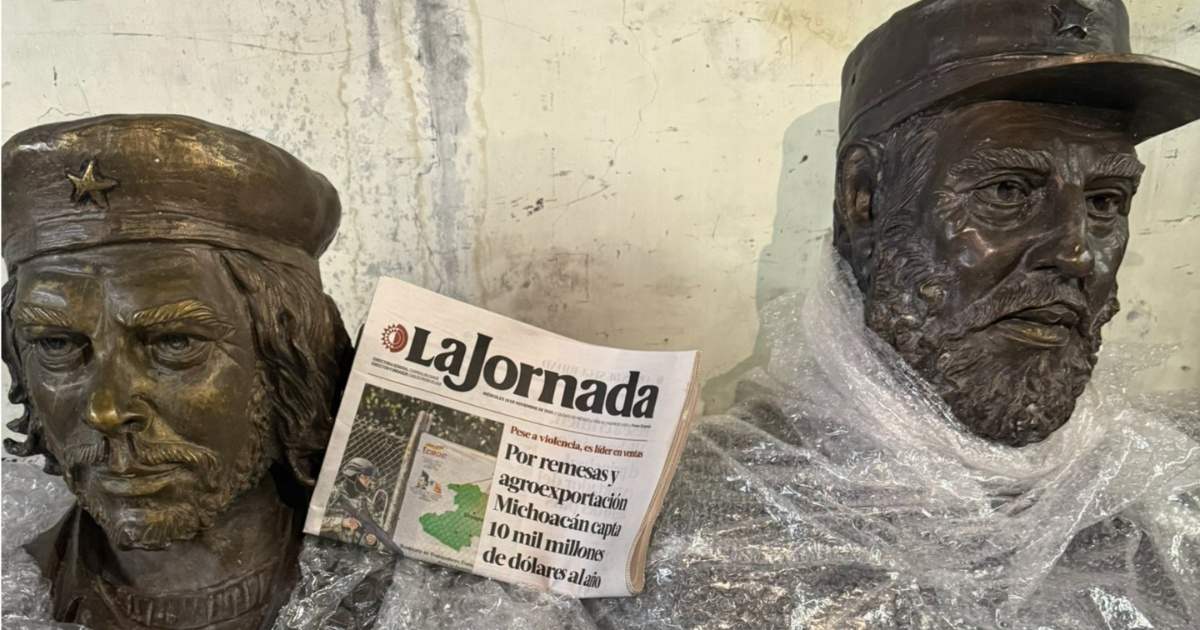
The sculptures, which made up the group officially called the Monument Encounter —though popularly known as “The bench of Che and Fidel”— were removed by decision of the local authorities, who cited irregularities in their installation and multiple complaints from residents.
The municipality announced that the ensemble will be kept safe while its final destination is determined, as part of a process to catalog the work.
Rojo de la Vega accompanied the announcement with a strong message: “These are the ones who should be the true political prisoners, dictators and murderers, whom you venerate and apparently continue to follow in their footsteps. A great idea would be to melt them down and pay tribute to Carlos Manzo. Long live resistance and freedom!”
The General Directorate of Culture and Education of the mayor's office explained that, after reviewing the files, it was determined that the monument was installed in 2018 without the authorization of the Committee on Monuments and Artistic Works in Public Spaces (COMAEP), as required by the regulations of Mexico City.
"The file was incomplete; the necessary documentation was not provided, nor was the identity of the supposed neighbors who supported the application verified," the agency stated. Nevertheless, in 2020, the sculptures were reinstalled without addressing the identified legal omissions.
Since their installation, the figures of Fidel and Che have generated backlash from various sectors of the community, merchants and residents, as well as among opposition politicians.
The controversy escalated with acts of vandalism: the sculptures were smeared with red and white paint, banners appeared with accusations of "murderers" and messages against communism, and on one occasion, they had to be protected with metal structures after an attempted theft.
The work, created by the sculptor Óscar Ponzanelli in 2017, depicted the meeting between Fidel Castro and Che Guevara in Mexico City in 1955, where both began to plan the Granma landing and the start of the Cuban Revolution.
Its installation in the Tabacalera Garden was promoted as a tribute to the historical connection between Mexico and Cuba.
However, public figures such as deputies Jorge Triana and América Rangel referred to Fidel and Che as "murderers," "homophobes," and "dictators," demanding their removal and arguing that they were not worthy of tribute in public spaces of the city.
The Communist Party of Mexico reacted strongly to the removal of the sculptures and called for a protest against the decision, accusing the mayor of using "facile arguments" to justify what they deemed an "anticommunist act."
In a message posted on X, the party stated that it is "an affront to the friendship between Cuba and Mexico that will not go unanswered."
The controversy escalated to the federal level. Mexico's president, Claudia Sheinbaum, described the measure as illegal, intolerant, and hypocritical, recalling that Rojo de la Vega had vacationed in Cuba, and warned that auctioning the sculptures would constitute a crime of patrimonial damage.
Additionally, the federal government requested that the statues be handed over to relocate them "in an institutional manner," in a space they deem appropriate.
The debate occurs in a context of close ties between the ruling party Morena and the Cuban regime.
Last May, the general secretary of Morena, Carolina Rangel Gracida, signed a cooperation agreement with the Communist Party of Cuba in Havana, in the presence of Miguel Díaz-Canel. For critics of the government, this confirms a political closeness to Havana that goes beyond mere diplomacy.
For the opposing Cuban community in Mexico, the removal of the statues was an act of justice and democratic coherence.
They point out that the demonstrations in defense of the monument have been driven by associations linked to the Cuban embassy, which they accuse of harassing dissidents and replicating political pressure tactics known on the island.
From this perspective, the proposal to melt down the statues of Fidel and Che to dedicate them to a figure like Carlos Manzo is interpreted as a symbolic gesture of breaking away from the official narrative regarding the Cuban Revolution.
With the sculptural ensemble under protective custody and without a definitive decision on its fate, Rojo de la Vega's suggestion to melt the statues encapsulates the deep polarization surrounding the memory of Fidel and Che: for some, historical icons that deserve to be honored; for others, symbols of dictatorship, repression, and human rights violations that should not occupy a place of honor in Mexican public space.
Filed under: