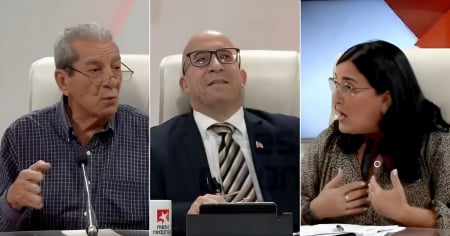
The Ministry of Foreign Affairs of Cuba (MINREX) conducted its annual review highlighting what it considered achievements of Cuban diplomacy in 2024, such as denouncing the U.S. "blockade" and its integration into the group of countries known as BRICS.
However, beyond the official rhetoric, the meeting highlighted the fundamental missions of the regime's foreign policy: the promotion of the "blockade" narrative, the pursuit of donations and support from strategic allies, the consolidation of relations with authoritarian regimes, and ongoing interference in the affairs of other nations.
Led by Miguel Díaz-Canel, Manuel Marrero Cruz, and Minister Bruno Rodríguez Parrilla, the event reaffirmed MINREX's commitment to what is referred to as "revolutionary diplomacy", a propagandistic concept that in practice translates into the internationalization of the regime's propaganda and the promotion of its interests, focused on the goal of perpetuating itself in power.
During the meeting, the diplomatic victory at the UN against the "blockade" was emphasized, a symbolic act that occurs annually with no practical consequences for U.S. policy towards the Island.
One of the notable milestones in the MINREX report was Cuba's inclusion as a partner country in the BRICS bloc, an economic alliance led by Brazil, Russia, India, China, and South Africa, which aims to create alternatives to structures dominated by the West.
This movement, far from representing a real advancement in the Cuban economy, responds to Havana's strategy of aligning itself with powers like China, Russia, and Iran, nations with a notable history of human rights violations and hostility towards the democratic world.
The strengthening of diplomatic ties with like-minded regimes also played a key role in the assessment of the Cuban Ministry of Foreign Affairs. In 2024, the Island further tightened its relations with Russia, consolidating its dependence on the Kremlin in economic and military areas.
Similarly, Havana continued its collaboration with governments like those of Venezuela and Nicaragua, known for their repressive practices and the dismantling of democratic institutions.
In addition to strengthening alliances with totalitarian regimes, Cuban diplomacy focused on undermining democracies opposed to Castro's regime. From its more than 140 missions abroad, Cuban diplomats continue to promote disinformation campaigns, organize networks of influence, and utilize Cubans living abroad as a platform to pressure governments and civil society actors that do not conform to the official narrative.
The MINREX meeting emphasized the "priority" of consolidating support from the emigrants, with the goal of turning it into a lever against U.S. policy and curbing opposition activism.
Another highlighted aspect in the MINREX report was political communication as the central focus of its work. Diplomats were urged to continue "vindicating" the image of Cuba abroad, reinforcing the propaganda on the supposed achievements of the Revolution in health and education.
This approach, however, overlooks the systematic deterioration of both sectors on the Island, the exploitation of Cuban doctors on international missions and the ideological indoctrination in the classrooms.
The event also addressed the economic difficulties of the country, urging diplomacy to be more "proactive" in attracting foreign investment. However, the lack of legal security, the state's absolute control over the economy, and the absence of guarantees for investors continue to discourage any realistic possibility of economic opening.
One aspect that the Cuban regime watches with anticipation is the evolution of Donald Trump's foreign policy, who, in an unprecedented turn, has shown a rapprochement to Russia, a traditional enemy of the United States and ally of Castroism.
This movement confuses Havana, which for decades has used the hostility between Washington and Moscow as an argument to justify its alignment with the Kremlin. The possibility that the Trump administration strengthens cooperation with Vladimir Putin places the Cuban regime in an uncertain position, as it could alter the balances in the region and affect how the U.S. manages its policy towards the Island.
Meanwhile, the silence of the Cuban official press regarding this rapprochement between Trump and Putin reveals the regime's discomfort with a scenario that could undermine its traditional narrative of victimization against "U.S. imperialism." While Havana has historically relied on the support of Russia and China, the possibility of a thaw between Washington and Moscow introduces an unexpected variable that could affect the geopolitical interests of Castroism.
In conclusion, the 2024 report from MINREX did not present any new developments regarding Cuba’s diplomatic strategy, which remains tied to the doctrine of Castroism: victimization in the face of the "blockade," strengthening alliances with dictatorships, destabilization of democracies, and the expansion of regime propaganda.
Sixty-five years after its foundation, the diplomacy of the so-called "revolution" remains anchored in the same old script: the defense of a failed system at the expense of international manipulation and internal repression.
Filed under: