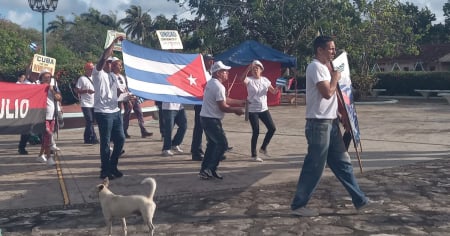
During a visit to the municipalities of Jobabo and Colombia in the province of Las Tunas, the leader Miguel Díaz-Canel stated that “at this moment, we have much more land under cultivation than in other periods.” However, this statement contrasts with the reality faced by Cubans, marked by a profound food and agricultural crisis.
The leader attributed this supposed progress to the people's understanding that "we have to move forward on our own, with our own talent and work, and not rely on imports," reported the official channel Tunas Visión, which presented it as an achievement of the current agricultural context, although without providing figures or verifiable data to support it.
However, he failed to mention the numerous challenges facing the agricultural sector, such as the lack of supplies, fuel, and machinery, as well as the bureaucratic hurdles that limit food production and distribution.
It is not the first time that Díaz-Canel has resorted to this type of statements. In May 2024, during a visit to San Luis, Santiago de Cuba, he urged citizens to "plant more" and asserted that "there is land here to produce the food we need". However, these exhortations have not translated into significant improvements in agricultural production or access to food for the population.
While the government promotes the idea of increasing national production, in November 2024, it withdrew land in usufruct from 137 farmers in Ciego de Ávila, claiming "repeated violations of current legislation." This measure contradicts efforts to encourage agricultural production and generates uncertainty among producers.
In March 2025, the legalization of the allocation of land in usufruct to foreign companies and permanent residents on the island was announced, as part of a strategy to boost agricultural production. This decision has sparked criticism, as it is seen as a preference for foreign stakeholders at the expense of local producers.
Despite the official statements, the rice production in Cuba is facing one of its worst crises in decades, reaching only 30% of what was harvested in 2018. This situation reflects the ineffectiveness of the implemented policies and the lack of real support for the agricultural sector.
In this context, Díaz-Canel's statements about the increase in cultivated land are disconnected from the reality faced by the Cuban people, who daily confront food shortages and difficulties in accessing basic products.
Frequently Asked Questions about the Agricultural and Food Crisis in Cuba
Is it true that Cuba has more cultivated land than in previous stages, as Díaz-Canel claims?
Despite Díaz-Canel's claims of an increase in cultivated land, the reality in Cuba reflects a deep agricultural crisis, characterized by shortages of inputs, fuel, and machinery, as well as a lack of effective government support, which calls into question the truthfulness and effectiveness of his statements.
How has the lack of inputs and fuel affected rice production in Cuba?
The production of rice in Cuba has dropped dramatically, reaching only 30% of what was harvested in 2018. The lack of supplies and fuel has significantly reduced the areas under cultivation and yields per hectare, which has directly impacted food supply and raised prices in the market.
What measures has the Cuban government taken to address the agricultural crisis?
The Cuban government has attempted measures such as legalizing the transfer of land in usufruct to foreign companies and individuals, and promoting "popular rice." However, these measures have not resolved the structural problems of the agricultural sector, and the dependency on foreign inputs and technology remains a significant challenge.
Why is the Cuban government taking land away from farmers in Ciego de Ávila?
The Cuban government withdrew usufruct lands from 137 farmers in Ciego de Ávila, citing "repeated violations of current legislation." This measure creates uncertainty and contradicts efforts to encourage agricultural production, affecting food security and increasing pressure on small farmers.
What is the impact of current agricultural policies on the Cuban population?
Current agricultural policies in Cuba have not managed to meet the food needs of the population. The scarcity of basic products and high prices in the informal market reflect the ineffectiveness of government strategies, forcing families to confront a persistent and deep food crisis.
Filed under: