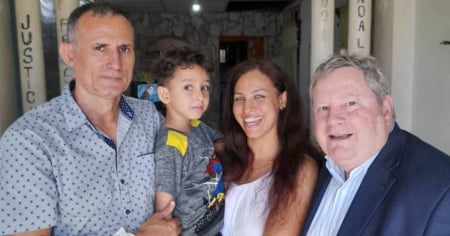
The arrest on April 29 of José Daniel Ferrer, leader of the Patriotic Union of Cuba (UNPACU), marks a new chapter in the long history of persecution that the Cuban regime has maintained against this activist.
More than just a simple revocation of parole, the arrest represents a new political retaliation against someone who has made public denunciation and humanitarian action their stronghold.
Ferrer had been released on January 16, after serving his sentence as stated in a legal report on the case published by CiberCuba in December 2024. From the very beginning, the opposition leader warned of the regime's maneuvers to imprison him again.
Despite the fact that the justice system acknowledged that “the entirety of the imposed sentence had already been served”, he remained arbitrarily under cautionary measures disguised as “conditional release”, an ambiguous provision that left him at the mercy of selective legality, manipulated by the authorities.
Solidarity action in the face of a country in ruins
After his release, Ferrer did not choose silence or exile. On the contrary, he resumed his work at the helm of UNPACU, once again opening the doors of his home in Santiago de Cuba as a support center for vulnerable individuals.
Elderly individuals, single mothers, and the ill found medical care, food, and medicine at Ferrer's home. His wife, Dr. Nelva Ismaray Ortega Tamayo, has played a crucial role in this solidarity effort.
These actions, rather than being recognized, were subject to surveillance, harassment, and intimidation. At the end of March, the residence was surrounded by State Security forces, which prevented access to those seeking assistance.
Ferrer denounced the blockade as a way to criminalize compassion and punish the free exercise of civic solidarity. The regime's response was violent: internet interruptions, brief arrests of collaborators, smear campaigns, and, finally, the assault on the UNPACU headquarters, resulting in the detention of his family and associates.
Persistent harassment and digital censorship
The repression was not limited to the physical realm. Ferrer was subject to systematic cuts to his internet access, a common practice of the regime to silence critical voices and prevent international outcry.
Despite this, he managed to use his social media to raise awareness about the repressive situation, highlight the misery of the poorest neighborhoods, and call for action from the international community. These reports even reached international organizations and democratic governments that had celebrated his release.
His voice, however, was never appreciated by those in power. In his videos, Ferrer denounced hunger, the lack of medications, constant repression, and the hypocrisy of the Cuban judicial system. That bravery, far from providing him protection, became the final argument for his detention.
What does the regime's "justice" say?
The Supreme People's Tribunal justified the revocation of probation by claiming that Ferrer did not attend two court summonses.
"Hermanos y amigos, I have just been summoned for tomorrow before an Execution Judge of the tyranny. I AM NOT GOING ANYWHERE. If the intention is to threaten me with returning to prison, they are wasting their time. For the freedom and well-being of my people, I would give my life. I am not afraid of prison!" Ferrer said at the end of January, just days after his release and immediately resuming his solidarity and opposition actions.
The explanation, limited and opaque, failed to mention that Ferrer had already served his sentence, as this editorial documented in December 2024, following the denial of a habeas corpus. The continuation of precautionary measures without a solid criminal basis represents a clear violation of fundamental rights.
How can "parole" be imposed on a prisoner who has served their sentence? The use of "absence" as a legal pretext to revoke this arbitrary measure is not only legally questionable but also reflects how the judicial system in Cuba operates as an instrument of political repression.
A pursuit with a name and surname
What happened this Tuesday is not an isolated incident, but part of a pattern. Ferrer has been arrested and convicted multiple times since he was part of the "Group of 75" imprisoned after the so-called "Black Spring" in 2003. He has endured beatings, isolation, punishment cells, and yet, he has maintained his commitment to civic resistance.
UNPACU, the organization she founded in 2011, has been one of the leading opposition movements in the country, focused on direct denunciation, peaceful civil disobedience, and community assistance.
That combination—political activism and social action—makes him an uncomfortable figure for a regime that does not tolerate legitimacy alternatives outside of the Communist Party.
The recent arrest of José Daniel reveals, once again, the true face of the so-called "revolutionary justice": a system designed to protect the power and punish any form of independence.
Ferrer, whose sentence was already extinguished according to the judicial record, does not represent a "legal danger," but rather a moral threat to a corrupt system that is incapable of dealing with criticism or providing real solutions to the problems faced by the Cuban people.
Today, Ferrer is imprisoned, but not silenced. His actions, his legacy, and his example transcend the bars. Every citizen who was fed, every sick person who received care, and every outcry shared on social media are living proof that even in the darkest contexts, dignity and solidarity can flourish.
Filed under: