
Related videos:
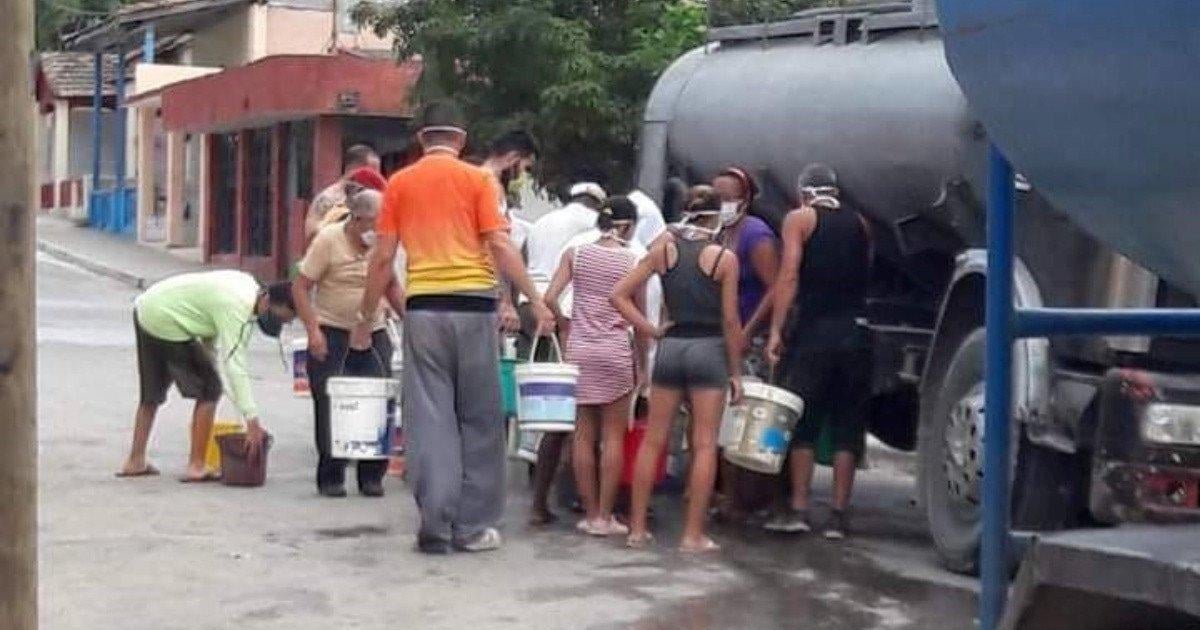
The province of Holguín is experiencing one of the worst crises in water supply services in recent years, with over 370,000 people affected by a combination of prolonged drought, frequent power outages, and technical failures in the pumping systems.
According to official data, Holguín ended 2023 with a population of 938,744 inhabitants, which means that approximately 39.4% of its residents are affected by the current water crisis.
Luis George Ávila Mustelier, general director of the Water Supply and Sewerage Company in the area, reported that more than 121,000 residents are experiencing disruptions in hydraulic service due to a lack of electricity. The municipalities of Holguín, Frank País, Calixto García, and Urbano Noris are among the most affected.
This figure is increased by an additional 21,000 affected by breakdowns in pumping equipment, particularly in Moa, Calixto García, and Mayarí, the official elaborated, as reported by the state newspaper ¡Ahora!
According to Ávila, the three main sources of water supply in the provincial capital are in a state of drought, with negative consequences for 229,000 people, forced to face distribution cycles exceeding seven days.
The delegate of Hydraulic Resources in the province, Juan Mario Hechavarría Hernández, pointed out that the capital of Holguín "is facing a serious water crisis," as the Gibara dam, one of the main reservoirs of the liquid, has only 97 days of coverage, and other dams are also in critical condition.
“If the drought continues, measures will be taken to increase water coverage, including an investment to move the float at the Gibara dam and to rehabilitate the pumping station,” he reported. Adjustments to the energy matrix and maintenance actions are also being considered to stabilize the supply.
According to the local newspaper, an improvement in the water supply is expected starting from the second half of May, with the arrival of the rains.
Holguín records a 22% deficit in rainfall across the region. According to a recent report from the Meteorological Center, 47.7% of the northeastern province is experiencing meteorological drought (which occurs when there is a prolonged period without rainfall or when precipitation levels are below average), particularly in Banes, Sagua de Tánamo, and Moa, where it has lasted for seven consecutive months.
Vegetation and crops are facing extreme conditions, with 100% of the territory classified as "very dry," except for small areas in Mayarí and Moa, the source indicated, pointing to the negative impact on crops and livestock.
In the neighboring Santiago de Cuba, drought, breakdowns, and lack of energy support are hitting thousands of people hard, who are facing distribution cycles of up to 85 days, with no long-term solutions in sight.
Ciego de Ávila, for its part, has experienced a cumulative four-year deficit in rainfall, as 35 of the last 51 months (69%) saw precipitation levels below historical records.
Due to the reduction in the flow from the main sources of supply and the decline in the efficiency of pumping equipment, local authorities imposed a 24-hour water distribution cycle every nine days in all the popular councils of the municipal seat, with very negative impacts on economic, social, and agricultural entities.
In provinces like Sancti Spíritus, in just one year, the number of people receiving water through tanker trucks has doubled, from about 40,000 in May 2024 to nearly 82,000 at present.
However, the situation is complicated by structural problems: ongoing blackouts, pipe leaks, and the depletion of underground reserves affect the efficiency of the system. Furthermore, there are clear difficulties in eliminating losses at major leakages and in the tanks of multifamily buildings, which further exacerbates the challenge of ensuring a stable supply in a context of scarcity.
In September 2024, more than 600,000 Cubans were without access to the potable water supply service, and the Institute of Hydraulic Resources blamed the blackouts.
Filed under: