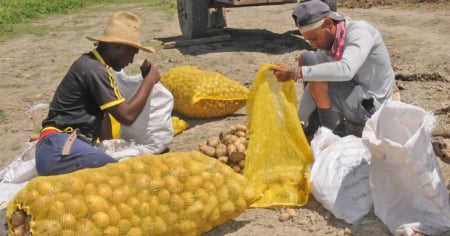
The spring planting campaign in Pinar del Río has been affected by a critical situation regarding the supply of seeds, fuel, or fertilizers.
The challenges revolve not only around the electric energy deficit but also pertain to a critical situation with fuel and fertilizers, even regarding pesticides, insecticides, and biological products, said Ortelio Rodríguez Perugorría, agricultural subdelegate at the Provincial Agriculture Delegation, to the local press.
The official also acknowledged that “another complex issue is the seed, especially for vegetables, due to problems in the refrigeration facilities, which has forced them to turn to other provinces.”
"A very difficult campaign of cold and tobacco has come to an end, and we are entering a very strong spring. The center pivot irrigation machines are barely functioning due to the lack of electricity, which is why we are trying to, as we conclude the tobacco campaign, make use of solar irrigation systems to prioritize the seeds and utilize the greenhouses and seedlings," he lamented.
Of the 5,000 tons of mango that were traditionally harvested, Pinar del Río will obtain only 2,000 this season.
Rodríguez Perugorría attributed the problems to both the drought and the delay in the tobacco campaign, which have caused setbacks in the use of land dedicated to crops such as corn and cowpea.
In the current spring campaign, agriculture in Pinar del Río is planning a sowing plan of 35,567 hectares: over 12,000 for root vegetables, about 5,000 for vegetables, and around 17,000 for grains. Rodríguez Perugorría did not clarify how much these figures have decreased compared to previous years.
Díaz-Canel "scolds" farmers
In a country where more than 70% of food is imported, and where markets are understocked and prices are skyrocketing, the Cuban leader Miguel Díaz-Canel Bermúdez reprimanded the farmers of the nation this Saturday for the low agricultural production, stating that “there is a lot of land to cultivate,” without acknowledging the State's role in the structural inefficiency of the Cuban agricultural system.
During the closing of the National Congress of the National Association of Small Farmers (ANAP), the president reiterated old promises of productive transformation, blaming the farming sector for not making better use of the land under usufruct, despite the numerous restrictions imposed by the government itself.
"This congress will truly be historic if we manage to change the situation regarding food production in the country... and there is plenty of land to cultivate, there is a lot of land to put into production," said Díaz-Canel in a speech that overlooked the serious issues of access to inputs, technology, and autonomy faced by Cuban producers.
Despite acknowledging that in earlier stages the country had abundant resources that were wasted "without achieving efficiency," the leader did not take institutional responsibility nor propose significant reforms to the centralized model that keeps Cuban agriculture constrained.
In his remarks, there was also room to criticize the intermediaries in food marketing, accusing them of unfairly inflating prices for the population and benefiting without adding any value.
"Every time there is an intermediary, the price keeps going up for the population (...) There are four or five people making more than the producer," he reported.
However, their criticism overlooks an essential point: it is the State itself that designs and regulates the distribution chain, limits producers' freedom to sell, imposes capped prices, and monopolizes access to markets and supplies.
Recently, in Las Tunas, the leader stated that "we have much more land cultivated than in previous stages. However, the national production data tells a very different story."
According to official figures, rice production, one of the staple foods in the Cuban diet, barely reaches 30% of what was harvested in 2018, highlighting the failure of the policies implemented by the government.
Frequently Asked Questions about the Agricultural Crisis in Pinar del Río
What are the main issues facing agriculture in Pinar del Río?
Agriculture in Pinar del Río is facing a severe shortage of basic supplies such as seeds, fuel, and fertilizers, which significantly complicates planting campaigns. Furthermore, the lack of electricity affects the operation of irrigation machines, exacerbating the situation for crops.
How does the lack of resources affect agricultural production in Cuba?
The lack of resources hinders the proper development of agricultural campaigns, resulting in a low production of essential foods. This contributes to shortages in the markets and rising prices, directly impacting the Cuban population.
What has Miguel Díaz-Canel said about the agricultural situation in Cuba?
The Cuban leader, Miguel Díaz-Canel, has blamed the farmers for the low agricultural production, without taking responsibility for the state's role in the inefficiency of the agricultural system. Díaz-Canel has overlooked the issues related to access to supplies and the restrictions imposed by the government, and has criticized intermediaries for driving up food prices.
What impact does the drought in Pinar del Río have on agriculture?
The drought has caused delays in the use of land dedicated to crops such as corn and cowpeas, further complicating the agricultural situation in the region. This situation is compounded by a lack of resources and energy, exacerbating the impact on agricultural production.
Filed under: