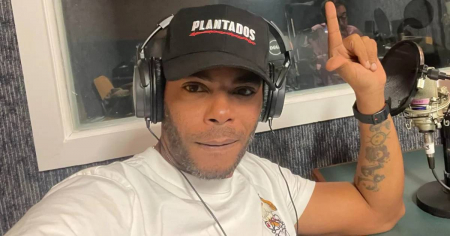
The Cuban rapper El Funky, known for his role in the San Isidro Movement and as one of the performers of the iconic song “Patria y Vida”, is facing a delicate immigration situation in the United States that could result in his deportation to Cuba.
In an interview granted to the YouTube program Destino Tolk, the artist confirmed that he received, a few days ago, an official notification to leave the country within 30 days.
“I received this notification stating that I have to leave the country in 30 days; otherwise, I will be deported. This, of course, puts me on high alert,” confessed the musician, whose real name is Eliécer Márquez Duany.
El Funky did not hide his concern about the possibility of being sent back to the island. “That would be suicide for me. It would put me in the hands of the enemy,” he stated firmly.
Although he claims that he is not afraid to return to his country, he acknowledges that the regime's reprisals would be immediate. "I know there will be immense control... they would wait for me to stick my head out to fabricate a charge or a crime against me."
Additionally, he warned that he would not be able to work in Cuba or support himself. “If I go to Cuba, I will depend on money from abroad, and they would use that as justification to say that I am still in activism”.
The artist reported that his case was not handled properly from the beginning by his former lawyer. “I am a real case of political asylum, but a case of asylum was never made for me”.
This is compounded by a legal precedent fabricated by the Cuban regime. "That false charge they filed against me in Cuba affects my process here in the United States. They are a factory of charges."
According to his explanation, he arrived in the U.S. with a six-month visa through an invitation letter and stayed in the country trying to legalize his status. “I have no family here, I didn’t have a guide, and I left everything in the hands of someone who didn’t do their job.”
Constant work and struggle
Despite having two Grammy awards thanks to his participation in “Patria y Vida”, El Funky is currently working maintenance at a Christian school in Miami. “I don't eat Grammys, brother. Here we have to pay rent”.
In the midst of his situation, he expressed his gratitude for the support received from the Cuban exile community. “I have felt the support of many people. People who write to me, advise me, and tell me not to give up”.
Various artists and activists have expressed their solidarity with him, including Osmani García, Andy Vázquez, and the members of the Patria y Vida team.
El Funky stated that he is seeking legal advice to appeal the migration decision. "What I really need right now is a good lawyer."
Although he has received proposals to open fundraising campaigns, he remains cautious. “I don't want to be tied to money. I need a lawyer who can take on this cause.”
On the brink of migratory eviction, El Funky delivered a powerful message. “I escaped hell. You know what it's like to go back. No. I came here to overcome and to build a better future.”
The case of El Funky revives the debate about the immigration status of Cuban activists in the United States and highlights the vulnerability of those who, after raising their voices against the dictatorship, are left exposed to abandonment or bureaucracy, even after becoming symbols of resistance.
Filed under: