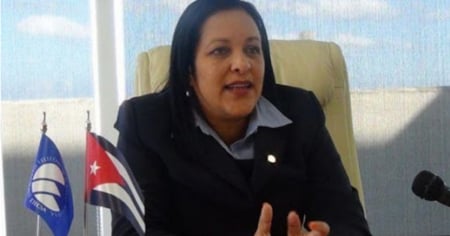
The executive president of the Telecommunications Company of Cuba (ETECSA), Tania Velázquez Rodríguez, defended this Friday in the Mesa Redonda the controversial price increase implemented by the state entity, asserting that “there is a market outside of Cuba that wants to communicate with their relatives” and that the new offers also aim to cater to that segment of customers.
His statements came just hours after the official announcement of new restrictions on mobile top-ups in Cuban pesos (CUP), as well as the entry into force of new data plans sold in U.S. dollars (USD) through international cards and the MiTransfer Wallet, which many consider another step towards the dollarization of basic services on the island.
Velázquez sought to separate ETECSA from the concept of complete dollarization, asserting that "the rates remain in CUP, just as they have been established until now", and that these are supported by resolutions from the Ministry of Communications and the Ministry of Finance and Prices. However, he acknowledged that "the concept of dollarization is a necessity today, in some way, in certain sectors".
“For more than 15 years, we have had the concept of international top-ups, which has been very well utilized by a significant percentage of our customer base,” added the executive. “We also take advantage of the opportunities available today to reach a market outside of Cuba, which is also interested in keeping their family members connected.”
The new measures imposed by ETECSA's communication monopoly have caused immediate rejection among the Cuban population, which has witnessed an increase in the costs and inaccessibility of internet access and mobile phone services.
Many users on social media rated the measures as a "armed robbery", reporting that the new plans in CUP exceed even the monthly minimum wage on the island.
A 15 GB plan costs 11,760 CUP, while national top-ups in local currency have been limited to 360 CUP every 30 days. At the same time, packages in dollars are being promoted with prices of 10, 20, and 35 USD, an option only feasible for those who receive remittances or have access to foreign currency.
Criticism has multiplied, accusing ETECSA of perpetuating inequality through a system of “communication by castes”, where only those who receive assistance from abroad can stay connected. “They regulate your money and open their mouths to dollars, hypocrites,” wrote an outraged user on social media.
One of the most striking responses to the official statements came from social media, where a young Cuban identified as Alex Umur explained the new measures with sarcasm.
In his video, Umur revisits the words of ETECSA's vice president, Lidia Esther Hidalgo, who justified the limit on national top-ups, arguing that it is still possible to use balance through international top-ups or transfers.
“Before, you could recharge whatever you wanted from Transfermóvil. Now you can't. Only once a month and up to 360 pesos. That's not good,” lamented Umur.
He then joked about the growing dependence on intermediaries. “Juancito has a family over there that sends him a top-up, Juancito sells the balance from that top-up, you buy balance from Juancito, and you’ll be able to keep connecting. Now we just need to see how much Juancito is going to sell that balance for.”
His comment, laden with irony, highlights a reality that is already tangible on the island, reflecting digital inequality and the creation of an informal market where connectivity relies on access to dollars or relatives abroad.
Although Velázquez insisted that the rates in CUP remain, ETECSA's strategy confirms a clear trend: an increasing number of key services depend on payments in foreign currency, while the majority of the population, who survive on Cuban pesos, is excluded from a service considered essential.
Frequently Asked Questions about the ETECSA Rate Increase and the Dollarization of Services in Cuba
Why has ETECSA implemented new rates in dollars?
ETECSA has implemented dollar rates to attract foreign currency, justifying that it is necessary to sustain and develop telecommunications infrastructure. The president of ETECSA, Tania Velázquez, argues that there is an international market interested in maintaining communication with their relatives in Cuba.
How do the new ETECSA rates affect users who only use Cuban pesos?
The new rates severely limit top-ups in Cuban pesos to 360 CUP per month, which restricts internet access for those who do not have access to foreign currency. The plans in CUP are unattainable for many, as they exceed the country's minimum wage, worsening the inequality in access to essential services.
What criticisms has ETECSA received regarding the new tariff measures?
ETECSA has been criticized for perpetuating inequality and for the dollarization of basic services. Many people see the measures as a "robbery at gunpoint," as they exclude those who do not have access to dollars. Furthermore, the lack of improvement in service quality despite the high rates is also a point of criticism.
What does the Cuban population think about the dollarization of ETECSA services?
The Cuban population has expressed its outrage and frustration through critiques on social media and official platforms. They believe that the measure increases the economic gap and limits access to the internet, turning an essential service into a privilege for those receiving remittances from abroad.
What has been the reaction of student organizations to ETECSA's rate hike?
The University Student Federation (FEU) openly rejected the new fees, stating that they limit the right to information and education. They believe that these measures harm academic development and demand an urgent review to take into account the economic realities of students.
Filed under: