
Related videos:
The growing wave of opposition to the price hike by the Empresa de Telecomunicaciones de Cuba (ETECSA) has escalated to a new level of confrontation within the student movement itself.
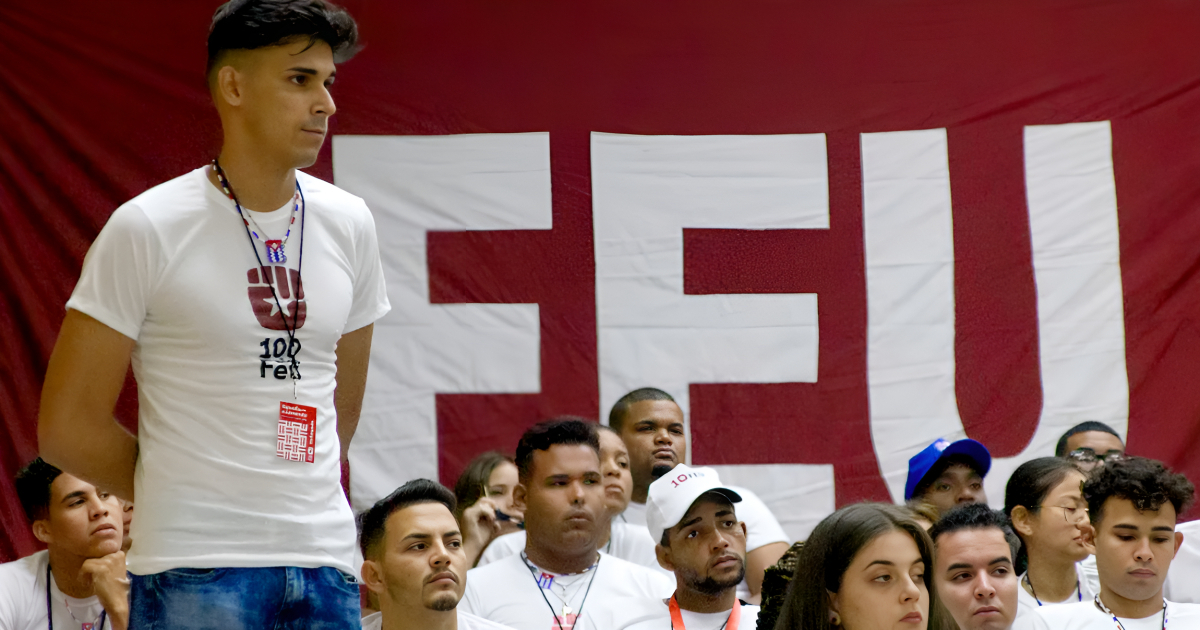
On June 3rd, the Faculty of Philosophy, History, Sociology, and Social Work (FEU-FHS) of the University of Havana issued an unprecedented demanding the immediate resignation of the national president of the University Student Federation (FEU), Ricardo Rodríguez González, for being unable to represent the interests of the student body during the current crisis.
In its statement, the FEU-FHS described Rodríguez González's attitude towards the discontent generated by the new tariffs imposed by ETECSA as “complacent, passive, and uncritical”, which exclude millions of Cubans from the right to access the internet who do not receive their salaries in dollars or have relatives abroad who can afford their connectivity.
The students also reported the lack of clear responses from the company’s executives following a meeting with university authorities, and demanded the total revocation of the measures or, at the very least, the removal of the 360 CUP limit for monthly top-ups.
“Our student body chooses not to trust in symbolic and non-binding commitments... it chooses to get involved, participate, and take action,” emphasized the statement, which also expressed solidarity with the positions taken by other faculties such as Psychology, Communication, and Mathematics and Computing (MATCOM), the latter on academic strike since Monday.
The Humanities document represented the most direct and structured statement of the current university mobilization, not only raising the level of criticism towards ETECSA but also highlighting a legitimacy crisis within the national FEU itself.
Rodríguez González, who was elected in July 2024 as a member of the Council of State —the highest institutional authority in Cuba— has been at the center of scrutiny.
His role as the national president of the FEU and his connection with the state apparatus have been subject to scrutiny by students who believe he has prioritized political loyalty over the defense of those he represents.
This Monday, Rodríguez González participated in a special broadcast of the Mesa Redonda television program dedicated to explaining ETECSA's measures and its new "offers" for university students. His intervention was interpreted by many as an alignment with the official narrative, focused on the technical and economic justifications of the company, without addressing the genuine discontent of the student body.
The following day, the president of the FEU published an extensive message on social media where he defended dialogue “within the legitimate spaces of the Revolution” and accused “enemies” and “opinion puppets” of manipulating student concerns.
"We cannot allow them to take away the history of our people," he wrote, referring to the legacy of the FEU as a revolutionary organization, a historical truth manipulated by the regime that was established in 1959. In his post, he denounced what he viewed as a campaign to destabilize university tranquility.
However, Rodríguez's statements have not succeeded in calming the discontent. The FEU of Humanities stated in their announcement that the student mobilization is legitimate, autonomous, and profoundly political. In their words, it is not just a demand for internet access, but for the right to be heard, represented, and respected.
The conflict has gone beyond the bounds of access to technology and has turned into an open dispute over youth representation in Cuba.
In a country where youth has historically been instrumentalized as a pillar of political legitimacy, the questioning of the leadership of the FEU poses an unprecedented challenge.
For the first time in years, students from an iconic faculty like Humanities are publicly demanding the resignation of their highest representative, who is now also a member of the State Council headed by Miguel Díaz-Canel.
While other faculties continue to join the rejection of the price hike and critical voices grow both within and outside the University of Havana, the national leadership of the FEU is facing an unprecedented crisis of authority and trust.
The future of this confrontation is still uncertain, but one thing has become clear: the new generation of students is ready to defend their rights and their voice, even if it means challenging those who, until now, have spoken on their behalf with words dictated by the power of the totalitarian regime.
Filed under: