
Related videos:
Amid the growing student discontent over the fees imposed by ETECSA, officials from the University Student Federation (FEU) and the Young Communists Union (UJC) are raising the tone of their statements, accusing the "enemies of the Revolution" of manipulating the university atmosphere and attempting to "destabilize" academic life in Cuba.
In a statement, the FEU of the University of Havana asserts that it will continue to "promote dialogue" with students and rejects what it sees as a campaign of media manipulation aimed at fracturing the unity of the student movement.
"We support our students, but we reject media manipulation and attempts to disrupt the normalcy of university life (...). The FEU is one and will continue to be revolutionary," states the text shared by Raúl Alejandro Palmero, first secretary of the UJC in Havana.
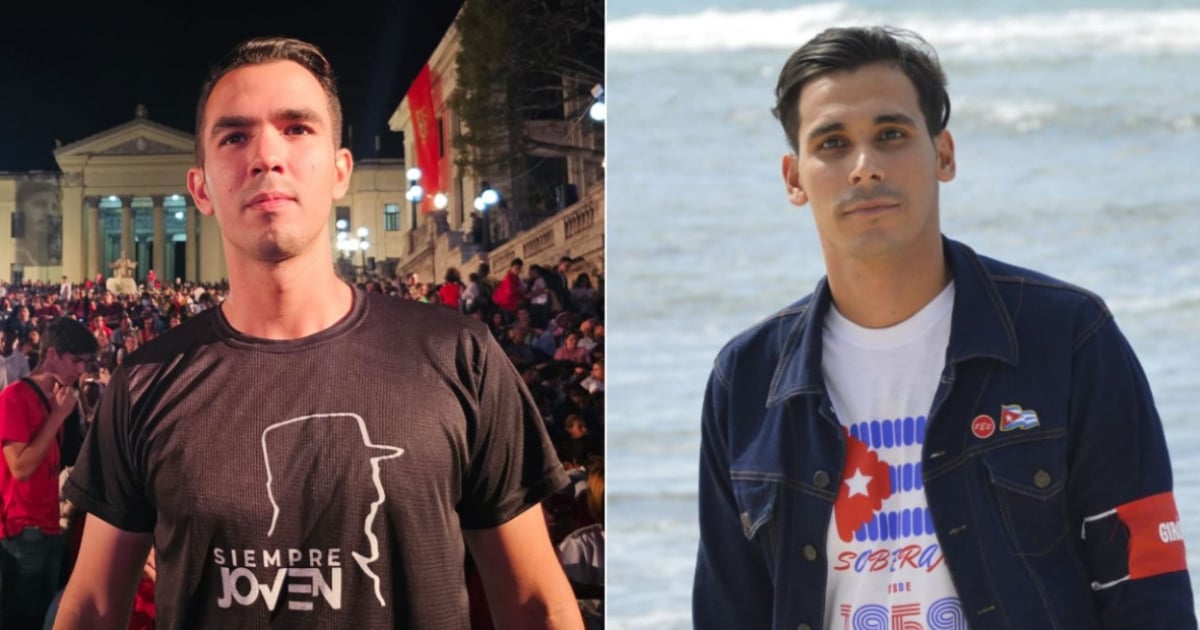
In the same vein, the national president of the FEU, Ricardo Rodríguez González, a member of the PCC, published a text in which he accuses media opposing the regime and "pawns of opinion" of promoting "hate" and "betrayal" regarding what he called "dialogues of respect and proposals" in the university.
Rodríguez reported pressures on student leaders aligned with the government, claiming that they are being coerced into making decisions contrary to institutional order and the "tranquility" of the universities.
"They are vilely manipulating our history, and we will not allow it. Enough," he declared. "Our spaces are authentic. Here I am to continue the Revolution for which our martyrs died."
The university strike and the internal divisions
The statements come in the context of unprecedented mobilization within Cuban universities, following new restrictions imposed by ETECSA, which limits the service in Cuban pesos while offering broader plans in dollars.
In response to widespread outrage, ETECSA announced a partial response: a supplementary package of 6 GB for 360 CUP, exclusively for university students, along with free access to more than 40 educational websites.
But university students reject mobile data packages solely for themselves and emphasize that they are not seeking sectorial privileges, but rather social justice and equitable access to the Internet for all citizens.
The peak of tension was marked by the call for an indefinite academic strike by students of Mathematics and Computer Science at the University of Havana, which was joined by faculties of Philosophy, History, Sociology, and Social Work, among others.
They also demanded the resignation of Ricardo Rodríguez González due to his inability to represent the student body.
Fracture in the official narrative
While student sectors are calling for horizontal dialogue, transparency, and inclusive measures, the recent statements from the leadership of the FEU and the University of Havana indicate an increasingly closed stance, aligned with the traditional discourses of power.
The accusation of external interference and media manipulation, common in government statements, contrasts with the deliberative, critical, and constructive tone of the communications issued by various university faculties.
The conflict also reveals a generational and ideological rift within the very structures of the Cuban educational system, with a youth that demands to be heard without filters or guardianship, and a leadership that fears losing control.
Meanwhile, student discontent continues to grow and gain support both inside and outside Cuba, in a context that some analysts compare to key moments of university mobilization in the country's history.
As academic José Raúl Gallego recently pointed out, "hopefully the university will regain the place it once held in the history of Cuba." The next battle could once again be decided from the classrooms.
Frequently Asked Questions about Student Protests in Cuba and ETECSA Rates
Why are student protests occurring in Cuba?
Student protests in Cuba have erupted over the new fees imposed by ETECSA, which limit national recharges to 360 CUP per month. These measures have been viewed as insufficient and affect access to the internet, which is deemed essential for the academic and professional development of students. The restrictions have also been criticized for their economic and social impact in a context of crisis in Cuba.
What measures has ETECSA taken in response to the protests?
ETECSA has announced an additional package of 6 GB for 360 CUP for university students, bringing the total to 12 GB per month. It has also provided free access to more than 40 educational sites. However, these measures have been deemed inadequate by many students who demand a structural reevaluation of the rates and connectivity on the island.
What has been the stance of the FEU regarding the protests and ETECSA's rates?
The University Student Federation (FEU) has issued statements in which, while claiming to support dialogue with students, has accused "enemies of the Revolution" of manipulating student discontent. The FEU has faced criticism for its alignment with the authorities, and many students have expressed their distrust towards the organization, viewing it as an extension of political power rather than a genuine representative of their interests.
What is the impact of ETECSA's rates on education in Cuba?
ETECSA's rates significantly limit internet access for students and teachers, affecting their ability to access study materials, conduct research, and maintain communication with tutors and colleagues. These restrictions are seen as an obstacle to educational advancement and contradict the digitalization policies promoted by the Cuban government.
Filed under: