
Related videos:
While hundreds of political and common prisoners suffer inhumane conditions in the island's prisons, the Cuban regime boasted this Friday at the UN about respecting human dignity in its penitentiary facilities.
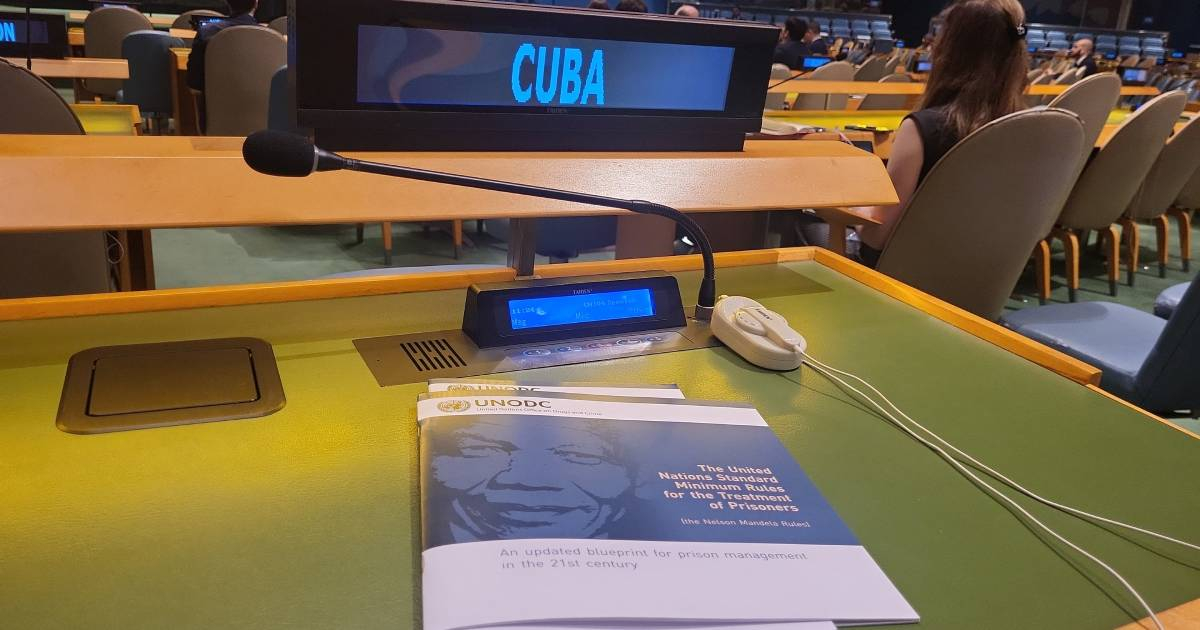
Through its official account on X (formerly Twitter), the Cuban diplomatic mission at the United Nations stated that the island's government participated in the high-level debate for the 10th anniversary of the Nelson Mandela Rules, international principles for the humane treatment of incarcerated individuals, and there presented “its best practices” regarding social reintegration, access to education, work, culture, and respect for the human dignity of inmates.
The statement unleashed immediate outrage. The Cuban journalist José Raúl Gallego described the official intervention as "an absolute and total lack of respect."
"And if not, let the political prisoners, the families of those incarcerated, or anyone who has been through a prison in Cuba say so," Gallego wrote on his Facebook profile.
The communicator reported that the regime systematically violates the Mandela Rules, and that in Cuba, prisons not only fail to meet minimum standards of humanity but often themselves become forms of torture.
The so-called Nelson Mandela Rules refer to the updated version of the United Nations Standard Minimum Rules for the Treatment of Prisoners, adopted by the UN General Assembly in 2015 in honor of the South African leader who spent 27 years in prison for fighting against apartheid.
These rules are not legally binding, but they represent an international ethical standard on how inmates should be treated: with dignity, without torture or discrimination, and with access to medical care, education, work, visits, and legal defense. They also establish the obligation to investigate any allegations of abuse or death in prison.
Despite all these guidelines and the official discourse, in recent years, Cuban prisons have become recurring sites of deaths in custody, torture, extreme malnutrition, and medical neglect.
According to reports from the NGO Cubalex, at least 56 people died in custody in Cuba between January 2022 and January 2024, of which 36 died in prisons. The most common causes were medical negligence, institutional violence, and lack of timely medical care.
Only in 2024, more than 40 inmates lost their lives under similar conditions, according to the Cuban Observatory of Human Rights.
Cases like that of Inoel Rodríguez, brutally beaten by several guards at the Ariza prison in Cienfuegos, or that of Jorge Luis Torres Vaillant, who died from malnutrition and without medical treatment in Santiago de Cuba, reveal a systematic pattern of abuse.
Prisoners such as Yankiel Justiz Despaigne in Melena del Sur and Frank Morales Cuesta in Boniato have also died from tuberculosis without adequate medical attention, where family members reported inhumane conditions.
The death of Manuel de Jesús Guillén Esplugas, a political prisoner from 11J, has raised even more alarm after being reported as a "suicide," which his family and organizations consider a covered-up murder.
These facts, documented in multiple reports from CiberCuba, reflect a structural crisis in the Cuban prison system, in glaring contradiction to international human rights standards, such as the Mandela Rules.
Frequently Asked Questions about Prison Conditions in Cuba and the Nelson Mandela Rules
What are the Nelson Mandela Rules and how do they relate to prisons in Cuba?
The Nelson Mandela Rules are a set of international guidelines adopted by the UN in 2015 to ensure the dignified treatment of incarcerated individuals. In Cuba, it has been reported that prisons do not meet these standards, as inhumane conditions, torture, and a lack of medical attention in jails have been reported, in clear violation of principles such as respect for human dignity and access to basic services.
How has the Cuban regime responded to criticisms regarding the treatment of prisoners?
In its official statements, such as the recent one at the UN, the Cuban regime has claimed that it respects human dignity in its prisons and promotes social reintegration. However, these claims have been labeled false by activists and human rights organizations, who report a systematic pattern of abuse and neglect within the Cuban penitentiary system.
How many political prisoners are there currently in Cuba?
According to reports from organizations such as Prisoners Defenders, Cuba holds more than 1,150 political prisoners, many of whom were detained for protesting against the government. This number includes minors and reflects the repression against those who oppose the Cuban regime.
What is the European Union's stance on human rights in Cuba?
Although the European Union maintains a political dialogue agreement with Cuba, it has been criticized for not taking a stronger stance on human rights violations on the island. Activists are urging Europe to be more consistent in its defense of democratic values, arguing that the agreement has not led to significant improvements in the human rights situation in Cuba.
Filed under: