
Related videos:
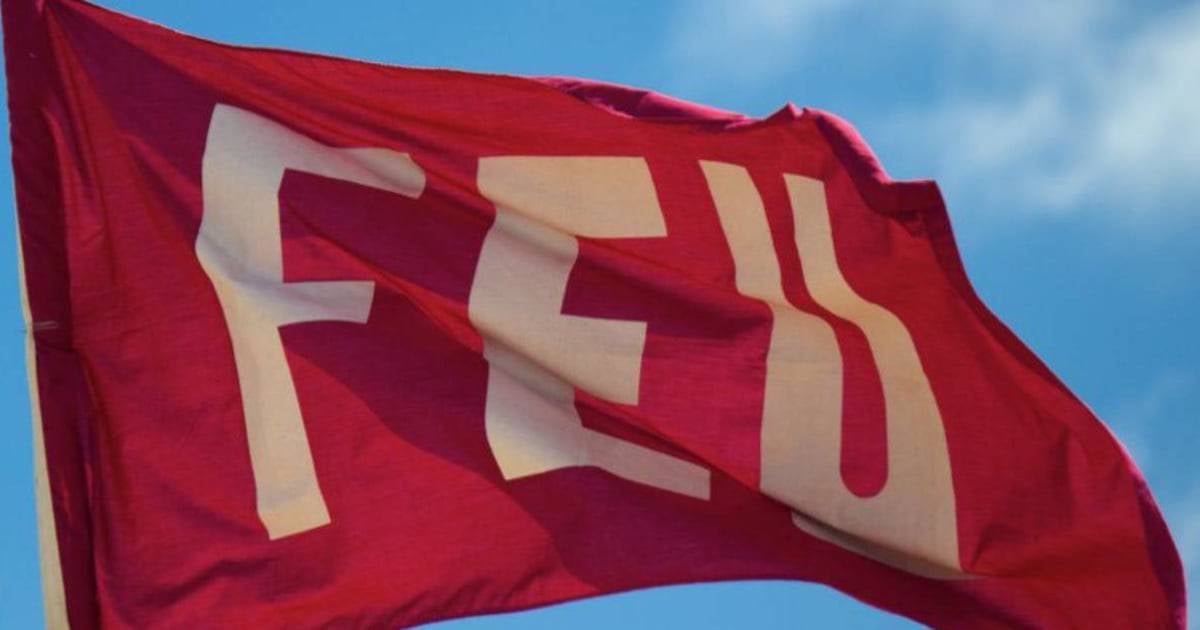
Amid the growing discontent over the increase in internet tariffs in Cuba, the University Student Federation (FEU) presented a report on Wednesday containing more than 40 proposals directed at the Telecommunications Company (ETECSA), following the meetings between both parties.
Undoubtedly, the document arises as a measure of political containment in a context marked by student protests, class strikes, and growing youth discontent. This scenario leads to a question: student representation or disguised political control?
The meeting on Wednesday, featured in a report on national television, was presided over by representatives of the Communist Party, the Government, the UJC, and the FEU itself, in what clearly structured as a strategy to appease the wave of criticism against the new pricing scheme for mobile data packages, implemented by ETECSA.
Although proposals were presented that included everything from technical adjustments to changes in the company's communication strategy, the overall tone of the meeting was more akin to a covert defense of the state enterprise than a genuine representation of youth discontent.
Beyond the results, the reality reveals the disconnect between the leaders of the FEU and the majority of the student body, who demanded a strong and direct stance against the so-called "tarifazo."
Apologies and even praise to ETECSA
One of the most controversial moments was led by Luis Yoel González, vice president of the FEU at the University of Pedagogical Sciences. After thanking everyone for the debates, he acknowledged ETECSA's efforts and urged others to understand the measure "based on the information received," thus softening the initial backlash, according to what was published by the official site Cubadebate.
In the same vein, José Alberto Almeida from the FEU of Havana emphasized the technical level of ETECSA specialists and proposed that university students be involved in national solutions, in a speech aligned with the official narrative.
These interventions can be seen as a betrayal of the legitimate protest that took place on social media and on campuses, where class disruptions were a clear way to express that connectivity in Cuba is not a privilege: it is a necessity.
Useful proposals or political maneuvering?
Among the mentioned initiatives are: a review of pricing policies and data packages; projects with social and economic impact; diagnosis of technical failures (batteries, nodes, infrastructures); creation of a manual for times of crisis, and proposals for "effective communication" to engage with the public.
But there was no specific mention of an immediate tariff reduction or an inclusive redesign of internet access in the country. No binding deadlines or real mechanisms for citizen oversight were offered either.
Judging by the content, the multidisciplinary group appears to be more of an instrument for institutional legitimization than a real platform for grassroots student pressure.
The dilemma of the FEU: voice of the students or arm of the power?
This episode marks a new chapter in the legitimacy crisis of the FEU, an organization historically used as a conduit for the political structures of the country. Despite the rhetoric of "frank and open exchange," what transpired this week demonstrates that student leaders opted for political accommodation instead of seeking popular support.
Meanwhile, the majority of university students in Cuba continue to face serious difficulties in connecting, in a country where access to the internet remains a luxury divided by class and geographic location.
In fact, under pressure from the regime and its apparatuses, the Faculty of Mathematics and Computer Science (MATCOM) at UH announced on Monday, June 9, the cancellation of the teacher strike that began on June 4, after receiving concrete commitments from the Ministry of Higher Education and ETECSA.
The report presented by the FEU has not calmed the waters. On the contrary, it has exposed the chasm between a leadership that calls for patience and understanding and a youth that demands real change and a voice of their own. If one thing is clear from this chapter, it is that true student representation is not built on praise or excuses, but on courage and coherence.
Frequently Asked Questions about the Student Protests and ETECSA's Rate Increase in Cuba
What proposals did the FEU present to ETECSA in response to the rate increase?
The University Student Federation (FEU) presented more than 40 proposals to ETECSA, which include a review of the pricing policy, the creation of a manual for times of crisis, and social impact projects. However, no deadlines were provided, nor were immediate tariff reductions mentioned, leading to doubts about the effectiveness of these initiatives.
How has the Cuban student body responded to the increase in ETECSA rates?
The increase in ETECSA rates has sparked a wave of protests at Cuban universities, where students have expressed their complete rejection of the new rates, arguing that they undermine equitable access to education and information. Many students are calling for the resignation of FEU leaders for failing to represent their interests and for supporting the regime.
What role has the FEU played in the protests against ETECSA?
The FEU has been criticized for its ambivalent stance. Although they initially rejected the rate hike, many of their leaders quickly aligned with the official discourse, which has generated distrust among students. Their role has been perceived more as an attempt to quell protests than as a genuine representation of the student body.
Why is the FEU accused of being an arm of power in Cuba?
The FEU is accused of acting as a political arm of the Communist Party because, despite student complaints, it has defended the regime's measures and dismissed protests, accusing "enemies of the revolution" of manipulating the discontent. This has generated a crisis of legitimacy and distrust towards the student organization.
Filed under: