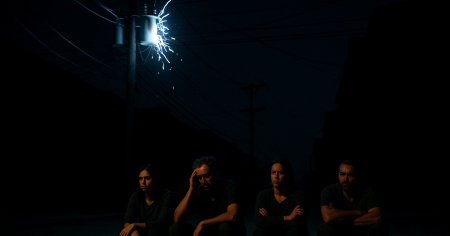
The Electric Company of the Isle of Youth urged the public to maintain their trust in its employees amid growing citizen unrest over the prolonged blackouts that have been affecting the area for more than a week.
"To the people of Pineiro, have confidence in our electrical workers. We will overcome these outages together," the entity stated this Thursday in a note shared on social media, where it also announced the coupling of a generator to machine 3 of the MAN 1 plant, as part of maintenance efforts aimed at increasing local generation capacity.
Despite these efforts, the situation remains critical. Initially, the outages were scheduled in alternating blocks of five hours without electricity and five hours with service.
But currently, most circuits experience outages of five hours with only two or three hours of power between each blackout.
In some areas, such as Micro 70 and Sierra Caballos, the impacts even exceed the anticipated times.
Public discontent has manifested in hundreds of comments on social media. The phrase "in the future," used by the company when referring to the possible reconstruction of three damaged generators with Chinese technical assistance, has become a subject of mockery and skepticism.
"Future? Ha, I've already wasted my life waiting," joked a user, while others pointed out that without financial resources, the promises will continue to be "nothing but empty words."
The arrival of the G-83 engine, which provides 1.6 MW, was announced as a temporary relief, and work is also being carried out on the MAN 5 unit and other machines. However, the structural solution will depend on technical and financial conditions that have yet to be defined, which does not help to ease public unrest.
"How is it possible to schedule disruptions from 10 p.m. to 3 a.m., and then another from 1 a.m. to 6 a.m.? Who can sleep like that?" a mother lamented, outraged by the impact of the heat and mosquitoes on the most vulnerable, including small children and the elderly.
The situation has also affected food supply: families without access to gas are claiming that they can't even boil milk.
The blackouts began on June 14, following the shutdown of two generating units. The deficit put a strain on a system that, until recently, was a model of energy self-sufficiency in Cuba.
With a daily demand of 28 MW, the Island barely manages to produce half of that. This crisis, coinciding with a visit from the ruling Miguel Díaz-Canel to the territory, has undermined the old myth that “in the Isle of Youth, the power never goes out”.
In addition to the physical and psychological strain, electrical instability also poses a threat to the tourist hub of Cayo Largo del Sur, which is a government priority for the summer season.
This pressure partly explains the presence of reinforcement brigades from Sancti Spíritus and the National Generator Maintenance Company, who are working against the clock to restore stability to the system.
The authorities have promised to resolve the issue “within a maximum of eight days,” but the population demands tangible results. On social media, symbolic calls for the autonomy of the territory are already circulating, and even for the administrative and energy independence of the Island.
“This is no longer just about the electricity: it's about dengue, food, insecurity… We are exhausted,” wrote a resident. What started as a technical crisis has turned into another symptom of the deep social fatigue affecting Cuba.
Filed under: