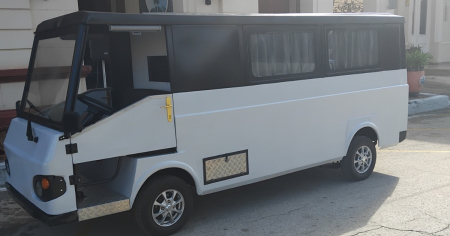
After the wave of criticism generated by the decision to
In a recent post on Facebook, the sector head, Eduardo Rodríguez Dávila, acknowledged that the initial distribution was re-evaluated following public complaints and announced that only half of these vehicles will remain in the capital.
Likewise, he emphasized that the rest will be sent to other provinces with higher urban traffic density.
According to the announcement, 50 minibuses will remain in Havana, while the other 50 will be distributed among Santiago de Cuba (20), Holguín (10), Camagüey (10), Villa Clara (5), and Ciego de Ávila (5).
The measure aims to justify the decision with the argument that Havana accounts for approximately 50% of the country's urban traffic.
However, the change in criteria reflects the social pressure generated by a citizenry tired of centralization and the unequal distribution of public resources.
Another common complaint was the sending of damaged vehicles that had already completed their cycle in Havana to the provinces; in this case, it involved 67 non-operational gacela minibuses.
Although the minister denied that it is a discriminatory policy, he acknowledged that it is a way of "making the most of what we have" in the midst of resource scarcity.
He also appealed to the argument of provincial ingenuity, referring to the ability of innovators in the regions to revive these used vehicles under a regime of lower requirements.
Critics also pointed to the poor current state of the service provided by the gacelas in the capital, with reports of irregular schedules, route deviations, inadequate maintenance, and unrealistic fares that drivers offset with unregulated nighttime services.
The ministry itself acknowledged that the service has been the subject of complaints and sanctions, and promised the creation of a working group to assess potential improvements.
However, he warned that for now the system will remain unchanged.
Regarding the new minibuses, they will operate during the day on routes different from the current ones, connecting areas of high mobility such as hospitals or transit points.
They will have a fixed price of 20 pesos per segment, will not offer nighttime service, and must start their routes with empty vehicles.
Its maintenance will be the responsibility of the supplier's network of workshops, and the funding will be covered by the Public Transport Development Fund.
Despite this partial redesign, the Ministry made it clear that minibuses will not be distributed in all provinces, as a minimum of five vehicles per route is needed to ensure service.
In summary, many areas of the country will continue to wait for solutions while the administration attempts to quell public discontent with partial measures that, rather than being planned, seem to be imposed by civic pressure.
The public transport crisis in Havana has reached a critical point, with canceled routes, vehicles out of service, and an increasingly frustrated population faced with a lack of concrete solutions.
One of the most alarming cases is the collapse of the so-called "gacelas", which have repeatedly disappeared from various areas of the city due to a lack of fuel, leaving entire communities without alternative means of transportation.
The Ministry of Transport has attempted to demonstrate control over the situation, but its messages have been contradictory. While it issues public warnings against private drivers for allegedly violating regulations, it does not provide effective solutions that ensure stability and operational efficiency for the state system.
This is compounded by the direct impact of power outages on the operation of alternative means such as electric tricycles. The reliance on energy in a context of national energy deficit turns these solutions into mere stopgaps that are unable to sustain themselves over time.
Official statistics also provide no relief: the numbers show a drastic decline in transportation capacity, with millions fewer trips and a vehicle fleet reduced to the minimum functional level.
Frequently Asked Questions about the Distribution of Microbuses in Cuba
Why did the Cuban government change the distribution of microbuses?
The Cuban government changed the distribution of microbuses due to social pressure and citizen protests that arose after the initial decision to allocate 100 new microbuses exclusively to Havana. Citizens criticized the centralization and inequality in the allocation of resources, which forced the Ministry of Transport to rectify and distribute half of the microbuses to other provinces.
How will the new minibuses be distributed in Cuba?
The new distribution establishes that 50 minibuses will remain in Havana, while the other 50 will be allocated among Santiago de Cuba (20), Holguín (10), Camagüey (10), Villa Clara (5), and Ciego de Ávila (5). This measure aims to meet the demands of the provinces with higher urban traffic density.
What will happen to the deteriorated Gazelle minibuses in Havana?
The deteriorated Gazelle minibuses will be sent to other provinces for repair with the support of the Public Transport Development Fund. This measure aims to make use of the used vehicles in an attempt to extend their lifespan through local repair and innovation, despite criticism for sending poorly condition vehicles to other regions.
What features will the new minibuses arriving in Havana have?
The new minibuses arriving in Havana are air-conditioned and can accommodate 14 passengers. They are from the Chinese brand Foton and are expected to operate on daytime routes in high-traffic areas. They will not offer nighttime service and will have a fixed fare of 20 pesos per segment.
What is the current state of public transportation in Havana?
The public transport in Havana is in a critical state, with canceled routes and vehicles out of service due to a lack of fuel and maintenance. The "gacelas," a taxi service, have collapsed in several areas of the city, leaving many communities without adequate mobility alternatives.
Filed under: