The President of Russia, Vladimir Putin, issued a clear warning to NATO on Monday by announcing the strengthening of Russia's nuclear triad, in response to the increasing military spending and new strategies of the Atlantic Alliance.
The leader accused NATO of provoking a global arms race and denounced the recent attacks by the United States and Israel against Iran as an "unjustified aggression."
During a ceremony with military academy graduates, Putin announced that Moscow is strengthening its nuclear capabilities with Tu-160M strategic bombers and RS-24 Yars intercontinental ballistic missiles, while starting serial production of the medium-range hypersonic system Oreshnik, which was tested last November in Ukraine.
"The strengthening of the nuclear triad - strategic aviation, atomic submarines, and intercontinental missiles - is a priority to ensure our security," he emphasized in a nationally televised message.
Putin also mentioned the upcoming NATO summit, where it is expected that member countries will approve an increase in defense spending to 5% of GDP by 2035.
"It is clear who is the true responsible party for global militarization," he stated.
"In light of the growing geopolitical tension, we will continue to adopt appropriate measures to strengthen the security of Russia and our allies. Developing our Armed Forces is a guarantee of a sovereign and independent Russia," he said.
Rejection of the attack against Iran
In parallel, the Kremlin strongly condemned the recent attacks on nuclear facilities in Iran, carried out by American and Israeli forces.
In a meeting with Iranian Foreign Minister Abás Araqchí, Putin described the actions as an "absolutely unjustified aggression" and reiterated Russia's support for Iran's right to develop a nuclear program for peaceful purposes.
Araqchí expressed gratitude for Moscow's support and described the bilateral relationship as "strategic."
"Russia is on the right side of history," said the diplomat, after denouncing that the U.S. and Israel "attack our sovereignty" and violate international law.
The Kremlin spokesman, Dmitri Peskov, stated that Moscow will assess what kind of support Iran needs at this critical moment.
He also warned about the risk of radioactive contamination and the possibility of an expansion of the conflict in the Middle East if the situation continues to escalate.
Tensions with the United States
Amid the deterioration of relations with Washington, Moscow accused U.S. President Donald Trump of ignoring a Russian mediation proposal aimed at preventing conflict with Iran.
According to sources from the Kremlin, Putin had offered to act as a mediator between Tehran, Tel Aviv, and Washington, but never received a formal response.
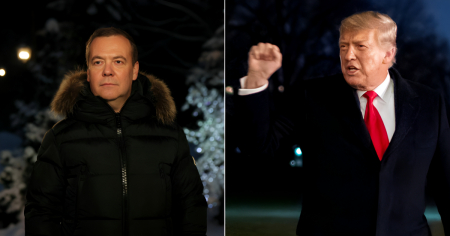
High-ranking Russian officials, such as the Vice President of the Security Council, Dmitri Medvedev, have been unequivocal: "Trump has just started a new war for the United States," he stated, noting that the offensive in Iran "endangers the security of all of West Asia."
NATO Context: Increase in military spending
All of this is happening on the eve of the NATO summit in The Hague, where the approval of the new commitment to spend 5% of GDP is expected.
Although the United States has promoted this objective, President Trump has suggested that his country may not fully meet it, citing its history of financial support for the alliance.
Some countries, like Spain, have expressed their reservations. President Pedro Sánchez stated that committing to that percentage would be "unreasonable and counterproductive." NATO plans to make its application more flexible to accommodate cases like the Spanish one.
Meanwhile, nearly one third of Alliance members still do not meet the current target of 2%, despite the increase in spending following the Russian invasion of Ukraine in 2022.
Global escalation
The rhetoric from Moscow, the enhancement of its nuclear capabilities, and the escalating tensions in the Middle East indicate a new phase of international confrontation.
In Medvedev's words: "The United States has crossed a dangerous line." In response, Putin sends a clear message: Russia will not be left behind.
Frequently Asked Questions about Putin's Warning to NATO and the Conflict in the Middle East
What does the strengthening of the Russian nuclear triad announced by Putin imply?
The strengthening of the Russian nuclear triad involves the modernization and expansion of its strategic nuclear capabilities, including strategic aviation, nuclear submarines, and intercontinental ballistic missiles. Putin emphasized that this reinforcement is a priority to ensure Russia's security in response to NATO's actions.
What was Russia's response to the attacks by the United States and Israel against Iran?
Russia strongly condemned the attacks by the United States and Israel against nuclear facilities in Iran, deeming them an "absolutely unjustified aggression". Putin reiterated his support for Iran's right to develop a nuclear program for peaceful purposes and criticized the escalation of tensions in the Middle East.
What measures is NATO adopting in response to the current geopolitical situation?
NATO is considering an increase in defense spending to 5% of GDP by 2035, in response to rising global tensions. This increase aims to strengthen the military capability of member countries in light of the escalation of international conflicts such as that in Ukraine and Russia's actions.
What impact do the tensions between the United States and Iran have on global stability?
Tensions between the United States and Iran increase the risk of an expansion of the conflict in the Middle East, which could further destabilize the region and have global repercussions. The recent U.S. offensive against Iranian nuclear facilities has heightened tensions and the possibility of retaliation from Tehran.
Filed under: