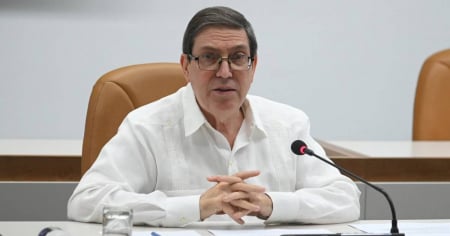
The Minister of Foreign Affairs, Bruno Rodríguez Parrilla, accused residents in the state of Florida of “compulsively” replicating posts from the United States Embassy in Cuba to “impose narratives” against the government.
From his official account on X, Rodríguez declared that the interactions on the posts of the Facebook page of the U.S. diplomatic mission in Havana are “not spontaneous.”
"We can demonstrate that this is a propaganda and amplification operation. Users from Florida are compulsively replicating content to impose narratives against the Cuban government," wrote the chancellor.
However, the lack of concrete evidence and the tone of the complaint sparked ridicule and criticism on social media.
Several users pointed out the absurdity of a head of diplomacy dedicating time and state resources to examining shares and comments on social media. “Is the Foreign Minister really analyzing who shares the posts of an Embassy? The level of ridiculousness you have reached is unparalleled,” questioned an internet user.
Other comments focused on the contrast between the government's concern for what happens outside of Cuba and the repression of expression within the country.
"What is interesting is not that people from Florida share critical content: it's that millions inside Cuba would do the same if they weren't censored, monitored, or imprisoned," wrote a user.
In his view, “talking about amplification as if it were a crime reveals how much fear they have of public opinion when it is not under state control.”
And he concluded: "If the government's arguments were so solid, why worry so much about Facebook comments? The narrative that bothers them is not imposed from outside; it is generated from within... and you have been ignoring it for decades."
Similar criticisms highlighted the unconvincing nature of the complaint, the lack of official self-criticism, and the indifference to addressing the real problems faced by Cubans. "My God, they can't even put together 10 tweets; they should focus on solving real issues instead of wasting time monitoring who visits the Embassy's profile," commented another internet user.
The chancellor's statement was seen as yet another attempt to divert attention from internal discontent. Instead of amplifying his message, social media made it the target of irony, making it clear that the true narrative that disturbs those in power does not come from outside, but from a citizenry tired of being silenced.
Days ago, the Cuban government prevented the invited singer from performing the national anthem at the reception for the Independence Day of the United States in Havana on July 4th.
Additionally, it unleashed a new wave of repression to prevent journalists, activists, and political opponents from participating in the event organized by the U.S. Embassy.
According to reports from opposition members and human rights organizations, the measure included house arrests, arbitrary detentions, and police operations in several provinces aimed at isolating dissent and halting any contact with U.S. diplomats.
In recent weeks, alleged “spontaneous” citizens have confronted the Chargé d'Affaires of the United States in Cuba, Mike Hammer. What the regime tries to present as casual scenes are, in reality, clumsily orchestrated episodes.
Since assuming the role of head of the U.S. diplomatic mission in Havana in November 2024, Hammer has been the target of an increasing campaign of harassment by the Cuban regime.
His policy of direct contact with citizens, human rights defenders, activists, and religious leaders has visibly unsettled the authorities.
In recent weeks, the Ministry of Foreign Affairs (MINREX) has publicly attacked Hammer, accusing him of "provocative behavior," "interference," and "violating the Vienna Convention."
The Deputy Director General for the U.S. at MINREX, Johana Tablada de la Torre, publicly warned him, saying "do not confuse patience with weakness", in a veiled threat widely disseminated through state media.
On May 30th, the regime summoned Hammer to deliver a Note Verbale of protest, blaming him for inciting "criminal actions" in Cuba.
Two days later, the U.S. State Department responded by summoning the Cuban ambassador in Washington, in rejection of the harassment against its diplomats.
Meanwhile, official media outlets such as Cubadebate, Granma, and numerous social media profiles controlled by State Security have intensified their discrediting campaign against Hammer, attempting to portray him as an instigator of unrest and part of a supposed destabilization plan.
Frequently Asked Questions about the Cuban Government's Policy and Critiques of the Regime
Why is the Cuban government concerned about the U.S. Embassy's posts on Facebook?
The Cuban government, through its Minister of Foreign Affairs, Bruno Rodríguez, accuses residents in Florida of replicating publications from the United States Embassy in Cuba to impose narratives against the Cuban regime. According to Rodríguez, these interactions are not spontaneous and are part of a propaganda and amplification operation. However, the lack of concrete evidence to support these claims has led to mockery and criticism on social media.
How has the Cuban population reacted to Bruno Rodríguez's statements?
The statements made by Chancellor Bruno Rodríguez have been the subject of criticism and mockery on social media. Many users point out the regime's inconsistency in worrying about what happens outside of Cuba while suppressing expression within the country. Additionally, there are questions about the allocation of state resources to monitor interactions on social media, and there is criticism of the lack of official self-reflection regarding the internal problems faced by the Cuban population.
What repressive measures has the Cuban government taken recently?
The Cuban government has intensified repression to prevent journalists, activists, and political opponents from participating in events organized by the U.S. Embassy. This has included house arrests, arbitrary detentions, and police operations in several provinces. These actions reflect the regime's attempt to isolate dissent and curb any contact with U.S. diplomats.
What is the Cuban government's stance on protests in other countries?
The Cuban regime has been critical of the protests in the United States, denouncing excessive use of force and human rights violations. However, this stance has been criticized for its lack of coherence, as the Cuban government represses protests and limits freedoms within the island. The contradiction between its international rhetoric and internal practices has been a subject of criticism from the populace and international observers.
Filed under: