
Related videos:
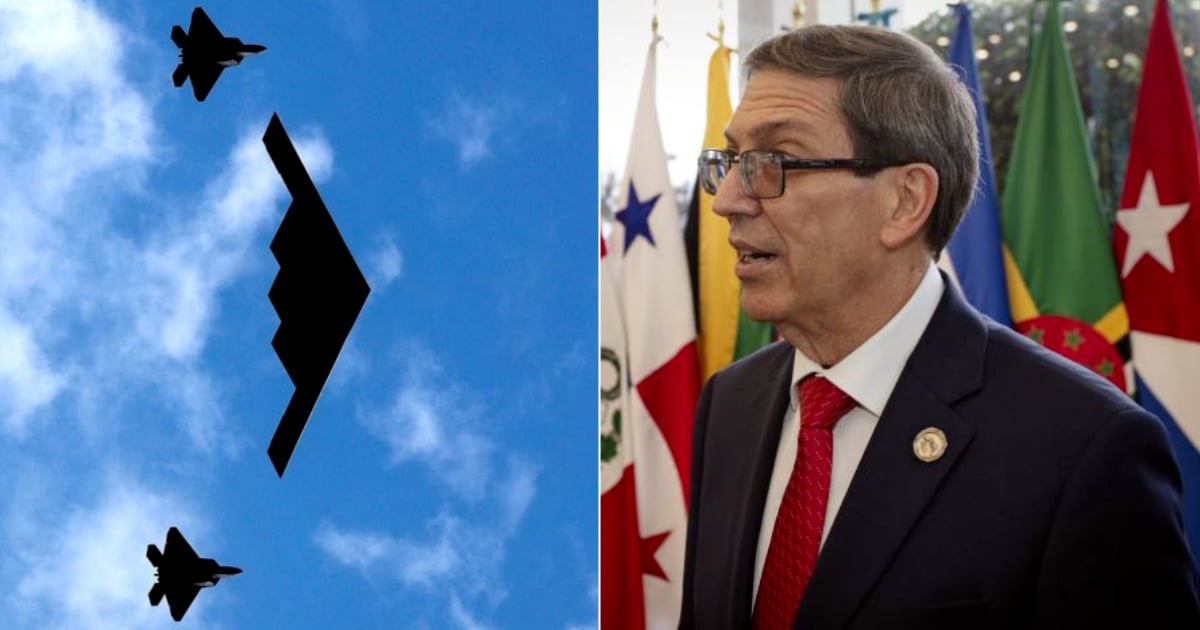
The chancellor of the Cuban regime, Bruno Rodríguez Parrilla, recently posted a tweet in which he criticized the American doctrine of "Peace through strength".
In his message, he stated that it is an "imperialist doctrine" that seeks to "impose terror, armamentism, and global destabilization" to sustain what he described as "the hegemonic debacle of the U.S." He concluded with a decisive statement: "It rests on the notion that those who hold power are right."
The statement, far from being a mere diplomatic opinion, reveals a more complex rhetorical operation. It intertwines the distortion of a strategic concept, the reaffirmation of an ideological narrative rooted in the Cold War, and a barely concealed fear of a potential scenario: that the United States may resort to this doctrine against key allies of the Cuban regime, such as Iran or Venezuela.
What is "Peace through strength"?
The doctrine known as ‘Peace through Strength’ has roots that date back to ancient Rome —si vis pacem, para bellum— but its modern formulation was popularized by President Ronald Reagan in the 1980s.
The premise is simple: a robust military power serves as a deterrent against potential enemies and, therefore, can preserve peace.
Although it can and has been used as a justification for interventionist policies, it has also served to define defensive strategies, especially during the Cold War.
Its contemporary use is not monolithic: it varies according to the contexts and governments that invoke it. It is not, in itself, a warlike doctrine, although it can be used for aggressive purposes if not subjected to clear legal and political limits.
The Political Use of Discourse: Between Anti-imperialism and Hypocrisy
The condemnation of Rodríguez Parrilla fits perfectly within the official rhetoric of the Cuban regime, which for over six decades has made anti-imperialism its central narrative.
By labeling this doctrine as "imperialist," the chancellor is not aiming to nuance or question its application in specific contexts, but rather to completely delegitimize it. His emotional language—“terror,” “debacle,” “militarism”—serves a propagandistic purpose, not an analytical one.
But beyond the style, what is truly unsustainable is the hypocrisy of the approach. Cuba categorically rejects any doctrine of intervention under the argument of national sovereignty, even when it involves stopping crimes against humanity.
This stance, however, is applied selectively: it has never issued a clear condemnation of the repressions carried out by strategic allies such as Russia in Chechnya and Ukraine, Venezuela, Syria, or Iran itself. Thus, the Cuban regime uses international law as a political tool of convenience, rather than as a commitment to universal principles.
The double standard of the Cuban regime: Sovereignty for me, intervention for others
One of the most striking —and less sustainable— aspects of the Cuban regime's diplomatic discourse is its systematic appeal to the principle of national sovereignty and non-intervention.
From the UN forums to its official statements, Havana has defended for decades that no state should interfere in the internal affairs of another, even in cases of flagrant human rights violations or crimes against humanity. However, this defense has not been consistent with its foreign policy record.
For much of the 20th century, the Cuban regime was directly involved in military interventions and covert operations in Africa, Latin America, and other regions, under the pretext of "revolutionary internationalism."
Instead of condemning armed interventions, it actively promoted them when it came to supporting regimes or movements aligned with its ideology.
In Africa, more than 300,000 Cuban soldiers participated in the Angolan civil war between 1975 and 1991, supporting the MPLA in one of the largest military interventions of the century outside the framework of the superpowers.
It also deployed troops in Ethiopia, provided military advice to governments and armed movements in Congo, Guinea-Bissau, and Mozambique, and trained fighters in its military schools.
In Latin America, Cuba's support for guerrilla/terrorist movements has been a constant since the 1960s: the Sandinista Front in Nicaragua, the FMLN in El Salvador, the FARC in Colombia, and numerous smaller groups in Venezuela, Chile, Uruguay, and Argentina. Even the failed expedition of Che Guevara to Bolivia in 1967 was a direct operation of revolutionary intervention.
To justify these actions, the regime developed its own narrative: it was not intervening but offering "solidarity assistance"; it was not sending troops but "internationalist fighters"; it was not promoting war but the "liberation of peoples."
This manipulative use of language allowed him to build a moralistic facade that he now uses, without irony, to attack other powers when they invoke principles of security or the protection of human rights.
Ultimately, Cuba's defense of sovereignty is not a firm legal principle, but rather a strategic tool that is activated or ignored depending on what is convenient for the regime.
That is why, when the Cuban chancellor denounces doctrines such as “peace through strength” as instruments of domination, he conveniently overlooks the fact that the regime has historically employed armed interventionism to export its ideological model, without ever being held accountable in any international court.
This fundamental contradiction undermines much of the Cuban diplomatic discourse and turns its defense of non-intervention in conflicts where the lives and rights of millions of people are at stake into an exercise in political cynicism.
The reaction to Iran: Fear of the chain of consequences
The background of Rodríguez Parrilla's message seems to stem more from fear than from criticism. The recent escalation between the United States and Iran —which included mutual threats, military movements in the region, and bombings of nuclear facilities— sets off alarms in Havana, which views Tehran as a key partner.
Iran has been a provider of technological cooperation, intelligence, and fuel at critical moments for Cuba, especially following the collapse of Venezuela as a reliable energy partner.
A Western intervention against the regime of the ayatollahs, whether armed or through more covert means, would weaken one of the few international allies with which the Cuban regime shares geopolitical interests and authoritarian models of internal control.
Therefore, the chancellor's message not only aims to delegitimize the U.S. but also to diplomatically shield Iran, raising the political cost of any potential action against the Persian regime.
International law, sovereignty, and the R2P doctrine
The most delicate point in this debate is the legal aspect. In international law, the use of force is regulated by the United Nations Charter. It is only permissible in cases of self-defense or with authorization from the Security Council.
In this context, the doctrine "Peace through strength" should be interpreted with caution: as a strategy of deterrence, not as a blank check for military intervention.
In parallel, since 2005 the international community has made progress in formulating the doctrine of Responsibility to Protect (R2P), which establishes that sovereignty entails duties, and that if a state fails to protect its population from atrocious crimes, the international community must act, even —as a last resort— through the use of force.
The Cuban regime, however, outright rejects this doctrine. It does so because a coherent interpretation of the Responsibility to Protect (R2P) would imply intervening against states that commit systematic crimes, as occurs in regimes allied with Havana and, according to some experts, on the island itself.
Ironically, this places Cuba on the opposite side of international law regarding the protection of human rights, even as it claims to defend it through nationalist rhetoric.
Change of regime? The concept that sends shivers down the spine in Havana
One of the obsessions of Cuban rhetoric is to denounce alleged attempts at "regime change" promoted from abroad.
It is true that in contexts like Libya or Iraq, interventions based on protection criteria ended up destabilizing countries and fostering ungovernability, which has generated a valid debate about the limits of humanitarian interventions.
However, equating any doctrine of intervention or deterrence with regime change is, again, a self-serving distortion. The R2P does not endorse government changes as an objective, and international law requires multilateral mechanisms for its implementation.
The problem, in reality, is not the doctrine itself, but rather the fear of repressive regimes of any mechanism that could put an end to their impunity.
The message from Chancellor Bruno Rodríguez Parrilla does not aim to protect peace or international law. It seeks to shield the Cuban regime and its authoritarian allies from any external threat, disguising that defense with a supposedly principled discourse.
His criticism of "Peace Through Strength" is not based on ethical concerns, but on the genuine fear that one day the international community will cease to tolerate those who, under the banner of sovereignty, systematically violate the fundamental rights of their citizens.
Filed under: