
Related videos:
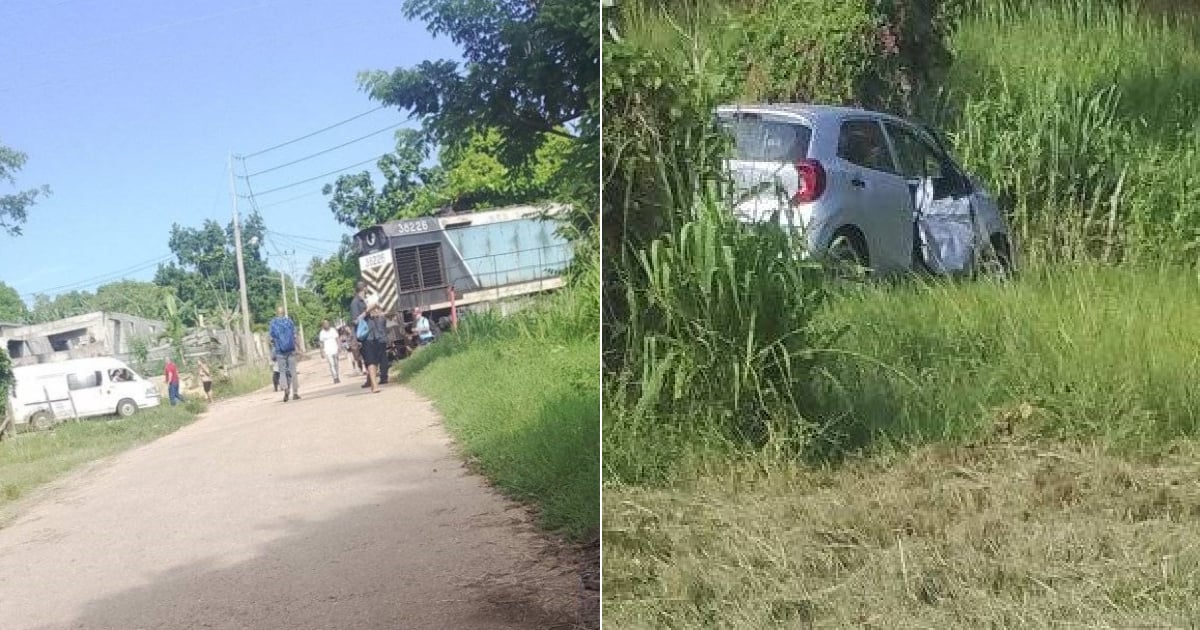
The train that runs the route to Expocuba in Havana collided this Thursday morning with a car at a railway crossing, with no casualties reported, according to unofficial reports.
The accident occurred when the car obstructed the level crossing at the América estate in Calabazar and was struck by the train that runs to the fairgrounds, according to a post in the Facebook group "LOVERS OF CUBA'S RAILROADS".
User Eddy Segura shared photos following the incident and stated that it ended “fortunately without injuries for the drivers of the car.”
In the comments of his post, Segura celebrated that "the worst didn't happen" and attributed it to the fact that the train passes through that area "quite slowly."
"Even so, it can be seen that it dragged the cart for about 20 meters, and yes, those in the cart were quite startled, but thank God they were unharmed," he stated.
Several people noted that the collision may have occurred due to a lack of signage at all the level crossings that the train uses on its way to Expocuba.
Some have noted that the signs have been stolen, but the authorities should have replaced them after so many years of that road being out of use.
However, other internet users pointed out that the lack of signage does not exempt drivers from responsibility. "Don't blame the signs. Every level crossing is a mandatory stop; every driver studied Law 109 [Traffic Safety Code]. We are irresponsible," warned one person.
The train accident occurred just 15 days after the train service to Expocuba resumed, following several years of being halted. On July 2, the train resumed operations, departing from the Central Station in Havana, from Wednesday to Sunday, with a fare of 20 pesos. The government promoted it as an “affordable and convenient option” during the summer season.
When announcing it, the Minister of Transportation, Eduardo Rodríguez Dávila, indicated that each train would consist of three cars, with each having a capacity for 48 seated passengers and 20 standing, allowing for a total of 204 passengers per trip.
During the journey of approximately 80 minutes, the train makes stops at 12 stations: Luyanó, Dolores, La Víbora, Naranjito, Miraflores, Los Pinos, Alcázar, Arroyo Naranjo, El Galápago, Calabazar, Piscina del Parque Lenin, and Expocuba.
The official presented the resumption of this service as a step within the government strategy to "facilitate access" to Expocuba and other nearby recreational areas such as the National Botanical Garden, Lenin Park, and the National Zoo.
As of the time of writing this note, no official information has been published about the accident.
Recently, the train to the eastern beaches of Havana has also beenrehabilitated, providing a low-cost alternative for the residents of the Cuban capital.
The government is trying to alleviate the harsh effects of the severe transportation crisis by restoring railway services in several provinces, such as Ciego de Ávila and Matanzas.
Last week, after seven years of inactivity, the train servicing the Morón-Perea-Venegas route resumed operations in Ciego de Ávila; meanwhile, the government announced that efforts are underway to restore the historic electric train of Hershey.
Meanwhile, the railway infrastructure continues to be a victim of vandalism and frequent accidents that affect both the safety and the efficiency of passenger and freight transportation.
Frequently Asked Questions about the railway accident in Expocuba and the transportation situation in Cuba
What happened in the train accident to Expocuba?
The train heading to Expocuba collided with a car at a railway crossing in Calabazar, Havana. Fortunately, there were no injuries in the incident. The accident occurred because the car obstructed the level crossing, causing the train to drag it for about 20 meters.
What are the causes of railway accidents in Cuba?
The causes of railway accidents in Cuba include both internal system errors and external factors, such as lack of signaling, human errors, and vandalism. Deteriorated infrastructure and the theft of signals contribute to accidents, while the responsibility of drivers also plays a crucial role in road safety.
What measures is the Cuban government taking to improve railway transportation?
The Cuban government is working to enhance rail transport by rehabilitating rail routes and promoting their use as an economical option for the population. Services such as the train to Expocuba and to the beaches east of Havana have been reinstated. However, the infrastructure continues to face challenges due to vandalism and maintenance failures.
How does the lack of signage at railway crossings in Cuba affect safety?
The lack of signage at railroad crossings in Cuba significantly increases the risk of accidents. The absence of warning signs and barriers at these crossings means that drivers do not have enough information to make safe decisions, which can result in collisions with trains.
Filed under: