
Related videos:
Raúl Castro, who in 2019 advocated for the age limit of 60 years to access the Presidency of the Republic for the first time, has now proposed its elimination, and the National Assembly of People's Power (ANPP) approved the constitutional reform in a vote without dissent or visible debate.
The initiative did not come from the parliament or a popular movement. It was Castro himself, at 94 years old, who requested the change from the Politburo of the Communist Party, as revealed by the president of the ANPP, Esteban Lazo, according to the official site Cubadebate.
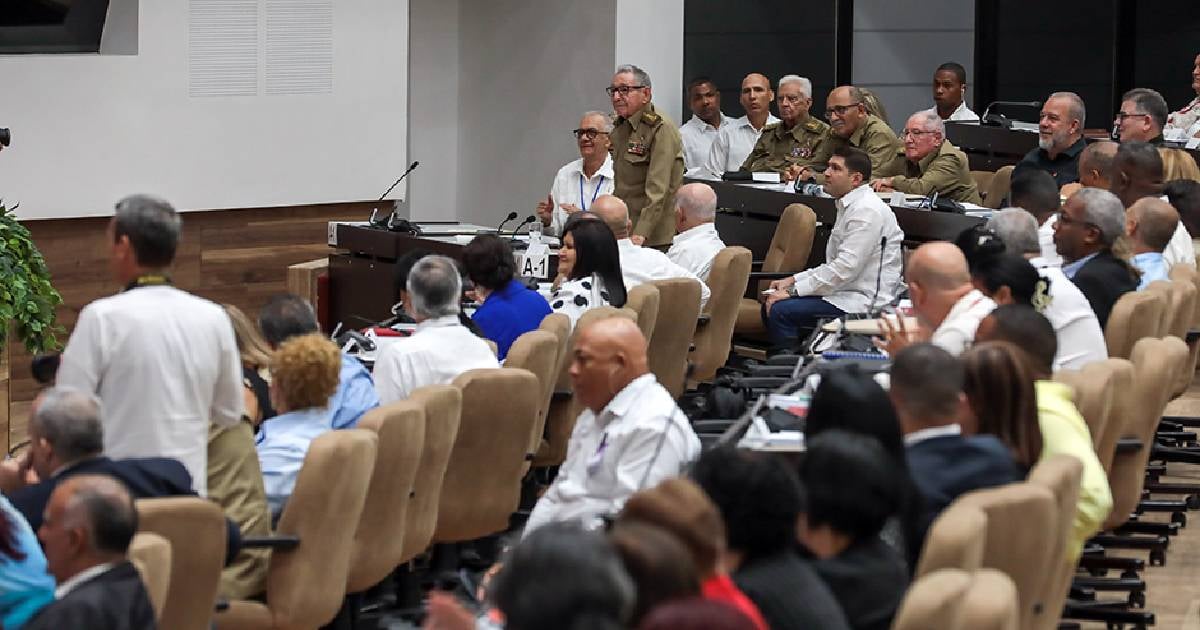
It was subsequently endorsed by the Council of State and finally presented to the plenary of the legislative body, where the 440 present deputies in a nominal vote said "yes," with no objections.
The amendment removes the second paragraph of Article 127 of the Constitution, which established the age limit for running for office for the first time. Lazo explained that the goal is not to exclude people "in full use of their faculties" for age-related reasons, especially in the context of an aging population.
In April 2016, during the VII Congress of the PCC, Castro announced that a maximum age limit of 60 would be set for entering the Central Committee of the PCC and 70 years for holding leadership positions within the organization.
These limits, along with the proposal made at the previous Communist Congress (April 2011) to hold political office for a maximum of two consecutive terms, "will ensure, from the ground up, the systematic rejuvenation of the entire system of party positions," said the then-president and first secretary of the organization at the VII Congress of the PCC.
Later, the draft Constitution of the Republic discussed in 2018 and finally approved in 2019, also introduced an age limitation for holding the new position of president of the Republic, but only for the first term: in that case, the individual must be between 35 and 60 years old.
Today, the argument changes: the priority would be to take advantage of the experience of older figures, as long as they have demonstrated "loyalty" to the Revolution. A popular consultation was not proposed for this modification, as it does not affect powers or term limits, according to Article 228 of the Constitution.
Deputies such as Edelso Pérez, Raúl Alejandro Palmero, and Yaisel Peter Terry defended the "flexibility" of the Constitution and justified the amendment for demographic and political reasons.
This is not related to the presidential term limits or his powers, but rather to a requirement that was necessary in 2019. In today's Cuba, what is essential is to fulfill a strong commitment to the homeland and the people. "What has been presented does not contradict any constitutional article," stated Peter Terry, deputy from Ranchuelo, Villa Clara.
For his part, Palmero, a deputy for Arroyo Naranjo and the first secretary of the UJC in Havana, noted that legal and political systems must adapt to the current times and that “now, this reform facilitates access for a greater number of people to the position.”
The dominant discourse focused on the need for adaptation and continuity. It was emphasized that the reform does not contradict constitutional principles, but rather responds to "current circumstances."
Since 2019, the country has reported a decline in population due to more deaths than births, as reported in 2024 by Prime Minister Manuel Marrero Cruz.
By the end of 2024, 25.7% of the Cuban population was 60 years old or older, according to the latest data published by the National Office of Statistics and Information (ONEI).
This is further compounded by more than 250,000 Cubans leaving the island in 2024, according to official figures from ONEI, in a year also marked by the lowest number of births in sixty years, an increase in the number of deaths, and a sustained population decline compared to 2023.
The resident population in Cuba has alarmingly decreased in recent years, and according to an independent study by the well-known Cuban economist and demographer Juan Carlos Albizu-Campos, it would now be below eight million people, representing a 24% drop in just four years, a figure that the author compares to war scenarios.
However, the change clearly shows who continues to set the pace for state decisions. Castro not only supported the limit he imposed in 2019 but is now advocating for its repeal, without anyone questioning the shift in the ANPP, defined as the "supreme organ of state power," which "represents the entire people and expresses their sovereign will," according to Article 102 of the Constitution of the Republic.
This Friday, the closing session of the fifth ordinary period of sessions of the ANPP was marked by a show led by Castro himself, shouting in support of President Miguel Díaz-Canel.
The scene was shared in an official post by the Presidency of Cuba, which described the sessions as "a true Assembly of the people."
Díaz-Canel, standing behind the former president, responded with a "Long live Raúl!", completing a political spectacle that aimed to publicly reaffirm unity in the leadership of the Cuban regime, amidst a week marked by controversies.
These legislative sessions were also marked by the scandal of the now-former Minister of Labor, following her controversial statements claiming that there are no beggars in Cuba, but rather “people disguised” as poor.
One of the parliamentary committees applauded the statements made by Marta Elena Feitó, without directing a single remark to her, but when her speech was made public, a wave of criticism erupted on social media. This forced Díaz-Canel to speak out against the official, who was ultimately removed from her position.
Castro took advantage of the Assembly's closure to publicly express his support for the current leader, which many interpret as a gesture of control in response to the social, economic, and political turbulence the island is experiencing.
Frequently asked questions about the constitutional reform in Cuba and the elimination of the presidential age limit
Why was the age limit for being president in Cuba removed?
Raúl Castro proposed eliminating the age limit of 60 years for first-time access to the Presidency of Cuba, arguing that it is necessary to take advantage of the experience of older figures in the context of an aging population. This proposal was approved by the National Assembly of People's Power without a popular consultation.
What is the impact of removing the age limit in Cuban politics?
The removal of the age limit allows older leaders, such as Raúl Castro and Miguel Díaz-Canel, to remain in power or to be reelected. This measure strengthens the continuity of the regime without generational alternation, in a context of economic and social crisis in Cuba.
Was a popular consultation held for this constitutional reform?
No popular consultation was held for this constitutional amendment. According to the regime, the reform does not affect the powers or the terms of office, therefore it did not require a referendum under Article 228 of the Constitution.
What arguments were used to justify the reform of the presidential age limit?
The arguments presented include leveraging the experience of older individuals and adapting to the current circumstances of population aging. The need to not exclude people in full use of their faculties due to age and to have a strong commitment to the homeland and the people was emphasized.
Filed under: