
Related videos:
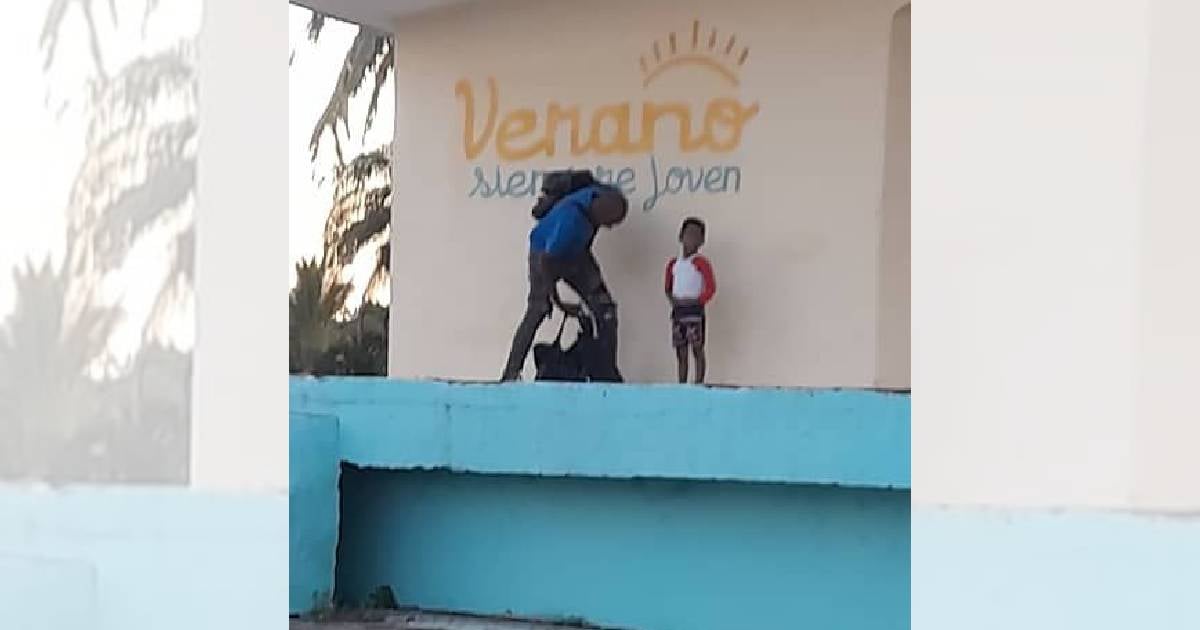
In the midst of the usual Sunday agricultural fair at the Plaza del Tenis in Matanzas, an entire family was seen sleeping on the ground under a platform, barely covered with rags and cardboard, a scene that dismantles any narrative of social protection in Cuba.
The account, sent by a follower through the page on Facebook La Tijera, explained that, like every Sunday, she went early to the place to buy food, but saw “something I never thought I would see in Cuba.”
She described how at dawn the adults—two older men, a young man, and a woman with a baby in her arms—were rummaging through the waste left by the food trucks.
“They ate rotten mangos with a desperation and hunger that left me speechless. The boy came up to me and asked for money. It hurt to see how the adults ignored him, leaving him behind without helping him down from the platform… I had to help him myself. He was dirty, wearing torn clothes, with a sad look that couldn’t be faked,” she illustrated.
It was an image that, in her own words, "squeezes the heart" and leaves a question hanging in the air: where are the social services?
He also indicated that the image accompanying the post was taken "when they had already gotten up to respect their dignities, but everyone who passed by at that hour could see them."
The testimony points directly to the State's absence and recalls the words of the former Minister of Labor and Social Security, who stated that in Cuba "there are no beggars," but rather "those in disguise."
But what I saw in Matanzas cannot be glossed over: it was misery without filters, visible pain, and official neglect.
While the Cuban state glosses over poverty with euphemisms such as "street dwellers" and "vulnerable," a growing population of elderly, sick, and marginalized individuals survives in the open in Matanzas and other Cuban provinces, lacking effective policies to protect them and with no real willingness to acknowledge what the country hides under the rug.
This has even been acknowledged by the state-run press, which in recent reports has showcased that other city beneath the city, the forgotten layer where those who have lost nearly everything—home, family, mental health, work—live and rummage through waste to survive.
The provincial newspaper Girón published a journalistic piece on August 1, revealing the serious situation faced by dozens of “vagrants” at the Social Protection Center of Jagüey Grande.
The report "Inhabitants of Dust (II): The Land That Was Never Promised" documents the living conditions in this place, which, according to the testimonies collected, seems less like a refuge and more like "a cemetery of living men."
Today, amid peeling walls, unmade mattresses, and gray hallways, there are people with physical disabilities, mental disorders, and elderly individuals without family, many of whom are interned there without visits, regular medical care, or legal and social assistance, the text indicates.
On July 14th, the then-Minister of Labor and Social Security, Marta Elena Feitó Cabrera, stated in one of the parliamentary committees that in Cuba “there are no beggars,” but rather people who are “disguised”, whom she also referred to as “drunks” and “pretenders.”
His statements denying the existence of hunger on the island and blaming citizens for their poverty sparked an outburst of indignation on social media, independent media, and among segments of the public.
Hours later, the Political Bureau of the Communist Party of Cuba and the Council of State accepted her resignation, which was submitted, according to official sources, after a "joint analysis" with the government leadership.
Two days later, the government acknowledged that more than 310,000 people living on the island are currently in a situation of poverty or social vulnerability, amid a deep economic crisis.
The Agreement 10056/2025 from the Council of Ministers defines “wandering” individuals as “a multicausal disorder of human behavior” that involves “instability and insecurity at home, lack of self-care and economic autonomy, absence of family care or support, as well as an unfavorable life project.”
The measure does not clearly address how to reverse homelessness, but rather how to manage its visibility. As a user commented weeks ago on the official portal Cubadebate: “One thing is to eradicate homelessness, and another is to eradicate the homeless.”
It also does not address the structural causes of the phenomenon centered on the collapse of the economic model, family disintegration, demographic aging, and mass emigration. The State does not acknowledge its responsibility in this crisis and opts for reactive measures to hide its symptoms.
The institutionalization of control over the poorest, under the label of "vagrancy behavior," is nothing more than another authoritarian band-aid to disguise a social fracture that can no longer be hidden.
The Cuban regime attributes the increase of homeless individuals to family neglect and the tightening of the United States embargo.
At the end of April, another report by Girón revealed one of the most painful realities of present-day Cuba: the extreme precariousness in which thousands of retirees live, who, after decades of work, find themselves forced to survive on the streets.
Frequently Asked Questions about the Situation of Homelessness and Poverty in Matanzas, Cuba
What is the current situation of homeless people in Matanzas, Cuba?
The situation of homeless people in Matanzas is critical, with entire families living in destitution and scavenging for food among the trash. The Cuban government has tried to hide this reality under euphemisms, but poverty and neglect are evident in the province.
What has the Cuban government said about poverty and begging on the island?
The Cuban government, through statements from the former Minister of Labor and Social Security, has denied the existence of beggars, labeling homeless individuals as "disguised." These statements have been harshly criticized for their lack of sensitivity and disconnect from reality.
Are there effective policies to assist vulnerable people in Cuba?
Currently, there are no effective policies to assist vulnerable people in Cuba. Social protection centers are in deplorable conditions, and government measures focus more on concealing poverty than on addressing it.
How has the Cuban population reacted to the crisis of poverty and neglect?
The Cuban population has expressed their outrage through social media, denouncing the inhumane conditions in which many citizens live. The discontent is palpable, especially following the government's statements that downplay the seriousness of the situation.
Filed under: